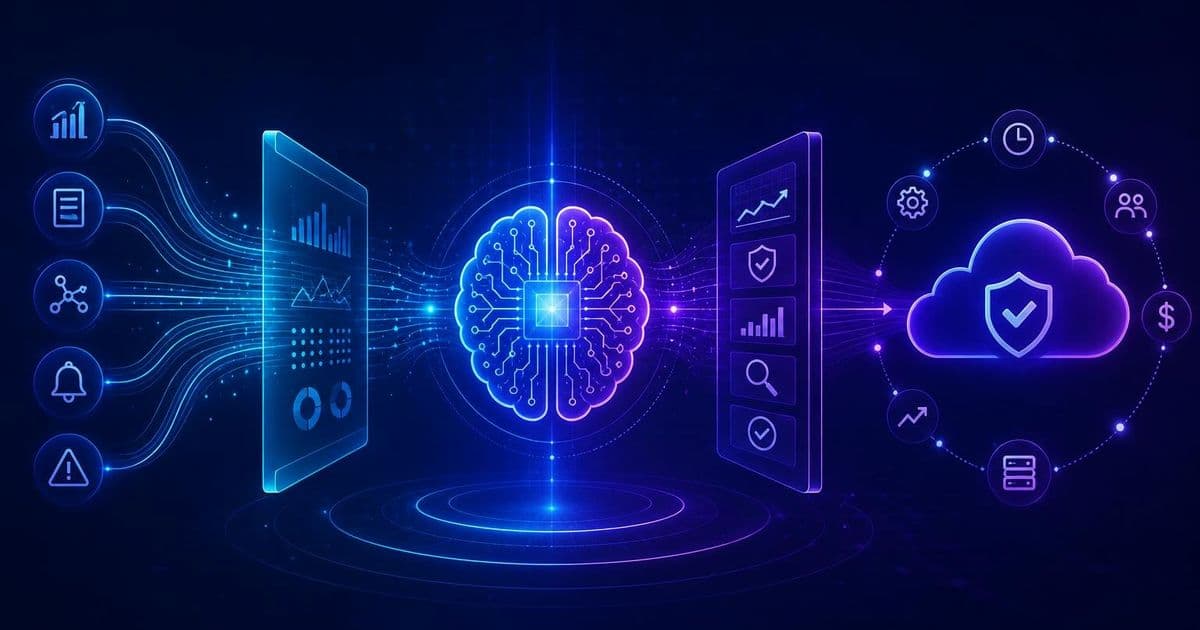
The article explains why traditional observability is hitting its limits in modern, multi‑cloud environments and how AI‑augmented Site Reliability Engineering (SRE) is shifting the reliability model from reactive monitoring to predictive resilience. It outlines the role of automation, the need for cross‑cloud intelligence, and the continued importance of human engineers, while highlighting the emerging market for AI‑driven SRE platforms.
From Observability to Predictive Resilience: How AI‑Driven SRE Is Redefining Cloud Operations
By Karthik Turaga – May 16, 2026
The problem: observability can no longer keep pace
For more than a decade, the dominant reliability strategy has been observability: collect traces, logs, and metrics; set thresholds; alert when something crosses a line; then scramble to fix it. That approach worked when workloads were predictable and the stack was relatively small. Today, a typical enterprise runs services across several public clouds, private data centers, and a mesh of micro‑services. The telemetry volume has exploded – thousands of metrics per second, millions of log lines, and a constantly shifting dependency graph.
Human engineers cannot parse that flood in real time. Alerts become noisy, and the signal‑to‑noise ratio drops. The result is longer mean‑time‑to‑detect (MTTD) and mean‑time‑to‑recover (MTTR), which translates directly into lost revenue, eroded customer trust, and higher compliance risk.
Automation as the foundation of reliability
The first response to this overload was to automate the reactive parts of incident handling: scripted failovers, auto‑scaling policies, and predefined recovery playbooks. Automation reduced reliance on “heroics” and made repeatable actions possible at scale. However, most of these automations still fire after a threshold breach – they are essentially faster versions of the same reactive loop.
Predictive resilience – the next logical step
Predictive resilience injects artificial intelligence into the decision‑making pipeline. Instead of waiting for a metric to cross a hard limit, an AI model continuously analyses historic and live telemetry to spot subtle precursors of failure:
- Small shifts in latency percentiles that precede a cascade.
- Gradual memory pressure build‑up that usually triggers OOM kills.
- Emerging error‑rate patterns that correlate with downstream service degradation.
When such patterns are detected, the system can recommend or automatically execute actions such as:
- Pre‑emptive scaling of a bottlenecked tier.
- Temporary configuration tweaks (e.g., circuit‑breaker thresholds).
- Initiating a graceful traffic shift to a healthier region.
In many deployments, these interventions happen before any alert reaches a human inbox, effectively turning incidents into non‑incidents.
Why multi‑cloud and hybrid setups need AI
Hybrid and multi‑cloud architectures promise cost optimisation, regulatory flexibility, and resilience, but they also multiply failure modes. Each provider has its own API quirks, latency characteristics, and failure semantics. A plain‑text dashboard that aggregates alerts from AWS, Azure, and on‑prem systems quickly becomes a wall of unrelated noise.
AI‑driven SRE platforms can correlate cross‑cloud signals, learn the normal interaction patterns between clouds, and surface a unified risk view. For example, a rise in latency on a GCP‑hosted API might be linked to a downstream Redis cluster on Azure that is throttling; an AI model can recognise the dependency and suggest a coordinated scaling action across both providers.
The human role does not disappear
Automation and AI are tools, not replacements. Engineers still set reliability service‑level objectives (SLOs), decide acceptable risk levels, and validate the policies that the AI suggests. The day‑to‑day firefighting workload shrinks, allowing teams to focus on higher‑value work such as architecture improvements and capacity planning. This shift also helps reduce burnout, a chronic problem in SRE teams that are constantly on call.
Market signals and emerging players
Several startups have begun to commercialise the predictive‑resilience stack:
- ArborAI raised $45 M in a Series B led by Andreessen Horowitz to build a platform that ingests telemetry from any cloud and applies unsupervised anomaly detection to forecast outages.
- ResilientOps secured $30 M from Sequoia Capital for its "intent‑driven" automation engine that can both recommend and execute remediation steps across hybrid environments.
- CloudMinder closed a $20 M round with Bessemer, focusing on a low‑code UI that lets SREs define AI‑driven policies without writing code.
These companies are positioning themselves between traditional AIOps vendors (which often stop at alert correlation) and full‑stack SRE platforms that promise end‑to‑end predictive control.
What this means for cloud reliability
The reliability model is evolving from three discrete layers to an integrated loop:
- Observability – provides the raw data.
- Automation – enforces consistent, repeatable responses.
- Predictive intelligence – anticipates problems and steers the system proactively.
Uptime is no longer the sole metric; the ability to forecast and self‑adjust becomes the new benchmark. Companies that adopt AI‑driven SRE can expect lower MTTR, higher customer satisfaction, and a more sustainable engineering culture.
If you want to experiment with predictive resilience, the open‑source project SRE‑AI‑Toolkit offers a starter kit for building custom anomaly detectors on top of Prometheus and OpenTelemetry data.
Comments
Please log in or register to join the discussion