
Steve Yegge's experimental agent orchestrator Gas Town reveals critical insights about bottlenecks, patterns, and costs in AI-driven development despite its intentionally chaotic implementation.
When veteran software engineer Steve Yegge released Gas Town – a Mad Max-themed agent orchestrator that runs dozens of coding agents simultaneously – he unleashed more than just code. This intentionally chaotic experiment, built through what Yegge calls "vibecoding" (rapid development without premeditated design), has sparked intense debate about the future of software development despite its glaring inefficiencies. Gas Town burns through thousands of dollars monthly in API costs, contains intentionally absurd terminology like "polecats" and "deacons," and comes with emphatic warnings from its creator not to use it seriously. Yet within its deliberately messy architecture lie vital patterns for how AI agent ecosystems might evolve.
The Design Bottleneck
The most immediate revelation from Gas Town is that when implementation becomes automated, design becomes the primary constraint. As Yegge states: "Gas Town churns through implementation plans so quickly that you have to do a LOT of design and planning to keep the engine fed." This shifts the developer's burden from writing code to precisely defining requirements, architecture, and user experience – tasks agents cannot yet reliably perform. The system's biggest weakness stems from this imbalance: Gas Town was "vibe-designed" without upfront architectural planning, resulting in what one Hacker News commenter describes as "a stream of consciousness converted directly into code."
This exposes a critical risk in agentic development: the easier coding becomes, the faster teams can accumulate technical debt. Without disciplined design guardrails, developers risk prompting sprawling, inconsistent codebases faster than they can comprehend them. Gas Town serves as a cautionary prototype demonstrating that velocity without intentionality creates chaos.
Emerging Orchestration Patterns
Despite its intentional disorganization, Gas Town prototypes several structural concepts likely to appear in future agent systems:
Specialized Roles with Supervision: Agents have defined responsibilities (e.g., the "Mayor" handles user requests, "Polecats" perform single tasks, the "Refinery" manages merges). This specialization allows parallel work without task collisions. A hierarchy of supervisor agents (like the "Witness") monitors workers and nudges stalled processes – a necessary workaround for current models' passive assistance tendencies.
Persistent Tasks, Ephemeral Sessions: Gas Town addresses context window limitations by storing agent identities and task queues as "beads" (JSON objects in Git). Agents can be restarted with retained context, and new sessions can "seance" previous ones for continuity. This pattern mirrors approaches in Anthropic's research on long-running agents.
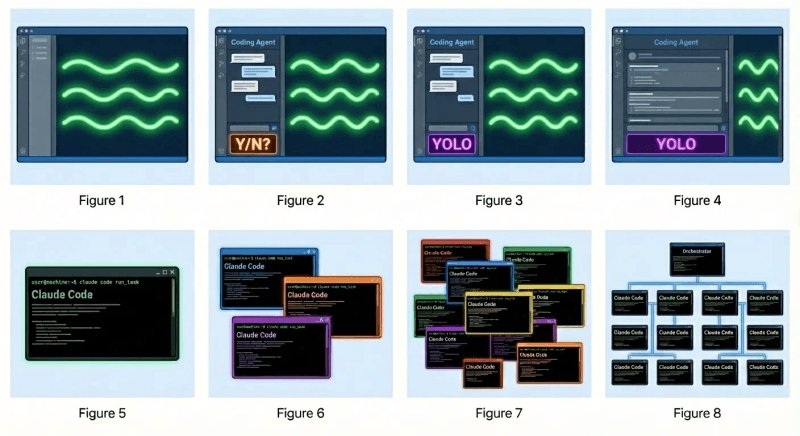
Continuous Work Queues: The system maintains agent productivity by feeding workers constant streams of atomic tasks. The Mayor breaks down features into small units, assigning them to available agents. Supervisors actively ping idle workers – a "heartbeat" mechanism keeping the system moving.
Agent-Managed Merges: The Refinery agent handles merge conflicts automatically, even "re-imagining" implementations when changes conflict severely. This points toward future systems optimized for stacked diffs – small, sequential changes that minimize merge conflicts – a workflow validated by Cursor's recent acquisition of Graphite.
The Cost-Value Equation
Gas Town operates at staggering expense – Yegge estimates "thousands of dollars monthly" in API costs, funded partly through a coincidental $GAS meme coin. While unsustainable today, it reveals a provocative economic reality: at scale, agent orchestration could compete with human development costs.
Conservative estimates ($1k-$3k/month) represent just 10-30% of a senior US developer's salary. If such systems could triple productivity, the math becomes defensible in high-salary markets. As models improve and inefficiencies reduce, this calculus will grow more compelling, though regional salary differences will shape adoption.
The Code Distance Debate
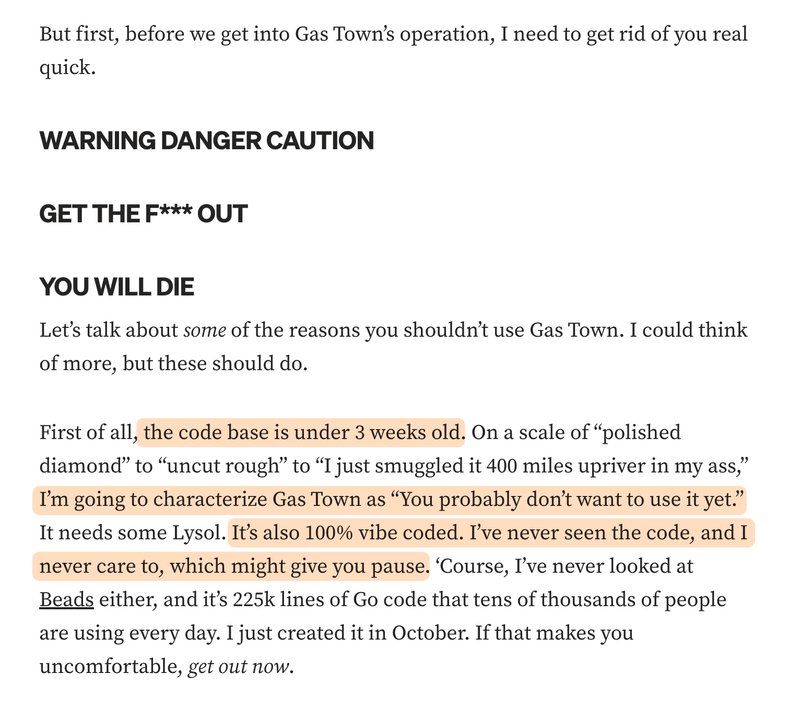
Yegge's claim that he "never looks at code" epitomizes Gas Town's most controversial premise: how close should developers stay to generated code? The answer varies by context:
- Risk tolerance: Mission-critical systems demand closer oversight than personal projects
- Feedback mechanisms: Agents self-correct better when tasks have clear validation (e.g., tests)
- Collaboration scale: Teams require coordination mechanisms as agent velocity increases
- Experience level: Senior developers better anticipate failure modes invisible to junior peers
Tools like GitHub's experimental Agentic Workflows suggest a middle path: agents run automated quality checks (security, accessibility) within CI/CD pipelines, reducing the need for manual scrutiny without eliminating safeguards.
Conclusion: Beyond the Chaos
Gas Town won't become mainstream software – it's intentionally raw and inefficient. But like a Rothko painting that seems simple yet reveals complexity upon examination, it provides something more valuable than production code: a provocative design fiction that forces us to confront practical questions about agentic development's future. The patterns it pioneers – specialized roles, persistent task management, and automated workflows – will inevitably resurface in polished tools. As implementation accelerates, the most valuable skills won't be writing code, but defining intent, managing complexity, and maintaining quality in an age of automated creation.
Comments
Please log in or register to join the discussion