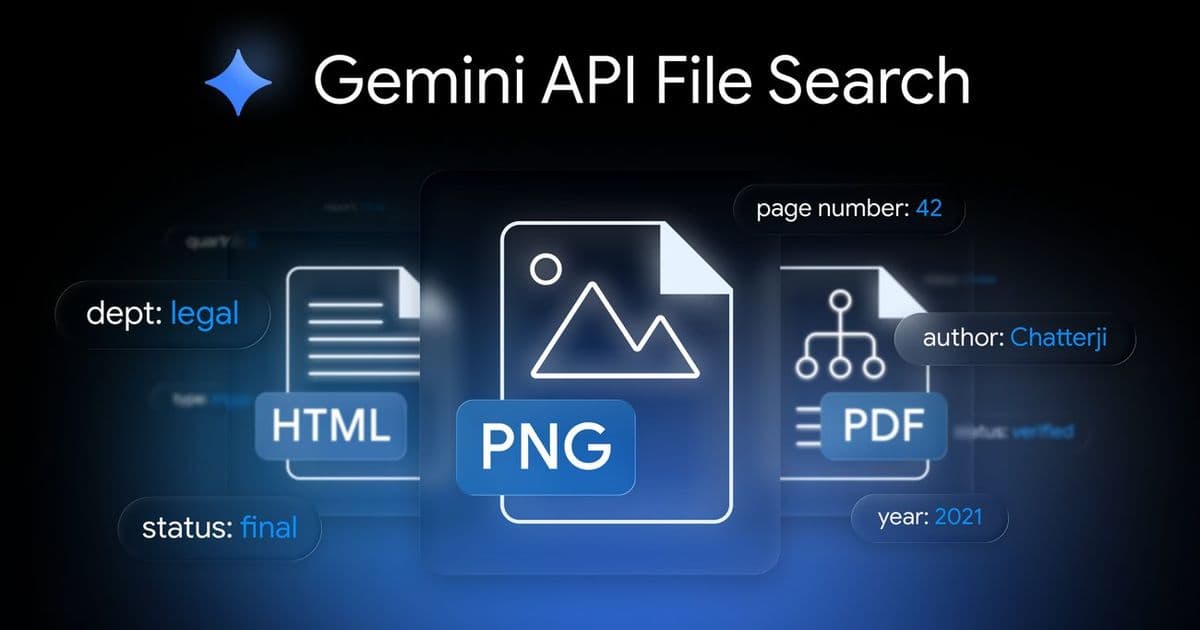
Google's expansion of the Gemini API File Search with multimodal capabilities, custom metadata, and page-level citations represents a significant evolution in building trustworthy RAG systems, though questions remain about implementation complexity and potential hallucination reduction.
Google's recent expansion of the Gemini API File Search marks a notable shift in how developers approach building Retrieval-Augmented Generation (RAG) systems. The addition of multimodal support, custom metadata capabilities, and page-level citations suggests an industry-wide recognition that AI applications need better grounding in verifiable data sources. This evolution reflects growing demands for transparency and reliability in AI systems that process both text and visual information.
The multimodal capabilities stand out as particularly significant. By enabling the system to "understand native image data" using the Gemini Embedding 2 model, Google is addressing a persistent challenge in AI applications: the gap between text-based queries and visual content. This could revolutionize how creative agencies, research institutions, and content-heavy organizations manage their digital assets. Instead of relying solely on keyword matching or metadata tags, systems can now search for images based on conceptual understanding, emotional tone, or visual style described in natural language.
For example, a marketing team could search an entire visual archive for "images with a hopeful, blue-toned aesthetic featuring diverse groups of people collaborating" rather than being limited to filenames or manually assigned tags. This capability moves beyond simple retrieval into semantic understanding of visual content, potentially reducing the manual curation burden that organizations currently face.
The custom metadata feature addresses a fundamental pain point in RAG implementation: the "haystack problem." As organizations accumulate vast repositories of unstructured data, finding relevant information becomes increasingly difficult. By allowing developers to attach key-value labels to their data—such as "department: Legal" or "status: Final"—the system can filter results more effectively at query time. This layered approach to data organization could dramatically improve both the speed and accuracy of RAG workflows, especially in enterprise environments where data volume and complexity create significant challenges.
Page-level citations represent perhaps the most important advancement for building trust in AI systems. By tying responses directly to specific pages within source documents, Google is providing a mechanism for verification that has been notably absent in many generative AI applications. This level of granularity allows users to trace information back to its original source, addressing concerns about AI "hallucinations" and providing a foundation for fact-checking and accountability.
The technical implementation appears straightforward, with a simple Python API for uploading files and searching across them. The code example shows how developers can create a file search store, upload documents and images, and then query the system using natural language. This accessibility suggests that Google is aiming to lower the barrier to entry for building sophisticated RAG systems while still providing the flexibility needed for production applications.

Despite these advancements, questions remain about the practical implementation challenges. Organizations will need to carefully consider how to structure their metadata schemas to maximize utility without creating excessive overhead. The multimodal capabilities, while powerful, may require significant computational resources, potentially impacting the cost-effectiveness for smaller applications. Additionally, while page-level citations improve transparency, they don't completely eliminate the risk of misinterpretation or context stripping that can occur when information is retrieved and processed.
The broader industry context suggests these updates reflect a maturation of the RAG space. As organizations move beyond experimental AI applications toward production systems, the demand for verifiable, transparent, and efficient retrieval mechanisms grows. Google's approach, combining multimodal understanding with structured metadata and precise citations, represents one possible path toward meeting these demands.
Early adopters in fields like legal research, academic publishing, and creative industries may benefit most from these capabilities. For legal professionals, the ability to search case law or contracts based on conceptual meaning rather than keywords, combined with precise citations, could transform how they conduct research. Similarly, academic institutions could build more sophisticated literature review tools that understand both the textual and visual content of research papers.
As with any technological advancement, the true test will come through real-world implementation and refinement. The success of these features will likely depend on how well they scale across different types of organizations and use cases, how they integrate with existing workflows, and how effectively they address the core challenges of information retrieval and verification in AI systems.
For developers interested in exploring these capabilities, Google has provided documentation and code examples to facilitate adoption. The question remains whether these enhancements will be sufficient to address the fundamental challenges of building truly reliable AI systems, or if they represent merely incremental improvements in a rapidly evolving field.
The introduction of these features suggests that Google recognizes the growing importance of RAG systems in the AI landscape and is positioning its tools to meet the increasing demands for reliability and transparency. As organizations continue to integrate AI into their core operations, the ability to verify sources and maintain accuracy will likely become differentiating factors in AI application development.
Comments
Please log in or register to join the discussion