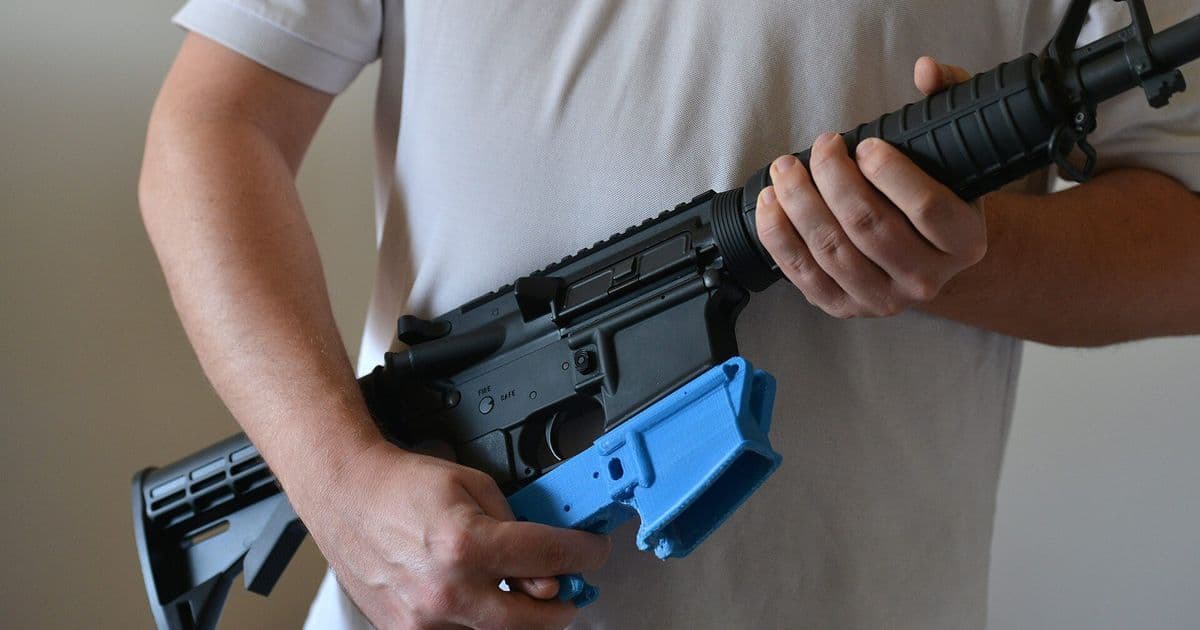
Two brothers from Staten Island ran an interstate ghost gun operation using 3D printers to manufacture untraceable firearm frames while associates purchased parts online, storing weapons in secret compartments and a mobile home.
Two brothers from Staten Island, New York, have been convicted of running an illegal ghost gun manufacturing operation that produced untraceable 3D printed firearms, marking another significant case in the growing challenge of regulating homemade weapons.
Brandon and Justin Nudelman, both from Staten Island, are now facing sentencing after being found guilty of operating a sophisticated interstate ghost gun enterprise. According to testimony from their associate Ronnie Mershon, the operation began as a casual idea around a pool table before evolving into a full-scale criminal enterprise complete with luxury vehicles, hidden compartments, and secret rooms.
The 3D Printed Gun Manufacturing Process
The group leveraged the accessibility of 3D printing technology to manufacture firearm frames, the critical serialized component that legitimate manufacturers use to trace weapons involved in crimes. By 3D printing these frames, the brothers created completely untraceable firearms that law enforcement cannot track through traditional serial number databases.
However, a 3D printed gun frame alone cannot function as a complete weapon. The group relied on another associate, Michael Daddea, to purchase essential firearm components including barrels, slides, magazines, and springs from online retailers like eBay. This division of labor allowed them to assemble complete ghost guns while maintaining operational security.
Mershon testified that the group used coded language when discussing their products, referring to the weapons as "pole, thang, piece, or stick" to avoid detection during communications with buyers.
Beyond Basic Firearms: Conversion Kits and Fully Automatic Weapons
The operation extended beyond simple ghost gun manufacturing. The group also produced and sold conversion kits dubbed "Nintendo" that could transform semi-automatic firearms into fully automatic weapons. These devices, also known as "switches," allow weapon owners to bypass federal restrictions on automatic firearms, creating a significant public safety concern.
Sophisticated Storage and Distribution Network
This was not a small-scale basement operation. The group established a mobile home in Pennsylvania specifically for storing manufactured firearms, strategically located to avoid scrutiny in their home state of New York. Brandon Nudelman went to extreme lengths to conceal weapons, including installing a hidden compartment in his Lamborghini that only opens after entering a specific button sequence and placing a special pen in a cup holder.
Mershon revealed that additional secret compartments existed throughout Nudelman's residence, which he only discovered after Brandon's arrest. This level of sophistication demonstrates the profitability and scale of the ghost gun market.
The Growing Ghost Gun Problem
The case highlights the escalating challenge law enforcement faces with ghost guns. Their use has skyrocketed in recent years, with untraceable firearms increasingly appearing in violent crimes. One high-profile case involved the assassination of United Healthcare CEO Brian Thompson in late 2024, where the alleged perpetrator used an untraceable 3D printed firearm.
Legislative Responses and Their Limitations
Multiple states including New York, Washington, California, and Colorado have introduced legislation aimed at addressing the ghost gun problem. However, critics argue that many of these laws are overly restrictive and may infringe on legitimate 3D printing enthusiasts' creative freedom without effectively addressing the core issue.
The challenge is compounded by the fact that 3D printers can produce virtually any object, making it nearly impossible to restrict their use without severely limiting their legitimate applications in manufacturing, prototyping, and creative projects.
Technological Arms Race: Detection and Prevention Efforts
Researchers are developing countermeasures to combat ghost gun proliferation. One team is working on embedding digital fingerprints into 3D printed parts to enable tracking and identification. Another group is attempting to link ghost guns to specific filament brands through chemical fingerprinting techniques.
However, these technologies remain in the research phase and face significant implementation challenges. The cat-and-mouse game between ghost gun manufacturers and law enforcement continues to evolve.
The Broader Implications
The case demonstrates how accessible technology, when combined with criminal intent, can create sophisticated illegal operations. The ability to manufacture untraceable weapons using consumer-grade 3D printers represents a fundamental shift in how firearms can be produced and distributed.
As 3D printing technology becomes more advanced and accessible, the challenge of preventing illegal weapon manufacturing while preserving legitimate uses will likely intensify. The Nudelman case serves as a stark reminder of the dual-use nature of emerging technologies and the ongoing struggle to balance innovation with public safety.
The brothers' conviction sends a clear message about the legal consequences of participating in ghost gun operations, but it also highlights the need for more comprehensive approaches to address the underlying technological and social factors driving this underground market.
Comments
Please log in or register to join the discussion