GitHub launches Agentic Workflows in technical preview, enabling AI coding agents to automate repository tasks through plain Markdown workflows that run in GitHub Actions with built-in security guardrails.
GitHub has unveiled Agentic Workflows in technical preview, a new approach to repository automation that brings AI coding agents into GitHub Actions through simple Markdown workflows. The system, developed by GitHub Next in collaboration with Microsoft Research and Azure Core Upstream, aims to automate repetitive repository tasks while maintaining strict security controls.
How Agentic Workflows Work
The concept is straightforward: describe desired outcomes in plain Markdown, add the workflow to your repository, and let AI agents execute the tasks. These workflows run as standard GitHub Actions but with enhanced guardrails for sandboxing, permissions, and review processes.
When triggered, workflows can use different coding agent engines including Copilot CLI, Claude Code, or OpenAI Codex based on your configuration. The system is designed to augment existing CI/CD pipelines rather than replace them, focusing on tasks that require reasoning rather than deterministic builds and tests.
Security-First Design
Security was a primary consideration in the architecture. Workflows run with read-only permissions by default, and write operations require explicit approval through "safe outputs" that map to pre-approved GitHub operations like creating pull requests or adding comments.
The defense-in-depth approach includes sandbox execution, tool allowlisting, and network isolation to prevent unintended behaviors and prompt injection attacks. This makes it practical to run agents continuously rather than as one-off experiments.
Practical Applications
GitHub identifies several categories of automations that become possible:
- Continuous triage: Automatically summarize, label, and route new issues
- Continuous documentation: Keep READMEs and docs aligned with code changes
- Continuous code simplification: Identify improvements and open pull requests
- Continuous test improvement: Assess coverage and add high-value tests
- Continuous quality hygiene: Investigate CI failures and propose fixes
- Continuous reporting: Generate regular health and activity reports
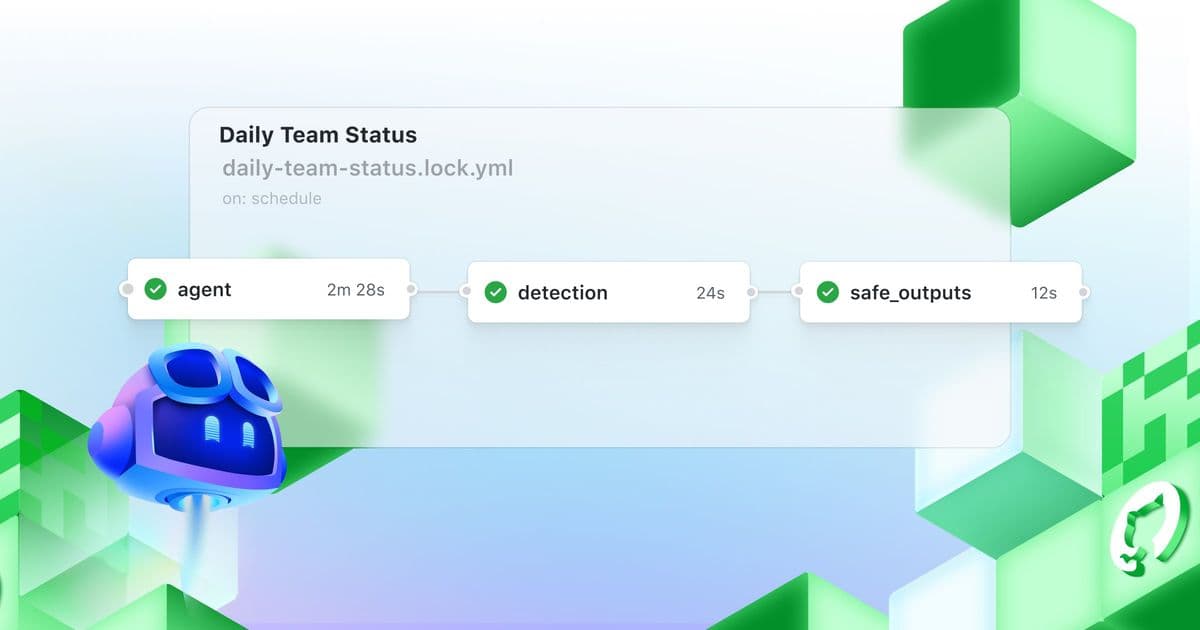
A simple example demonstrates the workflow structure. A daily repository status report workflow includes frontmatter for configuration (triggers, permissions, tools) and Markdown instructions describing the job in natural language. The workflow creates status report issues automatically, providing maintainers with daily summaries of repository activity.
Getting Started
Teams can begin with low-risk outputs like comments and reports before enabling pull request creation. The workflow Markdown should be treated as code—reviewed, kept small, and evolved intentionally. GitHub recommends starting with goal-oriented improvements like routine refactoring rather than complex feature work.
Each workflow run typically incurs two premium requests when using Copilot—one for the agentic work and one for guardrail checks. Costs can be managed through model configuration.
Available Now
Agentic Workflows are available in technical preview. Documentation, quick start guides, and a workflow gallery are available to help teams get started. The GitHub Next team invites developers to try the system and share feedback through community discussions and their Discord channel.
The launch represents a significant step toward "Continuous AI"—integrating AI into the software development lifecycle to enhance automation and collaboration, similar to how CI/CD practices transformed deployment workflows.
Comments
Please log in or register to join the discussion