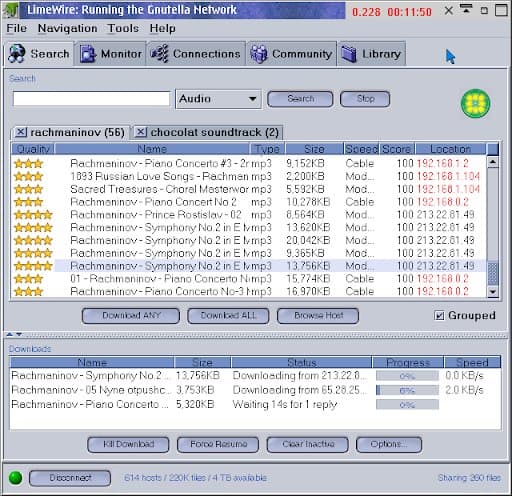
A thoughtful examination of Gnutella, the peer-to-peer file sharing protocol that achieved massive adoption without centralized control, and how its design principles enabled remarkable longevity despite the disappearance of the digital ecosystem it was built for.
In the landscape of technological history, certain systems emerge not through corporate planning or venture capital backing, but through the organic needs of users solving real problems. Gnutella represents one such phenomenon—a decentralized file sharing protocol that scaled to millions of concurrent users, survived numerous attempts to shut it down, and continues to function decades after its creation. This analysis explores not just how Gnutella worked, but why its design principles enabled such remarkable resilience and what that tells us about technology adoption, decentralization, and the fleeting nature of digital ecosystems.
The Paradox of Success
The central thesis presented is that Gnutella didn't fail—it succeeded so thoroughly that it outlived the world that created it. This counterintuitive perspective challenges the common narrative that peer-to-peer file sharing was a technological anomaly or a failed experiment. In reality, Gnutella achieved exactly what it set out to do: create a resilient, serverless system for sharing files that could scale to mainstream adoption and resist centralized control.
What makes Gnutella particularly interesting is its adoption pattern. Unlike many modern technologies that require users to understand complex concepts like decentralization, blockchain, or cryptocurrencies, Gnutella attracted millions of casual users precisely because they didn't need to understand its peer-to-peer architecture. They simply wanted to download MP3s, and the protocol happened to be decentralized. This suggests a profound truth about technology adoption: the best decentralized systems often succeed by hiding their decentralization behind intuitive interfaces that solve immediate user problems.
Technical Architecture of Resilience
At its core, Gnutella operated as a distributed search engine for binary data blobs, with five fundamental message types that formed the protocol's backbone:
PING/PONG: These messages formed the heartbeat of the network, allowing nodes to discover each other. A PING message would propagate through the network, and PONG responses would return with IP addresses, ports, and sharing statistics, effectively building a dynamic directory of available peers.
QUERY/QUERYHIT: These messages handled search functionality. When a user searched for "LinkinPark.mp3.exe," the QUERY would flood through the network, and QUERYHIT messages would return with matching files, including metadata needed for downloads.
PUSH: This message type addressed the practical challenge of firewalls, allowing nodes behind NAT to request files by having the uploader initiate the connection back to the downloader.
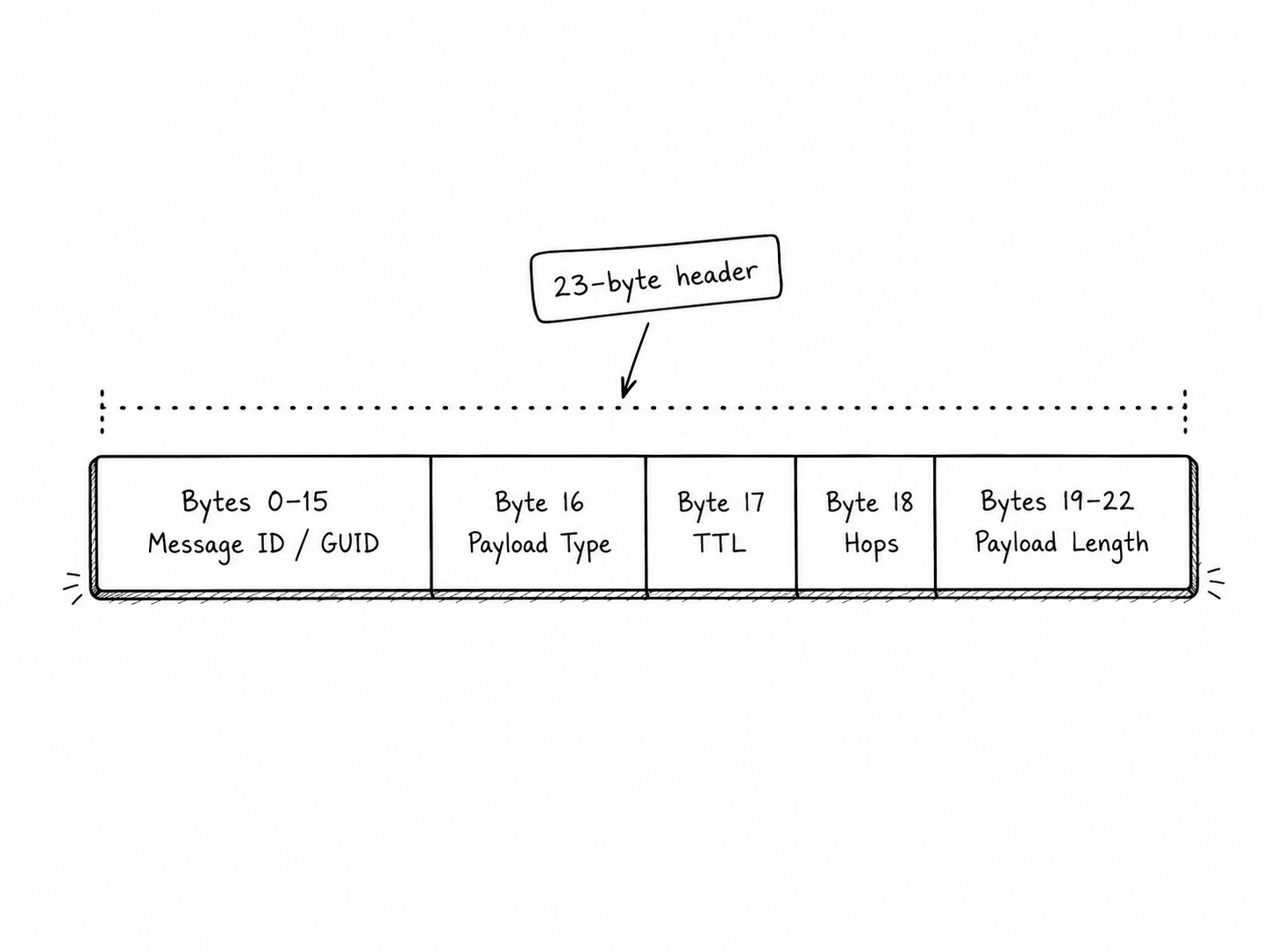 The 23-byte message header layout that formed the foundation of all Gnutella communications
The protocol's brilliance lay in its simplicity combined with extensibility. The core specification was minimal, but the GGEP (Gnutella Generic Extension Protocol) allowed implementers to add features without breaking network compatibility. This organic extensibility enabled the protocol to evolve with changing technical conditions while maintaining backward compatibility.
The Challenge of Bootstrapping
One of the most fascinating technical aspects of Gnutella was its bootstrapping mechanism. As a truly decentralized network with no central directory, new nodes needed a way to find initial peers. The solution, GWebCache, was a federation of independently managed web servers that would provide lists of active Gnutella participants.
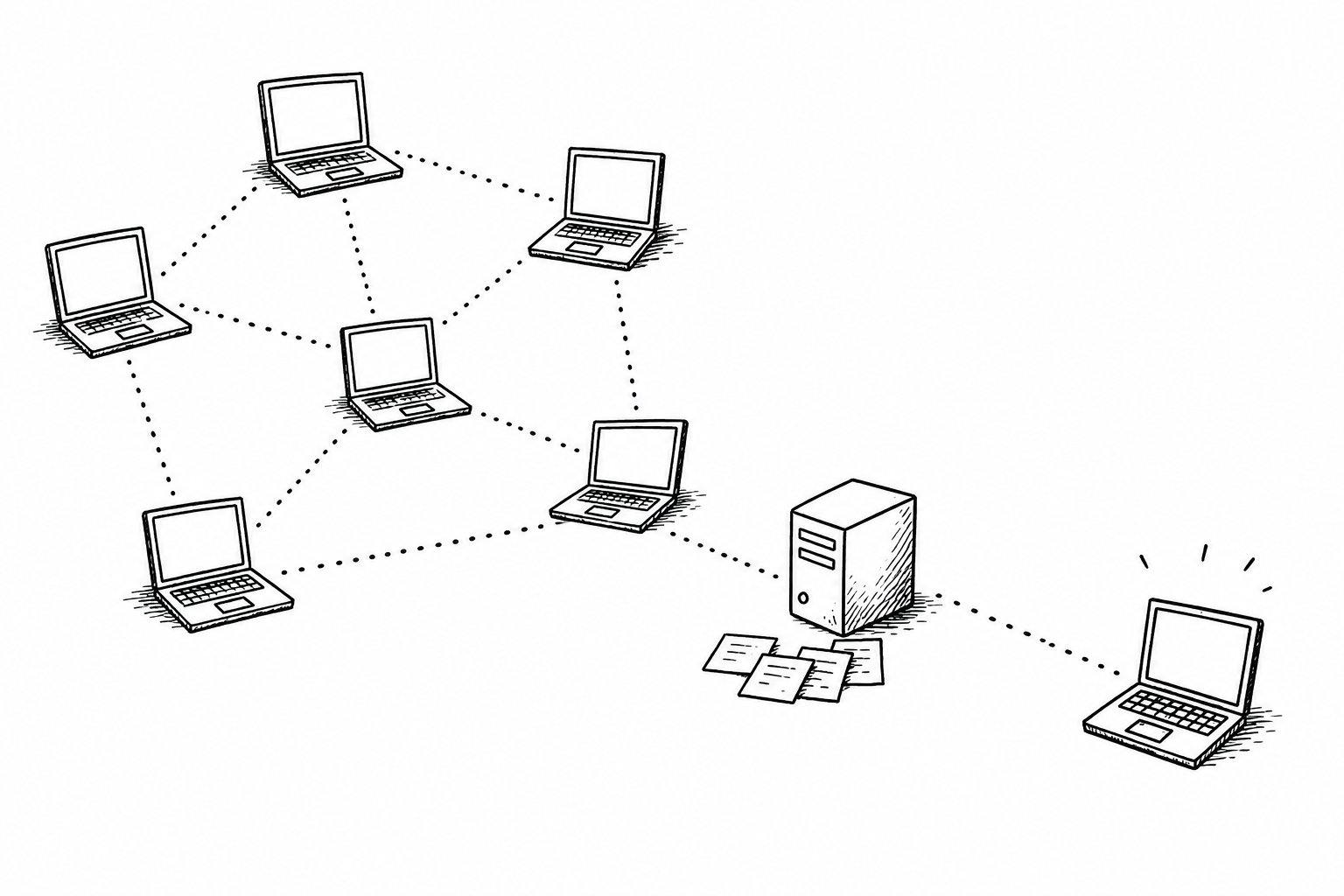 The Gnutella bootstrap process where new peers reach the network through web caches and known peers
What made GWebCache particularly elegant was that it wasn't a single point of failure. Multiple independent caches existed around the world, and clients could switch between them if one became unavailable. This created a resilient bootstrap mechanism that maintained the network's decentralized character while solving the practical problem of initial peer discovery.
The bootstrapping process reveals an important insight about decentralized systems: even the most serverless networks often require some centralized components for initial setup, provided those components don't become essential for ongoing operation.
HTTP, Gossip, and the Hybrid Architecture
Gnutella employed a clever hybrid approach combining HTTP for file transfers with a custom TCP-based gossip protocol for network discovery. This hybrid architecture solved several practical problems:
File Transfer: By using HTTP for actual file downloads, Gnutella leveraged existing web infrastructure and made downloads accessible to any client that could handle HTTP requests.
Network Discovery: The gossip protocol created a mesh network where information about available files and active peers could propagate efficiently.
Firewall Navigation: The PUSH message type and later extensions allowed nodes behind firewalls to participate fully in the network.
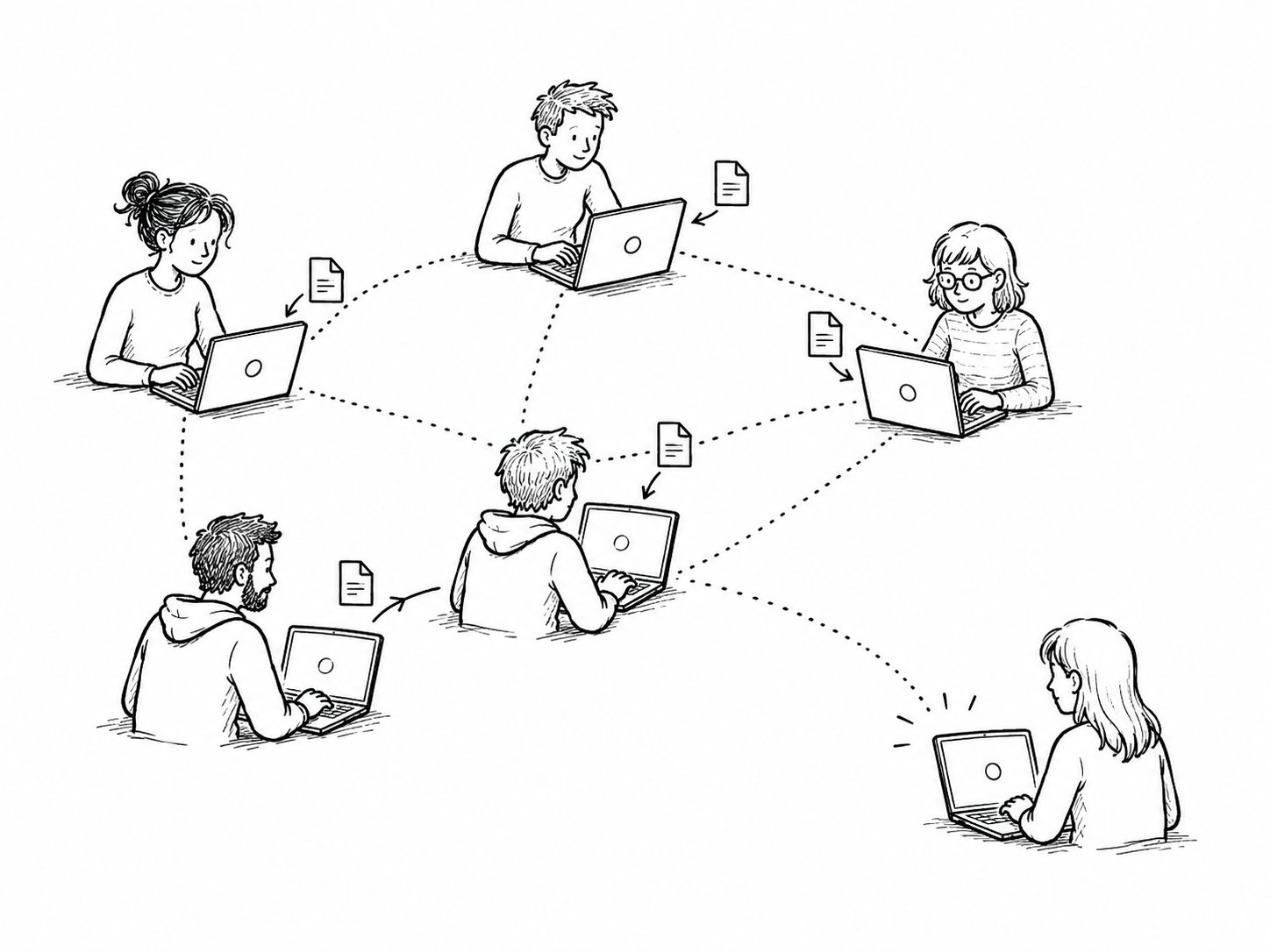 A hand-drawn mesh of laptop users exchanging files directly across peer-to-peer links
This hybrid approach was particularly effective because it separated concerns: HTTP handled the reliable transfer of known resources, while the gossip protocol handled the discovery of those resources. Modern peer-to-peer systems like BitTorrent would later refine this approach with similar architectural principles.
The Forgotten Context of User Behavior
Perhaps the most insightful aspect of the article is its exploration of the historical context that made Gnutella not just possible, but necessary. The early 2000s represented a unique moment in digital history:
- Internet adoption was crossing the 50% threshold in the US
- MP3 players and affordable storage were becoming mainstream
- Dial-up internet made streaming impractical
- Users were still comfortable managing local files and directories
These conditions created a perfect storm for file sharing. The music industry's refusal to adapt to changing consumer preferences created a vacuum that Gnutella filled. But as technology evolved—faster broadband, streaming services, cloud storage, mobile devices—the context changed, and with it, the utility of Gnutella's particular approach.
This historical perspective challenges technological determinism. It suggests that technologies don't exist in a vacuum but are deeply intertwined with specific historical conditions, user behaviors, and infrastructure limitations. When those conditions change, even well-designed technologies may fade from mainstream use, not because they failed, but because the problems they solved have been addressed through different means.
Protocol Evolution and Client Diversity
Unlike many modern protocols that evolve through formal standardization processes, Gnutella evolved organically through implementation. Multiple clients existed—LimeWire, BearShare, GTK-Gnutella—each extending the protocol in different ways while maintaining compatibility.
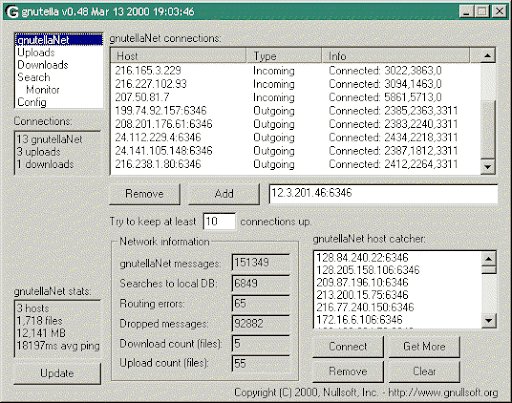 The original Gnutella 0.48 connection manager showing hosts, uploads, downloads, and cached peer addresses
This client diversity created a robust ecosystem where no single implementation controlled the protocol's direction. Even as LimeWire became the most visible client, others continued to innovate, implementing features like TLS support, IPv6 compatibility, and more efficient query routing mechanisms.
The article mentions dynamic query routing as a particularly important innovation. Early Gnutella used simple flooding for search queries, which became inefficient as the network grew. Dynamic query routing used bloom filters and network topology information to route queries more intelligently, allowing the network to scale to millions of users without collapsing under its own traffic.
This evolution through implementation rather than formal specification represents an alternative model for protocol development—one that prioritizes practical innovation over theoretical purity.
Resilience Against Centralized Control
Gnutella's most remarkable characteristic may be its resilience against attempts to shut it down. Its decentralized architecture made it impossible to kill through traditional means like targeting central servers or legal pressure on individual companies.
The protocol emerged from an internal AOL demo that was cancelled and leaked to the public. Once released, its serverless design meant there was no "off switch"—no central authority that could be pressured or shut down. This accidental decentralization created a system that was remarkably resistant to both technical and legal attempts to control it.
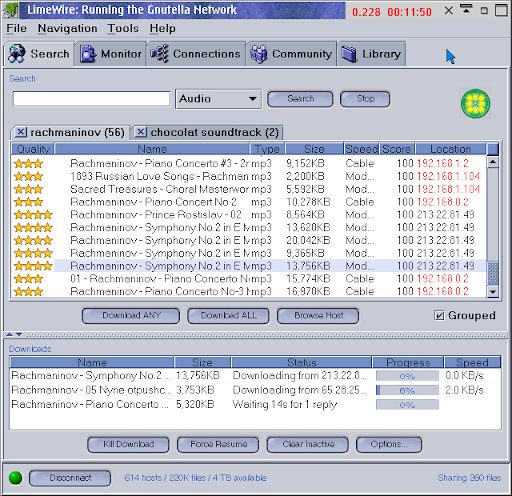 LimeWire search results with active downloads in progress
This resilience offers important lessons for modern decentralized systems. Gnutella demonstrated that truly decentralized protocols can achieve mainstream adoption while maintaining their resistance to centralized control—a combination that many modern blockchain projects have struggled to achieve.
The Afterlife of a Protocol
Perhaps the most striking aspect of Gnutella's story is its continued existence. The article notes that copies of the original Gnutella.exe are still available on archive.org, and the network continues to function at reduced capacity. This persistence suggests that well-designed protocols can outlive the companies, technologies, and user behaviors that initially drove their adoption.
The GTK-Gnutella client, mentioned in the article's resources, remains actively maintained decades after the protocol's emergence. This continued development and use challenges the common perception that peer-to-peer file sharing was merely a temporary phenomenon of the early internet.
Broader Implications for Technology Design
Gnutella's story offers several important insights for technology design:
Problem-First Design: Gnutella succeeded because it solved immediate user problems (downloading music) rather than promoting an ideological agenda (decentralization).
Resilience Through Simplicity: The protocol's minimal core specification made it easy to implement and extend while maintaining compatibility.
Organic Evolution: Allowing the protocol to evolve through implementation rather than formal specification created a more adaptable system.
Context Dependence: Technologies exist within specific historical contexts, and their success often depends on conditions that may be temporary.
Hidden Decentralization: The most successful decentralized systems often hide their complexity behind intuitive interfaces that don't require users to understand decentralization.
Critical Perspectives
While the article presents a compelling case for Gnutella's success, several critical perspectives deserve consideration:
Copyright Concerns: Gnutella was primarily used for sharing copyrighted music without permission, raising significant legal and ethical questions that the article doesn't deeply address.
Security Issues: The protocol had inherent security vulnerabilities, including the ease with which fake files and malware could be distributed.
Efficiency Limitations: Early versions of Gnutella used inefficient flooding algorithms that limited scalability compared to later systems like BitTorrent.
Comparison to Alternatives: The article doesn't deeply explore why BitTorrent achieved more mainstream longevity than Gnutella, despite similar decentralization principles.
Conclusion
Gnutella represents a fascinating case study in technological resilience and adaptation. It succeeded not because of corporate backing or ideological purity, but because it solved real problems for millions of users through a decentralized architecture that proved remarkably resistant to centralized control.
The protocol's continued existence decades after its emergence challenges common narratives about technological obsolescence and suggests that well-designed systems can outlive the specific contexts that initially drove their adoption.
Perhaps most importantly, Gnutella demonstrates that the most successful decentralized technologies are often those that hide their complexity behind intuitive interfaces that solve immediate user problems. In an era of increasing centralization and walled gardens, this lesson about the power of user-centric, decentralized design remains profoundly relevant.
For those interested in exploring Gnutella further, the GTK-Gnutella client remains actively maintained and offers a way to experience this historical protocol firsthand. The GTK-Gnutella GitHub repository provides the most robust implementation for modern systems, while the Gnutella Bun Client offers a more recent implementation that demonstrates the protocol's continued relevance.
Comments
Please log in or register to join the discussion