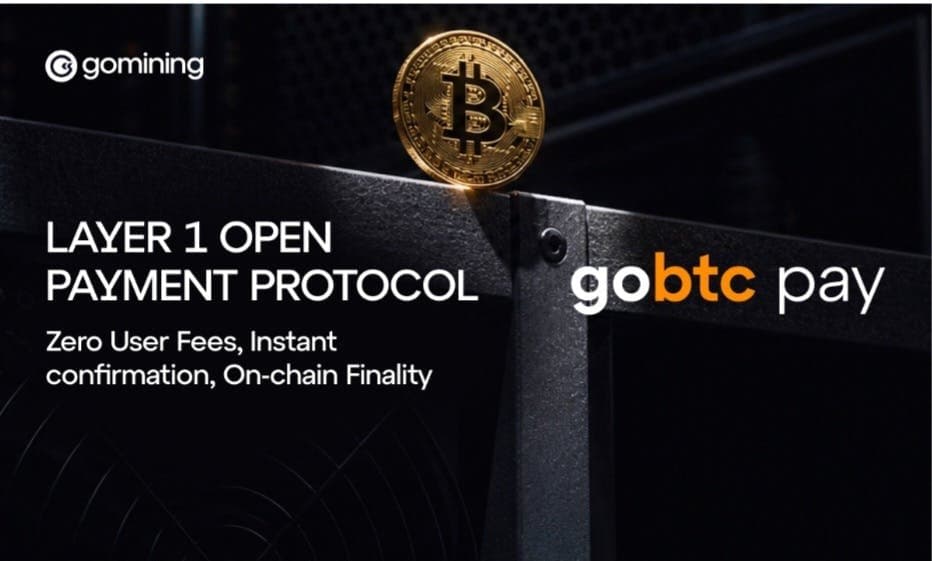
GoMining unveiled GoBTC Pay, a protocol that lets merchants and consumers move Bitcoin on‑chain within hours and at a fraction of card‑processing fees. The company backs the network with its own mining pool and plans a 12‑hour settlement window by the end of 2026.
GoMining launches GoBTC Pay to enable native instant Bitcoin payments
The problem GoBTC Pay aims to solve
Bitcoin’s base layer still processes transactions in ten‑minute blocks, which makes point‑of‑sale use awkward. Existing workarounds – the Lightning Network or off‑chain custodial solutions – have either required users to lock funds in payment channels or have struggled to reach retail‑grade volumes. As a result, fewer than three thousand U.S. merchants accept Bitcoin directly, even though roughly a fifth of adults own the asset. The gap between ownership and acceptance keeps Bitcoin locked in a store‑of‑value narrative instead of the peer‑to‑peer cash system described in the 2008 whitepaper.
What GoBTC Pay does
GoBTC Pay is a protocol that routes a payment through a 2‑of‑3 multi‑signature arrangement involving the payer, GoMining, and a regulated custodian. The transaction is broadcast to the Bitcoin network and then prioritized by a dedicated mining pool owned by GoMining. The pool’s goal is to embed the payment in a block within twelve hours, a timeframe the company says it will meet by the close of 2026.
Key features:
- Free to the end‑user – no on‑chain fee is charged to the consumer.
- Low merchant acquiring fee – 0.2 % of the sale, compared with 1.5‑3.5 % for typical card processors.
- Open integration – any wallet that supports the GoBTC Pay SDK – from Ledger hardware devices to Trust Wallet, MetaMask, or custodial apps – can offer instant Bitcoin checkout.
- Revenue sharing – half of the merchant fee is paid to the miners who confirm the transaction, the other half goes to the wallet provider that initiated the payment. GoMining itself retains no fee on third‑party transactions.
Mining‑powered confirmation
Most payment services rely on external mining pools that have no incentive to prioritize a specific transaction type. GoMining’s approach flips that model: the company runs a pool that exclusively processes GoBTC Pay payments and also supports its “digital miners,” users who own tokenized hashrate through the GoMining app. When a payment is confirmed, a slice of the fee is distributed to those token holders, creating a feedback loop where merchants, consumers, and miners all benefit from the same activity.
The multi‑signature design adds a layer of security. The regulated custodian holds a share of the signature, ensuring that a malicious miner cannot unilaterally release funds. At the same time, the custodian’s involvement satisfies compliance requirements in jurisdictions where on‑chain payments are scrutinized.
Merchant experience
Merchants can choose between two options:
- Direct receipt – the sale amount lands in the merchant’s own Bitcoin wallet, ready for on‑chain use or conversion.
- Custodial solution – GoMining provides a custodial wallet that yields additional BTC during the settlement window and offers an integrated fiat off‑ramp.
Both paths include a web dashboard for transaction monitoring, a point‑of‑sale terminal that displays QR codes, and plug‑ins for popular e‑commerce platforms such as Shopify and WooCommerce. The SDK is slated for public release in the next quarter, allowing developers to embed GoBTC Pay in mobile apps, gaming platforms, and other consumer‑facing services.
Market positioning and traction
GoMining already serves five million users and ranks among the top‑ten Bitcoin miners by hashrate. By coupling its mining capacity with a payment protocol, the company positions itself as a vertically integrated Bitcoin utility provider. The announcement coincided with a U.S. expansion that includes data centers designed for both mining and AI workloads, targeting one gigawatt of compute power by 2026.
At Consensus Miami 2026, GoMining demonstrated a live checkout using GoBTC Pay, showing a $25 grocery purchase settle on‑chain within ten minutes. The demo attracted interest from several large retailers that currently accept only card payments, indicating a potential path to broader adoption.
Why this matters for the broader ecosystem
If GoBTC Pay can consistently deliver sub‑hour settlements at near‑zero user cost, it could shift the perception of Bitcoin from a long‑term store of value to a viable everyday currency. Lower merchant fees also create a financial incentive for businesses to experiment with Bitcoin without sacrificing margins.
The model also illustrates a new way to monetize mining infrastructure: instead of selling block rewards solely to the market, operators can capture transaction‑fee revenue from a high‑volume retail flow. This could influence other mining pools to explore similar services, potentially increasing on‑chain activity and fee income for the network as a whole.
Next steps
- Q3 2026 – Release of the GoBTC Pay SDK and open‑source reference implementation on GitHub.
- Q4 2026 – Full rollout of PoS terminals, Shopify/WooCommerce plug‑ins, and the custodial merchant dashboard.
- 2027 – Expansion of the mining pool to support additional multi‑signature schemes and integration with regional payment processors.
For more technical details, see the official GoBTC Pay documentation and the GitHub repository.
GoMining’s press release can be read in full at the company site.
Comments
Please log in or register to join the discussion