
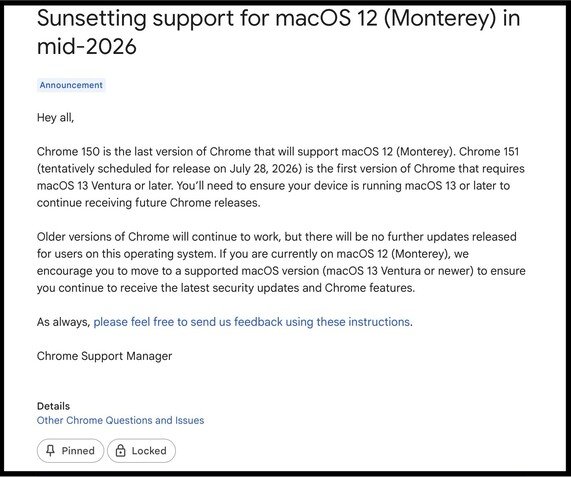
Google will cease Chrome updates for macOS Monterey starting with Chrome 150 this July, forcing users of pre-2018 Macs to upgrade hardware or switch browsers to maintain security updates.

Google has announced that Chrome 150, scheduled for release in July 2026, will be the final version of its browser supporting macOS 12 Monterey. This change creates significant implications for users still operating Intel-based Macs released before 2018, effectively cutting them off from future Chrome security updates and features.
The decision directly stems from Apple's own support limitations. macOS 13 Ventura—the minimum requirement for Chrome updates after version 150—doesn't support Intel Macs released before 2017. This leaves affected hardware in a compatibility gap:
- Supported Intel Macs for Ventura/Chrome:
- iMac (2017 or newer)
- iMac Pro (2017)
- Mac mini (2018 or newer)
- Mac Pro (2019 or newer)
- MacBook Pro (2017 or newer)
- MacBook Air (2018 or newer)
- MacBook (2017)
Apple Silicon Macs remain unaffected since they all support Ventura or newer macOS versions. For Intel Mac users unable to upgrade hardware, alternatives exist:
- Firefox: Continues supporting macOS Catalina (10.15) and Monterey
- Brave/Opera: Still compatible with Monterey for now
Unlike Chrome, these browsers haven't announced imminent discontinuation for Monterey. However, Firefox requires macOS 10.15 or later, meaning 2012-2017 Macs running Monterey remain compatible.
For users deciding between upgrading hardware or switching browsers, consider:
- Security Implications: Unsupported browsers won't receive critical vulnerability patches
- Feature Access: New web technologies won't function optimally on outdated browser versions
- Workflow Impact: Browser-specific extensions/settings may not transfer seamlessly
While upgrading to Apple Silicon hardware remains the most future-proof solution, browser switching provides a zero-cost alternative for maintaining security on older systems. Google hasn't specified how long Chrome 150 will receive security updates before becoming completely unsupported.
This change highlights the accelerating obsolescence cycle for Intel Macs as developers increasingly prioritize Apple Silicon compatibility.
Comments
Please log in or register to join the discussion