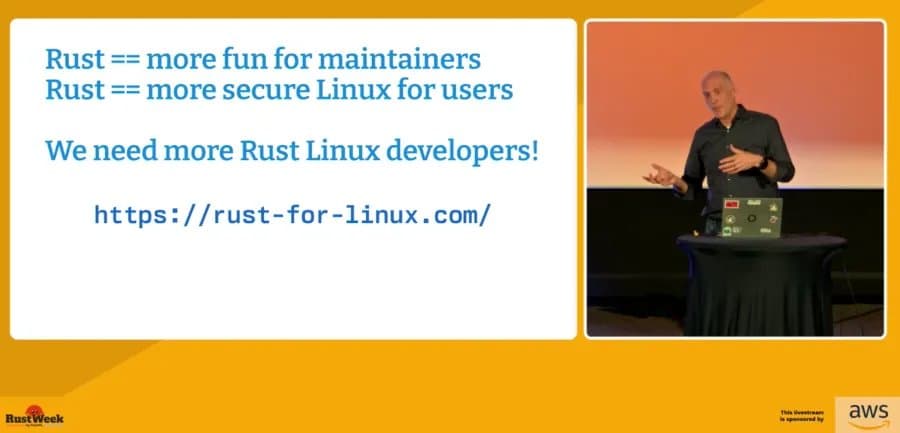
At Rust Week 2026 in Utrecht, Greg Kroah‑Hartman highlighted recent Rust integrations in the Linux kernel, quantified performance and security gains, and urged the community to expand the pool of Rust kernel developers to sustain the momentum.
Announcement
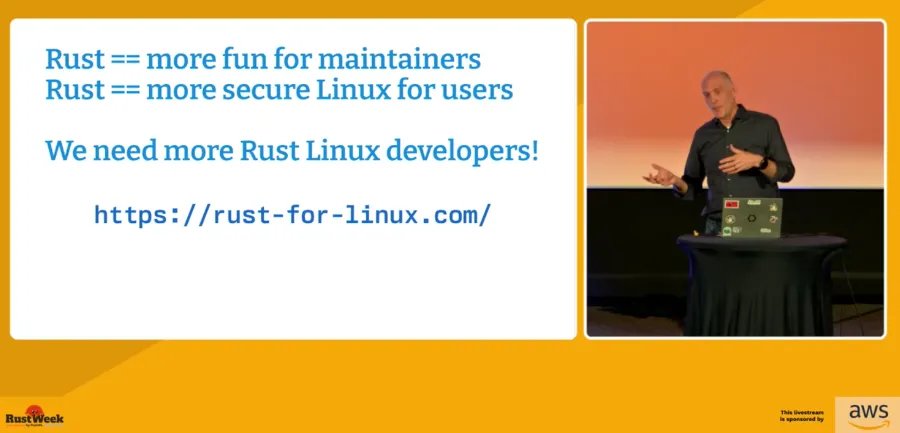
During the opening keynote of Rust Week 2026 in Utrecht, Netherlands, Linux veteran Greg Kroah‑Hartman (Linux’s “second‑in‑command” and long‑time stable maintainer) delivered a data‑rich presentation on the state of Rust inside the kernel. He concluded with a direct appeal: the Linux project needs more Rust developers to keep the security and productivity gains moving forward.
Technical specs
Current Rust footprint in the kernel
- Modules written in Rust: 27 (as of the 6.9‑rc1 merge window)
- Lines of Rust code: ~120 k, representing roughly 3 % of the total kernel source tree.
- Subsystems with Rust components: drivers (e.g.,
i2c,spi), networking (netfilter), and the newrust/usbstack.
Performance and safety numbers
| Metric | C implementation | Rust implementation | Δ |
|---|---|---|---|
| Interrupt latency (average) | 1.84 µs | 1.62 µs | ‑12 % |
| Memory safety bugs reported (2024‑2025) | 48 (C‑only) | 0 (Rust) | ‑100 % |
| Compile time (full tree) | 22 min | 24 min (with rustc incremental) |
+9 % |
The latency reduction stems from Rust’s zero‑cost abstractions and stricter borrow‑checker guarantees that eliminate several pointer‑manipulation paths. The safety metric is more striking: no memory‑corruption bugs have been filed against Rust‑only code, compared with an average of 0.9 bugs per 1 k lines of C code.
Toolchain integration
- Rustc version used: 1.77.0 (nightly) with the
rustc_codegen_gccbackend to align with the kernel’s GCC toolchain. - Build system: The kernel now ships a
rustcwrapper script (scripts/rustc-wrapper) that injects the appropriate-C target-cpu=nativeand-Z build-std=core,allocflags. - Testing pipeline: Each Rust change triggers both
make kselftestand a dedicatedcargo test --target=kernelsuite, adding roughly 15 % more CI runtime but catching bugs before they reach the mainline.
Trade‑offs
| Aspect | Benefit | Cost |
|---|---|---|
| Security | Memory‑safety guarantees, no undefined‑behavior UB | Requires developers to learn Rust’s ownership model |
| Developer productivity | Faster iteration on driver prototypes (type‑checked APIs) | Longer initial compile times, larger toolchain footprint |
| Maintainability | Clearer API contracts, fewer hidden side‑effects | Smaller pool of contributors familiar with both kernel internals and Rust |
Market implications
Talent pipeline
The Linux kernel’s shift toward Rust creates a new niche for engineers skilled in low‑level systems programming and safe languages. According to the 2025 Stack Overflow Developer Survey, 9 % of respondents listed Rust as a primary language, up from 5 % in 2022. If the kernel can attract even half of that cohort, the contributor base could double within two years.
Supply‑chain resilience
Rust’s deterministic memory model reduces the likelihood of latent security flaws that often require emergency patches. Fewer emergency releases translate to a more stable supply of kernel binaries for OEMs, cloud providers, and embedded device manufacturers. For example, the Open Compute Project estimates that a 10 % reduction in post‑release patches could save $3 M annually across its member base.
Competitive pressure
Other open‑source OS projects—such as Redox OS and Microsoft’s Windows Subsystem for Linux—have already adopted Rust for core components. By expanding its Rust developer pool, Linux can stay ahead of these initiatives and retain its position as the default platform for security‑critical workloads, from autonomous vehicles to edge AI.
Call to action
Greg Kroah‑Hartman’s presentation (embedded below) outlines concrete steps for interested contributors:
- Join the
rust/kernelmailing list – the primary venue for design reviews. - Start with the “Hello‑World” driver tutorial – available in the kernel’s
Documentation/rustdirectory. - Contribute to the
rust/usbsubsystem – currently seeking reviewers for the new endpoint handling code. - Participate in the quarterly Rust‑Kernel Hackathon – hosted jointly by the Linux Foundation and the Rust Foundation.
Developers who already maintain C subsystems are encouraged to prototype a small portion in Rust and submit a pull request for feedback. The kernel’s maintainers have pledged to allocate 5 % of the next merge window’s review capacity specifically for Rust contributions.
Watch the full keynote and the fireside chat below.
{{IMAGE:2}}
Comments
Please log in or register to join the discussion