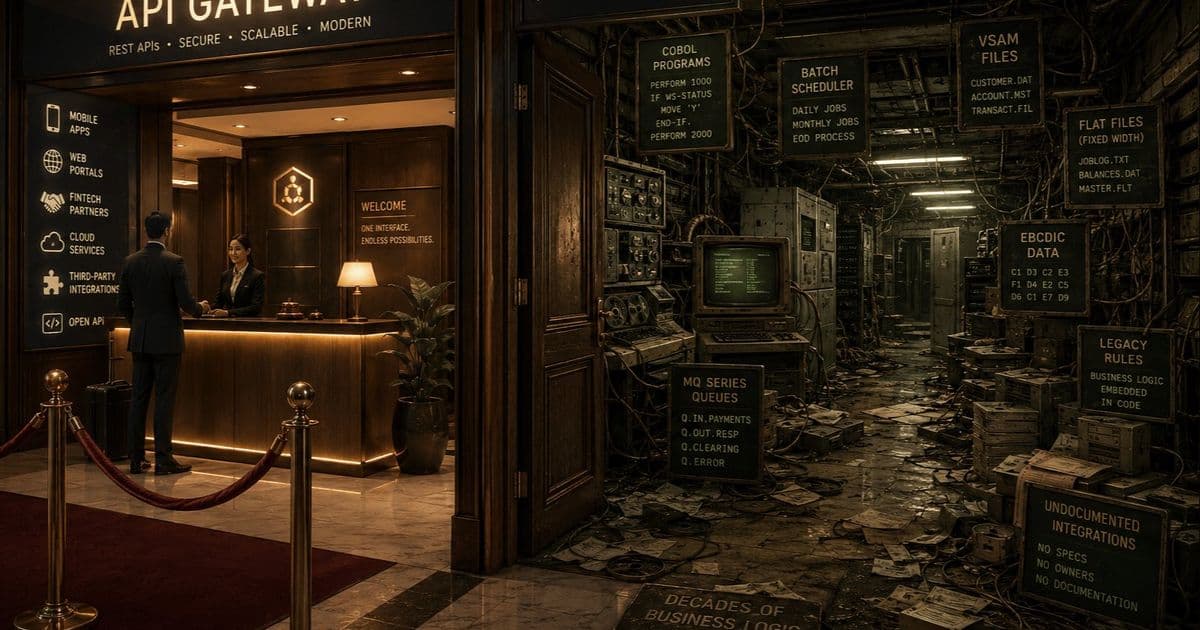
Mainframe modernization projects repeatedly stumble because they ignore the complex, undocumented integration layer that connects legacy COBOL systems to the rest of the enterprise. A realistic path forward requires exhaustive discovery of those connections, disciplined API contracts, and incremental strangler‑fig migration rather than quick API wrappers.
Why Mainframe Modernization Keeps Failing at the Integration Layer
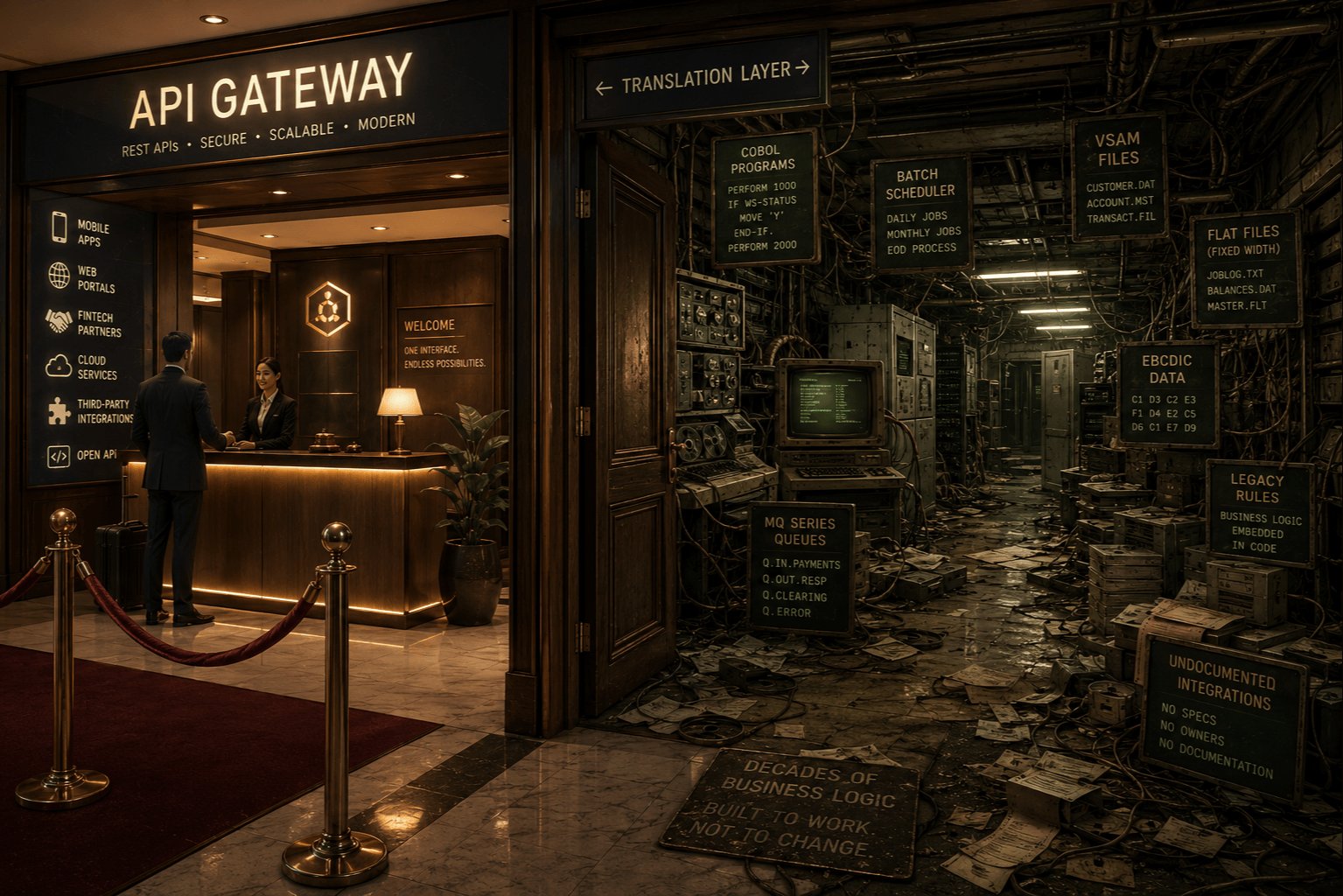
Every few years a large bank announces a multi‑year mainframe modernization program, signs a vendor partnership, and appoints a CTO with a mandate to "fix the legacy problem." Eighteen months later the initiative is either quietly descoped or its timeline has tripled, while the original mainframe still processes payroll, settlements and daily transaction volumes. The failure is not the COBOL code itself – it remains fast, deterministic and battle‑tested – but the layer that glues the mainframe to the rest of the organization.
The integration layer is the hidden cost centre
When executives talk about the difficulty of modernization they usually cite three factors:
- COBOL talent shortage – true, but hiring rates have stabilized as newer engineers learn the language through university programs and corporate bootcamps.
- Aging hardware – modern mainframes are more powerful than ever and can run AI workloads.
- Code volume – billions of lines of legacy code exist, but most of it is stable business logic.
What is rarely mentioned is that the mainframe sits at the centre of a web of integrations built over decades, often without documentation. Payment processing talks to a risk engine, the risk engine talks to fraud detection, fraud detection talks to reporting, and so on. Those connections were designed to work, not to be replaced.
A typical discovery phase will map COBOL programs, count lines of code, and produce high‑level diagrams. What is frequently missed are the undocumented MQ queues, file‑drop jobs, and point‑to‑point adapters that only surface when a production incident occurs.
The API wrapper trap
The most common response to the integration problem is to expose the mainframe's business logic through REST APIs. The idea is simple: keep the legacy system in place, let microservices call it, and gradually replace functionality.
In practice the API layer becomes a second integration façade. COBOL routines written for batch processing are called synchronously via HTTP, which masks the original execution model. Over time, new teams build against the API without understanding the underlying constraints, creating a hidden technical debt that must be untangled before any core logic can be moved off the mainframe.
Real‑time expectations vs. batch reality
Financial products now demand event‑driven, low‑latency responses – real‑time payments, instant credit decisions, on‑the‑fly fraud scoring. A REST endpoint that triggers a nightly batch job does not meet those requirements; it merely dresses a scheduling conflict as an API. The result is a system that appears modern but still fails the original business need.
Data formats – the silent blocker
Mainframe data lives in formats that modern tooling does not natively understand: VSAM files, EBCDIC encoding, fixed‑width flat files with field definitions known only to engineers who retired years ago. When a project replicates that data to a cloud database, edge cases appear quickly. A field that was implicitly padded in a COBOL record may lose its padding in a JSON payload, causing downstream validation errors that are expensive to trace because they require expertise in both worlds.
Industry surveys show that 70‑75 % of IT spend in financial services is consumed by legacy technologies, and a significant share of that spend is actually maintaining the integration patchwork rather than the mainframe itself.
Vendor promises vs. project scope
Vendors such as IBM, AWS, Kyndryl, Hexaware and Heirloom have introduced automated COBOL‑to‑Java tools, AI‑assisted refactoring and parallel‑run validation environments. Those tools reduce risk for the application but do not automatically surface the downstream systems that consume the application via proprietary MQ messages or custom file formats.
A Kyndryl 2025 survey of 500 senior leaders reported that 80 % of organizations shifted their modernization strategy in the past year, and 16 % changed direction because of budget overruns tied to undiscovered integration points. The core issue is scoping: the discovery phase is expensive and time‑consuming, yet it is essential for a realistic business case.
The strangler‑fig pattern – a slower but sustainable route
The architecture that consistently delivers results is the strangler fig: build new capabilities alongside the legacy system, route traffic incrementally to the modern layer, and let the mainframe shrink function by function. This approach forces teams to map every upstream and downstream dependency before traffic can be shifted, turning the integration layer into a first‑class deliverable.
Banks that have completed a meaningful portion of this migration report 50‑70 % faster product development cycles, but those numbers reflect institutions that have already invested years in careful integration work, not projects that are six months in with optimistic timelines.
Key characteristics of successful programs:
- Long, thorough discovery phases that map every data flow, message queue, file transfer and scheduled job.
- Integration layer treated as a separate workstream with its own milestones and budget.
- Success measured by the number of downstream systems cleanly decoupled, not by lines of COBOL replaced.
- Teams staffed with both mainframe experts and modern systems engineers.
Mainframes are still central – the narrative shift
The 2025 BMC Mainframe Survey found that 65 % of respondents already run generative AI workloads on their mainframes and 74 % consider the platform central to their strategy for the next two years. A new generation of engineers, many of them Millennials and Gen Z, now view the mainframe as a long‑term platform.
Consequently, the goal is not to eliminate the mainframe but to make it a participant in a modern architecture. That requires an integration layer built on event streaming, well‑defined API contracts, schema registries and observable message flows – not a collection of ad‑hoc point‑to‑point connections.
A practical checklist for the next project
- Map every integration – include MQ queues, file drops, batch jobs, synchronous calls and event streams.
- Document data formats – capture field definitions, encoding, and padding rules.
- Define API contracts – use OpenAPI specifications, version them, and enforce contract testing.
- Introduce middleware governance – centralize message routing, schema management and observability.
- Plan incremental migration – adopt the strangler‑fig pattern, routing traffic function by function.
- Allocate budget for discovery – treat the integration mapping as a separate line item.
- Staff cross‑functional teams – pair legacy experts with cloud‑native engineers from day one.
By following these steps, organizations can avoid the common pitfall of spending millions on API wrappers that become a new source of debt, and instead build a sustainable path toward a hybrid architecture where the mainframe and modern services coexist.
Mainframe modernization is not a sprint; it is a marathon that begins with honest, exhaustive mapping of the integration layer.
Comments
Please log in or register to join the discussion