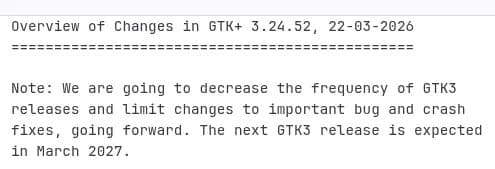
The GTK3 toolkit is winding down development to a single annual release, signaling a clear shift in focus toward GTK4 while maintaining support for legacy applications.
The GTK (GIMP Toolkit) ecosystem is undergoing a significant transition as the venerable GTK3 toolkit shifts to a once-per-year release cadence, a move that reflects both the maturity of the older version and the GNOME project's focus on encouraging migration to GTK4.
The Evolution of GTK
GTK has been a cornerstone of Linux desktop development for decades, with GTK3 representing a major evolution in the toolkit's architecture. Released in December 2020, GTK4 brought substantial changes including a new rendering engine, improved input handling, and a more modern API. Despite GTK4's arrival, GTK3 has continued to receive regular updates due to the extensive ecosystem of applications still built on this version.
Recent Changes: GTK 3.24.52
The most recent GTK3 release, version 3.24.52, rolled out on March 23, 2026, marking a turning point in the toolkit's maintenance strategy. This release addressed several critical issues:
- Wayland compatibility improvements
- GIMP-specific fixes
- Emoji CLDR 48 updates
- Various crash fixes and stability enhancements
- Translation updates for improved internationalization
What made this release particularly noteworthy was the inclusion of an explicit maintenance policy change, stating: "We are going to decrease the frequency of GTK3 releases and limit changes to important bug and crash fixes, going forward. The next GTK3 release is expected in March 2027."
Release Cadence Comparison
The shift in GTK3's release frequency represents a dramatic change from previous years:
- 2025: Five GTK 3.24.xx point releases
- 2024: Four GTK 3.24.xx point releases
- 2023: Six GTK 3.24.xx point releases
- 2026 onward: One GTK 3.24.xx point release per year
This reduction from approximately one release every 1-3 months to just one annually represents a significant scaling back of development resources dedicated to the legacy toolkit.
Implications for Developers
The GTK3 maintenance policy change carries several implications for developers:
Legacy Application Support: Applications still using GTK3 can expect continued support, but with fewer features and optimizations between releases.
Migration Incentive: The reduced development activity on GTK3 serves as a practical incentive for developers to consider migrating to GTK4.
Maintenance Burden: For teams maintaining both GTK3 and GTK4 versions of their applications, the reduced GTK3 cadence may simplify maintenance workflows.
Bug Fix Prioritization: Critical bugs in GTK3 will still be addressed, but non-essential fixes may be deferred or implemented in GTK4 instead.
The GTK4 Transition Status
GTK4 adoption has been gradual but steady since its release. Major GNOME applications have been migrating to GTK4, with the full GNOME desktop environment having completed its transition. However, many third-party applications remain on GTK3 due to:
- The significant effort required to rewrite UI code
- API compatibility challenges
- Testing requirements across different environments
- Resource constraints for smaller development teams
Looking Ahead
The GTK3 annual release schedule represents a pragmatic approach to maintaining legacy software while encouraging forward progress. For developers with GTK3 applications, this means:
- Planning for a longer support timeline for GTK3
- Considering the timeline for GTK4 migration
- Factoring in the reduced frequency of updates when planning development roadmaps
The GNOME project's approach mirrors strategies used in other open-source ecosystems where legacy versions are maintained with minimal updates while development resources focus on newer versions. This balance allows for ecosystem stability while encouraging technological progress.
For those interested in the specific changes in GTK 3.24.52, the complete changelog is available through GNOME's GitLab. The next GTK3 release is currently scheduled for March 2027, though this timeline may be adjusted if critical issues arise that necessitate an earlier update.
The transition underscores the natural lifecycle of software toolkits, where mature codebases enter maintenance phases while development focuses on newer versions that can incorporate modern architectures and capabilities. For the Linux desktop ecosystem, this transition represents a step toward a more consistent and feature-rich future built on GTK4.
Comments
Please log in or register to join the discussion