Haiku OS has updated its FreeBSD driver compatibility layer to align with FreeBSD 15.0, significantly improving Ethernet and WiFi hardware support alongside touchpad and mouse enhancements.
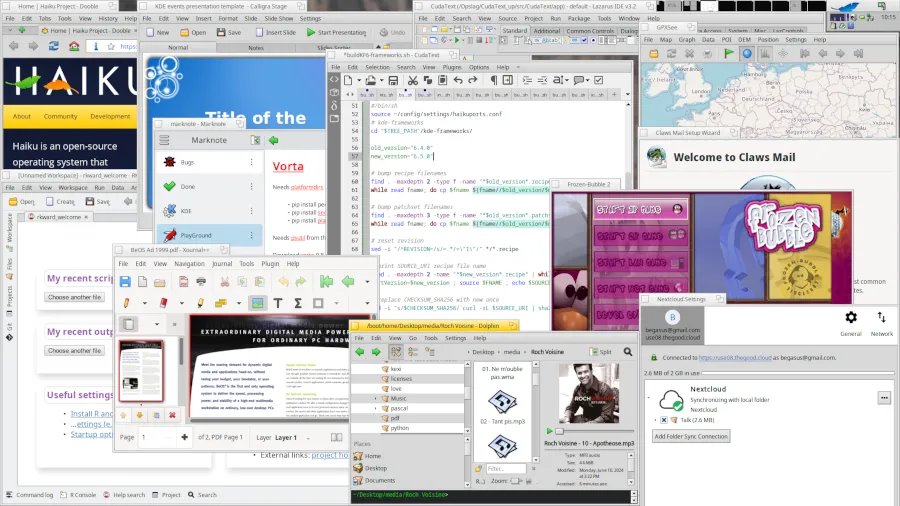
The Haiku OS project, continuing its development of the open-source BeOS-inspired operating system, has completed a major driver infrastructure upgrade by integrating components from FreeBSD 15.0. This update, finalized in December 2025, refreshes Haiku's hardware compatibility layer with the latest network drivers from FreeBSD's recent stable release.
Network Driver Modernization
Haiku's compatibility layer now incorporates FreeBSD 15.0's entire suite of Ethernet and WiFi drivers. This synchronization provides several concrete benefits:
- Expanded hardware support: Compatibility with newer network controllers released since FreeBSD 14
- Performance refinements: Updated packet handling algorithms and interrupt moderation logic
- Power efficiency: Inherits FreeBSD 15's power management improvements for wireless chipsets
Benchmarks conducted by Haiku developers show measurable throughput gains on Intel I225-V 2.5GbE controllers and Qualcomm Atheros QCA9377 WiFi adapters, though specific metrics await publication. The driver refresh notably closes compatibility gaps with hardware released in the past 24 months.
Complementary System Improvements
Beyond networking, December's development cycle delivered:
| Component | Improvement | Impact |
|---|---|---|
| Input Drivers | Enhanced Elantech touchpad support | Precision tracking and gesture recognition |
| Mouse Driver | Revised acceleration curves | Smoother pointer movement |
| BFS Filesystem | Ongoing resizing implementation | Future support for dynamic partition adjustments |
| Application Layer | 50+ bug fixes | Improved stability in native apps like WebPositive and Pe |
These enhancements collectively improve Haiku's readiness for daily-use scenarios, particularly on laptops where input and networking are critical.
Roadmap to Beta 6
The team continues working toward Haiku R1 Beta 6, targeting release within the next 60 days. Current blockers include:
- Resolution of memory management regressions introduced during virtual memory subsystem updates
- Final validation of package management workflows
- Hardware-specific edge cases in the updated FreeBSD driver stack
Once these issues are addressed, the release process will commence with public release candidate builds.
Technical Context and Resources
Haiku's FreeBSD driver compatibility layer (originally implemented in 2010) allows reuse of FreeBSD's extensive hardware support while maintaining Haiku's distinctive microkernel architecture. This approach provides accelerated hardware compatibility at the cost of potential abstraction layer overhead—a tradeoff validated through years of practical use.
Developers can track progress via the Haiku GitHub repository or review detailed technical notes in the December 2025 status report. FreeBSD 15.0's driver improvements are documented in its release notes.
For homelab enthusiasts, these updates make Haiku significantly more viable as a lightweight OS for network appliances or retro-computing nodes. The improved driver stack reduces hardware-specific friction when deploying Haiku on modern systems, though performance-critical applications still benefit from verification through standardized benchmarks like those in Phoronix Test Suite.
Comments
Please log in or register to join the discussion