The James Webb Space Telescope has revealed intricate details of NGC 5134, a spiral galaxy 65 million light-years away, showcasing star formation, interstellar dust, and complex organic molecules in unprecedented clarity.
The European Space Agency (ESA) has unveiled a breathtaking new image of NGC 5134, a spiral galaxy located approximately 65 million light-years away in the constellation Virgo. This remarkable observation demonstrates the James Webb Space Telescope's (JWST) extraordinary capability to capture detailed views of relatively nearby cosmic structures.
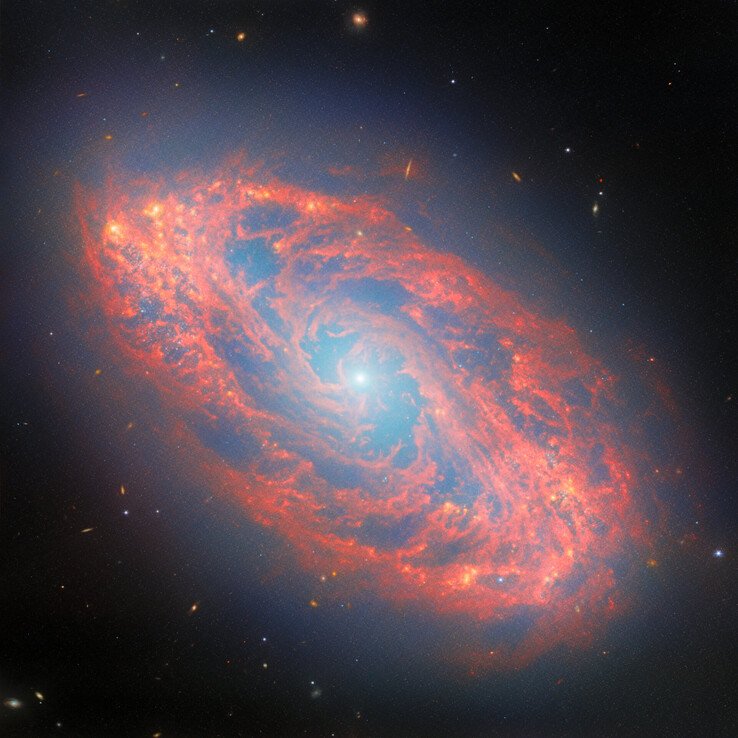
For this observation, Webb combined the power of its Near-InfraRed Camera (NIRCam) and Mid-Infrared Instrument (MIRI) to create a composite image that reveals different aspects of the galaxy's composition and structure.
NIRCam captures the stellar population
The NIRCam component of the observation focuses on the stars and star clusters scattered throughout NGC 5134's spiral arms. In the resulting image, these stellar objects appear as brilliant blue-white points of light, creating a striking contrast against the warmer tones of the galaxy's dust and gas.
MIRI reveals the hidden dust structures
In contrast, the MIRI instrument captures light emitted by warm dust surrounding the stars in the galaxy. This dust appears as bright red and orange regions in the image, creating a vivid tapestry of color that highlights the complex interplay between stellar radiation and interstellar material.
The glowing dust revealed by MIRI contains complex organic molecules, specifically polycyclic aromatic hydrocarbons (PAHs). These molecules are of particular interest to astronomers because they provide insights into the chemistry occurring within interstellar clouds.
Star formation in action
The image beautifully illustrates the sites of active star formation within NGC 5134. The interstellar clouds of dust and gas scattered throughout the galaxy's spiral arms serve as stellar nurseries where new stars are born. These clouds appear in varying densities across the image - some regions show dense concentrations while others appear more patchy.
This variation in density is likely caused by the clearing action of powerful radiation from young, massive stars. As stars form, they consume gas from their surrounding clouds, and when they die, they return some of this material to the interstellar medium.
Stellar lifecycles on display
The image provides a visual representation of the stellar lifecycle. Massive stars, those roughly eight times the mass of our Sun, end their lives in cataclysmic supernova explosions that can spread material across hundreds of light-years. Stars similar to our Sun experience more gentle deaths, but still contribute to the recycling of stellar material.
Looking beyond NGC 5134
In the background of this stunning image, numerous more distant galaxies are visible, appearing as faint smudges or streaks. While these distant objects cannot be studied in the same detail as NGC 5134, the understanding gained from observing this relatively nearby spiral galaxy can be applied to interpreting the properties and evolution of these more remote cosmic structures.
The James Webb Space Telescope continues to revolutionize our understanding of the universe, providing unprecedented views of cosmic phenomena that were previously hidden from our view. This image of NGC 5134 represents just one example of how JWST's advanced infrared capabilities are opening new windows into the workings of galaxies, star formation, and the complex chemistry of the cosmos.
Comments
Please log in or register to join the discussion