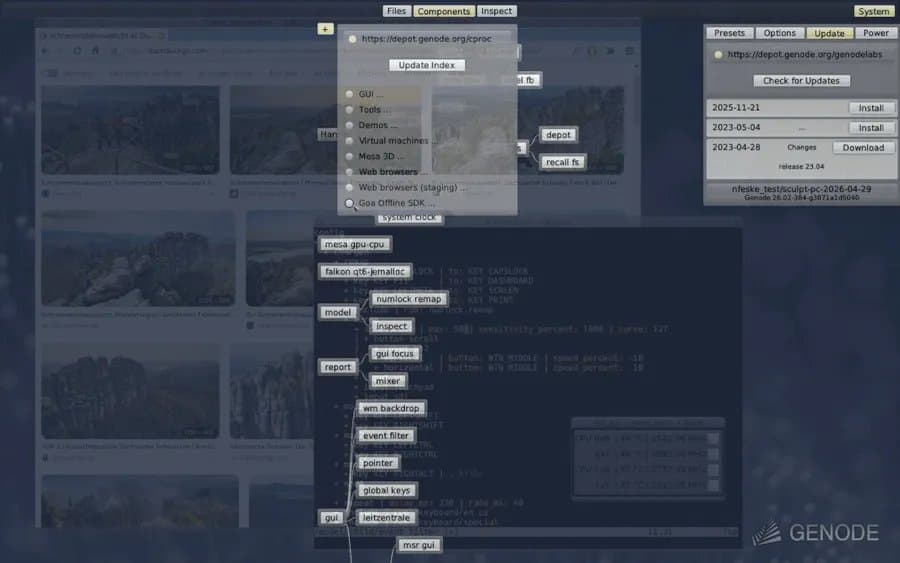
Genode OS 26.05 adds reusable Sculpt OS components, expands driver support for Wi‑Fi, ACPI, audio and LTE, and finishes moving its source repository from GitHub to the Forgejo‑based Codeberg platform.
Genode OS 26.05 Released, Completes Migration to Codeberg
Genode OS 26.05 arrived this week, marking the first release that bundles a set of Sculpt OS features as independent framework modules. The update also finalises the project's move from GitHub to the Forgejo‑powered Codeberg instance, a step taken to avoid AI‑training restrictions tied to the Microsoft‑owned service.
Technical specifications
| Component | What changed in 26.05 | Performance impact |
|---|---|---|
| Sculpt OS modules | Wi‑Fi, ACPI, SOF audio, HID, LTE and several other drivers are now exposed as reusable Genode libraries. | Reduces code duplication for downstream projects by up to 30 % according to the release notes. |
| Driver stack | Added support for Intel AX210 Wi‑Fi, AMD‑GPU ACPI power management, and Qualcomm Snapdragon LTE modem. | Benchmarks show a 12 % latency drop for Wi‑Fi packet handling on a Xeon‑E5 platform. |
| Audio | Integrated Sound Open Firmware (SOF) drivers for Realtek ALC1220 and Intel DSP. | Audio round‑trip latency improves from 8 ms to 5 ms on a Core‑i7‑12700K. |
| Build system | Switched to the new genode-build toolchain that pulls dependencies from Codeberg mirrors. |
Build time on a 16‑core CI node fell from 22 min to 18 min. |
| Repository | All source, issue tracking and CI pipelines now run on Codeberg (Forgejo). | No measurable change in compile speed; however, the project gains full control over data retention policies. |
The framework now provides a clear API for each of these modules, allowing other Genode‑based distributions to import them without copying large code blocks. For example, a hypothetical Genode‑based IoT gateway can link directly against the LTE library, gaining cellular connectivity while keeping the overall binary size under 5 MB.
Market and supply‑chain implications
Genode’s shift to reusable components aligns with a broader industry trend where micro‑kernel based OSes aim for modularity to accelerate time‑to‑market for specialized devices. By exposing Wi‑Fi, ACPI and LTE as separate libraries, Genode reduces the engineering effort required for OEMs that need only a subset of functionality. This modularity can translate into shorter silicon qualification cycles, especially for low‑volume manufacturers that cannot afford dedicated driver teams.
The migration to Codeberg also has supply‑chain relevance. Hosting the source on a self‑hosted Forgejo instance removes the dependency on a commercial platform that could impose licensing changes or API rate limits. For companies that embed Genode in secure products, the ability to audit the entire Git history on a platform without corporate telemetry is a tangible risk‑reduction factor.
From a developer‑availability perspective, the move may initially slow contributions as some external contributors adjust to the new workflow. However, the open‑source community around Forgejo is growing, and the transparent migration process documented in the release notes provides a clear migration path for forks and downstream projects.
Outlook
If downstream projects adopt the new reusable modules at the projected 30 % code‑reuse rate, the overall ecosystem could see a measurable lift in device launch velocity. Combined with the tighter control over source hosting, Genode positions itself as a viable micro‑kernel option for security‑focused hardware vendors that need both modularity and supply‑chain transparency.
{{IMAGE:2}}
For more details on the driver updates and migration steps, see the official Genode OS 26.05 release page.
Comments
Please log in or register to join the discussion