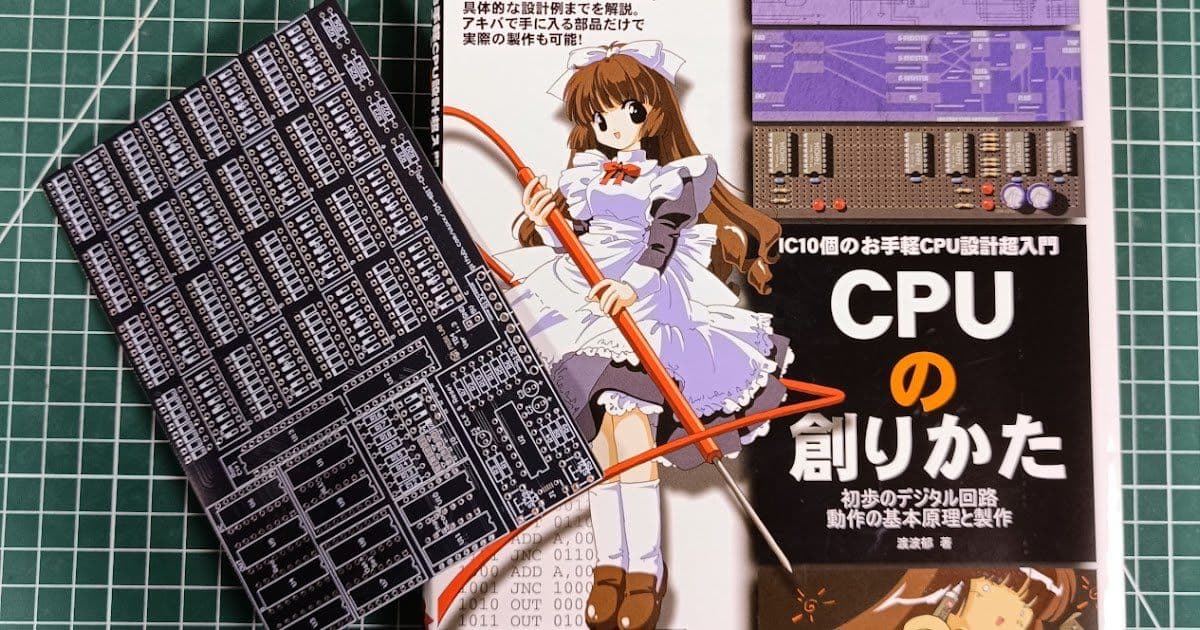
A detailed account of constructing and programming a 4-bit CPU using 74-series TTL logic ICs, with insights into the educational value of hard-wired processor architecture.
The TD4 represents an intriguing approach to computer education: a functional 4-bit processor built entirely from discrete 74-series TTL logic components. Featured in Kaoru Tonami's book "How to Build a CPU," this project offers a transparent view of CPU operation without the abstraction layers found in modern processors.
What the TD4 Actually Is
The TD4 is a hard-wired logic CPU with a 16-byte address space and 12 instructions. Unlike modern processors that rely on microcode, the TD4 executes instructions through direct electrical paths through logic gates. The design is intentionally minimal, featuring:
- 74HC161 chips for A and B registers and the output port
- Another 74HC161 for the Program Counter (PC)
- 74HC153 multiplexers for ALU input selection
- 74HC283 configured as a 4-bit ALU
- 74HC10 and 74HC32 gates for instruction decoding
The clock is generated by a simple 74HC14 oscillator circuit, allowing users to step through instructions manually or observe data flow through the registers at low speeds.
Construction Challenges and Solutions
Building the TD4 presented several practical challenges. The book is only available in Japanese, requiring the author to translate it themselves. Component sourcing proved difficult, particularly the 1S1588 or D8-1A diode networks specified in the book, which were replaced with individual 1N4148 diodes.
The diodes function as a Diode Matrix ROM, acting as one-way gates to prevent current back-feeding when multiple DIP switches are activated. This physical implementation of memory addresses to instructions demonstrates how early computers stored and executed programs without modern ROM or RAM chips.
The PCB design is relatively straightforward to assemble, with only four LEDs and a Micro-USB socket as SMD components. The author notes that while the USB socket might appear intimidating, only pins 1 and 5 need soldering, as the remaining pins are unused in this design.
Programming and Educational Value
Programming the TD4 reveals its limitations and strengths. With only 16 bytes of address space, the system can only execute very simple programs. The author experimented with counter systems and developed a web-based TD4 Assembler utility to convert assembly code directly into DIP switch positions.
The educational value of the TD4 lies in its transparency. By observing how bits move from switches through multiplexers into registers, users gain a concrete understanding of processor fundamentals. The absence of microcode, caches, and operating systems makes it an excellent "Hello World" for computer architecture.
Practical Applications and Limitations
While the TD4 is primarily an educational tool, its simplicity offers practical insights for embedded systems design. The hard-wired logic approach demonstrates how complex operations can be implemented with minimal components, which remains relevant in resource-constrained environments.
However, the TD4's limitations are significant. The 4-bit data path and 16-byte address space restrict it to trivial computations. Modern processors execute billions of instructions per second; the TD4 operates at a frequency low enough to observe individual LED toggles. The manual programming method via DIP switches makes iterative development cumbersome compared to modern development environments.
For those interested in exploring the TD4 further, the original book's support site offers additional resources, including a Windows-only emulator. The open-source PCB design files can be found on BG5DIW's GitHub repository, and the author's TD4 Assembler utility is available at github.com/dilshan/td4-assembler.
The TD4 project exemplifies how building simple systems can illuminate fundamental concepts in computer architecture. While not practical for modern applications, it provides an invaluable foundation for understanding how processors work at the most basic level.
Comments
Please log in or register to join the discussion