
Hisense debuts the Smart Audio Glasses G11 in China, a sub-$180 pair of ultra-lightweight audio glasses with 12-hour continuous playback, Vifa-tuned sound, and basic AI translation, skipping premium AR and camera features to keep costs low.

What's New
Hisense recently launched a slate of new products in the Chinese market, with the Smart Audio Glasses G11 standing out as a budget-friendly entry into the growing audio glasses category. Unlike many high-end smart glasses that prioritize augmented reality displays or advanced gesture controls, the G11 focuses almost entirely on audio performance, comfort, and basic smart features powered by a lightweight integrated AI large language model.
The glasses are designed for all-day wear, with the lightest frame option weighing just 26.5 grams, and temples measuring only 5.3mm thin. Hisense notes the G11 uses a second-generation ergonomic design intended to reduce pressure on the nose and ears during extended use. Many audio glasses suffer from uneven weight distribution that causes ear fatigue after an hour or two of wear, so Hisense’s updated design likely adjusts the center of gravity to sit closer to the nose bridge, spreading weight more evenly across the face. The G11 comes in multiple frame options to suit different face shapes and style preferences. 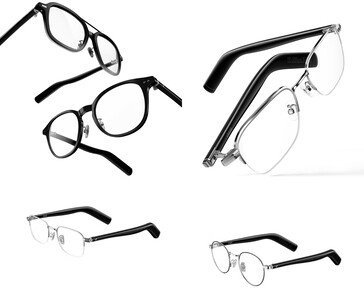 Hisense has not disclosed the full range of styles or colorways available at launch, but early listings show rectangular, round, and aviator-inspired frame designs.
The integrated AI LLM enables two core smart functions: real-time dialogue translation and interpretation, which Hisense positions as useful for travelers or professionals working across language barriers. These are intentionally limited features, avoiding the resource-heavy processing that would add bulk or drain battery life. The brand emphasizes that the G11 is optimized for outdoor use, with multi-dimensional interaction features that allow users to control playback, take calls, or trigger translation via touch or voice inputs on the frames.
The audio system is the G11’s headline feature, tuned by Danish audio company Vifa, which has a long track record of working on premium portable audio products. A 6-microphone array supports spatial input, which Hisense claims delivers clearer call quality and better voice command recognition even in windy or noisy outdoor environments. The brand also touts "best-in-class" noise reduction technology, though independent testing will be needed to verify that claim against competitors like Xiaomi and Huawei. 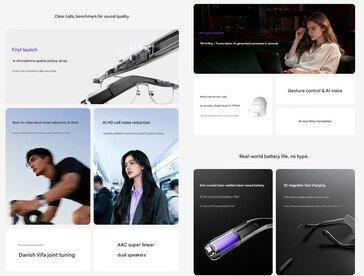 This image outlines the core highlights of the G11, including the Vifa tuning, 6-mic array, and AI translation features, though it is a machine-translated version of Hisense’s official marketing materials.
Battery performance is another key selling point, and Hisense’s claims hold up well against category averages. The brand states the G11 can deliver up to 47.2 hours of total use, which includes standby time and intermittent audio playback, with up to 12 hours of continuous audio listening on a single charge. That 12-hour continuous figure outpaces the category average of 8 to 10 hours for audio glasses in the same price range. For context, a full workday of 8 hours of meetings and music playback would leave 4 hours of battery remaining, while a cross-country flight from New York to Los Angeles (roughly 6 hours) would use less than half the total continuous playback capacity. Charging uses a magnetic connector, eliminating the need for exposed USB-C ports that could compromise the IP54 dust and water resistance rating. IP54 certification means the glasses are fully protected against harmful dust ingress and can withstand water splashes from any direction, making them suitable for light rain or sweaty outdoor workouts. The glasses also include a built-in audio recording feature, which can be used to capture voice notes, meeting minutes, or lecture audio directly from the frames, with recordings stored locally or synced to a connected smartphone via Bluetooth.
How It Compares
The G11’s most direct competitor in the Chinese market is the Xiaomi Mijia Smart Audio Glasses, which retail for CNY 1,099 (approximately $161 USD), roughly $13 cheaper than the base G11 model. The Xiaomi option weighs 28 grams, 1.5 grams more than the lightest G11 frame, and offers 10 hours of continuous audio playback, 2 hours less than the Hisense alternative. Xiaomi’s glasses use in-house audio tuning rather than Vifa’s expertise, and independent audio tests of previous Xiaomi audio glasses show flatter sound profiles with less bass response than Vifa-tuned models. However, Xiaomi’s smart glasses have wider availability outside mainland China, with official sales in Southeast Asia, India, and parts of Europe, while the G11 is currently China-exclusive. Xiaomi also supports more third-party app integrations, including WeChat and Alipay voice controls, while the G11’s AI features are limited to Hisense’s first-party translation and interpretation tools.
Against more premium global options like the Meta Ray-Ban Smart Glasses, the G11’s value proposition becomes even clearer. Meta’s glasses retail for $329 USD, nearly double the price of the G11, and weigh 50 grams, almost twice as much as the lightest G11 frame. Battery life is a major differentiator: the Meta Ray-Ban offers only 4 hours of continuous audio playback, compared to the G11’s 12 hours. Meta’s glasses include a 12MP camera for quick photos and video calls, as well as deeper integration with Meta’s AI assistant and smart home ecosystems, features the G11 lacks entirely. For users who do not need a camera or advanced smart home controls, the G11 delivers far better comfort, battery life, and audio quality per dollar spent.
Who It's For
The Hisense Smart Audio Glasses G11 are designed for a specific subset of users: budget-conscious buyers who prioritize comfort and battery life over premium features like cameras, AR displays, or advanced voice assistants. Commuters who spend hours on public transit listening to podcasts or music will appreciate the 12-hour continuous playback, which eliminates the need to carry a charging case. Runners and outdoor exercisers will benefit from the lightweight build and IP54 rating, which can handle sweat and light rain. Travelers who frequently interact with non-native speakers may find the built-in translation feature useful, though it lacks the offline language support and accuracy of standalone translation devices like the Pocketalk.
As of now, the Hisense Smart Audio Glasses G11 are only available in China, starting at CNY 1,189 (approximately $174 USD). Hisense has not announced plans to release the glasses in global markets, so users outside China will need to import them or opt for the Xiaomi Mijia alternative, which is available in more regions.
Comments
Please log in or register to join the discussion