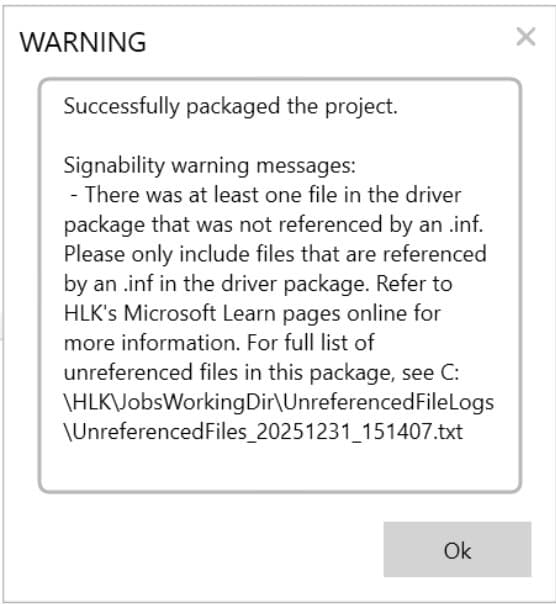
The Windows Hardware Lab Kit (HLK) February 2026 refresh adds a new warning system for unreferenced files in driver packages, helping developers identify potential issues before submission to the Hardware Dev Center.
The Windows Hardware Lab Kit (HLK) February 2026 refresh introduces a significant new feature for driver developers working with Windows 11, version 25H2, Windows Server 2025, and Windows 11, version 24H2. The update adds a warning system that identifies files in driver packages that aren't referenced by the .inf file, helping developers catch potential issues before submission to the Hardware Dev Center (HDC).
What's Changing
Starting with the February 2026 refresh, HLK will display a warning at the end of packaging if the attached driver package contains one or more files not referenced by an .inf file. The warning message will read: "This will not affect package generation. Even if the warning appears, an .hlkx will still be created regardless."
This change is designed to help developers identify potential issues early in the development process. The warning serves as a notification rather than a blocker, allowing developers to continue with package generation while being aware of unreferenced files that may need attention.
API Updates
The PackageWriter class in the Microsoft.Windows.Kits.Hardware.ObjectModel.Submission namespace receives several important updates:
- The AddDriver and AddReplacementDriver methods now include a new check for files in the driver package that weren't referenced by an .inf file
- Warning information will be available through the warningMessages output argument
- New overloads of AddDriver and AddReplacementDriver expose unreferenced file information through additional output arguments
- The updates provide developers with programmatic access to unreferenced file data for integration into automated workflows
How to Validate Your Driver Package
To check for unreferenced files, developers can:
- Attach the driver package to your HLK project
- Create an .hlkx package (test results not necessary)
- Observe whether the warning appears
- If the warning appears, navigate to the log path to see which files were not referenced
This validation can be performed at any time after target selection, making it easy to integrate into existing development workflows.
Recommended Actions
When encountering unreferenced files, developers have several options depending on their situation:
For Original Submission Packages
Option 1 (recommended): Remove the driver package from the project, remove the unreferenced files from the driver package, then re-attach.
Option 2 (recommended): Remove the driver package and modify the .inf to reference all the files. Re-test the driver and attach the modified driver package.
Option 3: Keep the driver package attached, even with the unreferenced files. If submitting to HDC, review the documentation for any policy updates regarding submissions with unreferenced files.
For DUA Packages
Option 1 (recommended): Replace the attached driver package with a new one. Before re-attaching, remove any unreferenced files from the driver package.
Option 2: Create a new original submission. Modify the .inf to reference all the attached files. Re-test the driver and attach the modified driver package.
Option 3: Keep the driver package attached, even with the unreferenced files. If submitting to HDC, review the documentation for any policy updates regarding submissions with unreferenced files.
Compressed File Support
The new unreferenced file check supports most compressed files with specific behaviors:
- Files compressed with extensions ending in "_" will not trigger the warning if their decompressed versions are properly referenced by the .inf
- .cab files included in the .inf's [SourceDisksNames] section will have their contents examined during the unreferenced file check
- .cab files referenced as driver files in the .inf will be treated as such, and their contents will not be examined
Unsupported Scenarios
Several scenarios are not supported by the unreferenced file check:
- Attaching compressed .cat files
- Attaching double-compressed files (e.g., a file compressed individually and then packed into a cab, or a .cab compressed a second time with an underscore extension)
Troubleshooting Common Issues
Failed to Analyze Driver Package
If you receive the message "Failed to analyze driver package for unreferenced files," this indicates that HLK couldn't complete the check. Confirm there are no files missing from the attached driver package (i.e., the .inf referenced a file that wasn't attached).
File Identified as Unreferenced But Included in .inf
If a file is being identified as unreferenced despite being included in the .inf, the issue may be that the file is in a section not properly referenced. Run infverif to identify any unreferenced sections. Also, verify that the file's relative path in the attached package exactly matches what's specified in the .inf file.
.inf File Identified as Unreferenced
If an .inf file is being identified as unreferenced, confirm that it's placed at the top root of the driver package, not in a subdirectory.
Integration and Resources
The new functionality integrates with existing HLK workflows while providing additional visibility into driver package structure. Developers can access detailed information through the updated API methods and review comprehensive documentation on Microsoft Learn.
For developers working with automated testing pipelines, the new API overloads provide programmatic access to unreferenced file information, enabling integration with CI/CD systems and custom validation tools.
Getting Help
For additional questions or assistance, developers can reach out to the Microsoft support team by creating a support ticket through the Windows HLK Support portal.
The February 2026 HLK refresh represents Microsoft's ongoing commitment to improving the driver development and certification process, providing developers with better tools to ensure their drivers meet Windows quality standards before submission.
Comments
Please log in or register to join the discussion