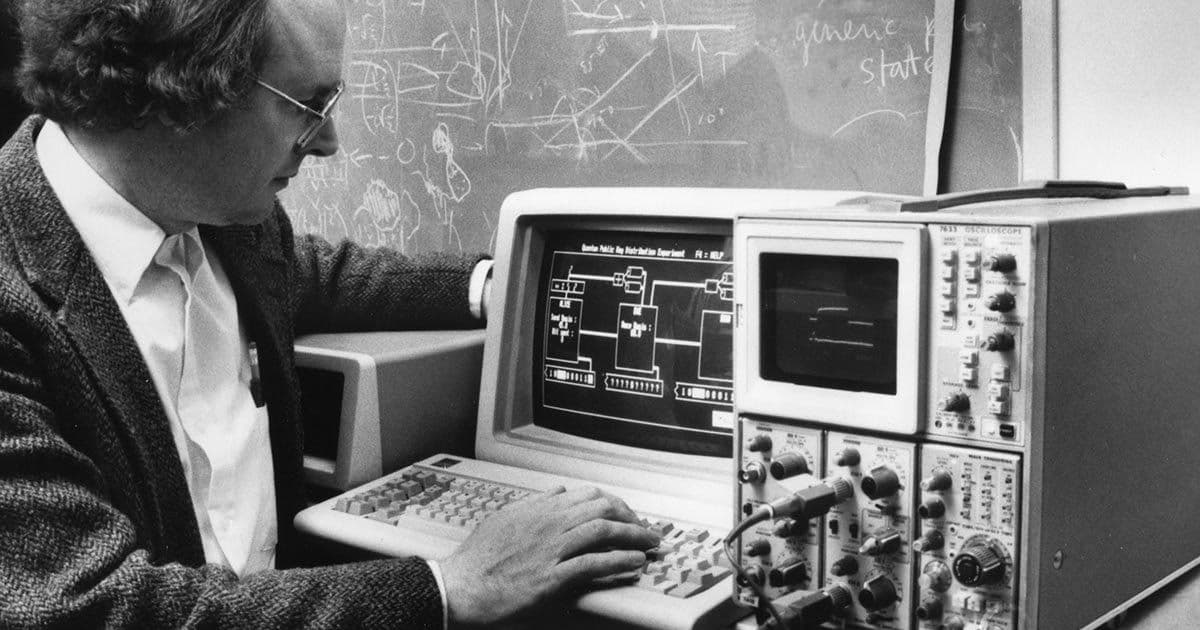
Charles Bennett and Gilles Brassard win the 2025 Turing Award for pioneering quantum cryptography and teleportation, marking the first time quantum research has received computing's highest honor.
In October 1979, a chance encounter in the waters off San Juan, Puerto Rico, set in motion a revolution in information security that would take nearly half a century to reach its full significance. Gilles Brassard, then a young computer scientist swimming near his hotel, found himself approached by a stranger who immediately began describing a method for creating unforgeable currency based on quantum physics. That stranger was Charles H. Bennett, a physicist at IBM Research, and their conversation would eventually lead to the development of quantum cryptography—a field now considered essential as nations and corporations race to secure communications against the threat of quantum computers.
The Association for Computing Machinery announced today that Bennett and Brassard will share the 2025 A.M. Turing Award, often called the Nobel Prize of computer science. The USD 1 million prize marks the first time the Turing Award has recognized quantum research, underscoring how far the field has progressed from theoretical curiosity to practical necessity.
Bennett's journey into quantum information theory began with a fundamental insight: information is physical. In the early 1960s, IBM physicist Rolf Landauer argued that information processing must obey the laws of thermodynamics. Building on this work, Bennett demonstrated in 1973 that computation could theoretically be performed reversibly, without energy loss—a finding that revealed deep connections between physics and information processing that most scientists had overlooked.
But it was Bennett's collaboration with Brassard that would define their careers. The two developed the BB84 protocol in 1984, a method for establishing encryption keys using the quantum properties of photons. In this system, two parties—traditionally named Alice and Bob—can exchange single particles of light in such a way that any attempt by an eavesdropper to intercept the communication would disturb the photons and reveal the intrusion. As Bennett and Brassard wrote, their method offered security "even against an opponent with superior technology and unlimited computing power."
At the time, BB84 attracted little attention. The internet was in its infancy, and conventional mathematical encryption seemed sufficient. That changed dramatically in 1994 when mathematician Peter Shor, then at Bell Labs, demonstrated that a sufficiently powerful quantum computer could break the mathematical locks protecting most internet communications. Suddenly, Bennett and Brassard's theoretical work looked urgently practical.
By then, Bennett had already built the first quantum cryptography machine in his IBM office in 1989—a two-meter-long device assembled from mirrors, polarizers, and photon detectors. The technology has since advanced to enable secure communication over distances up to 1,200 kilometers between satellites and Earth.
The pair's contributions extended beyond cryptography. In 1993, they published a paper introducing quantum teleportation—not the science-fiction version, but the transfer of quantum states between particles using entanglement, a phenomenon where measuring one particle instantly affects another regardless of distance.
Bennett has a unique way of explaining quantum information's peculiar properties. "Quantum information is like the information in a dream," he told IBM. "As soon as you start trying to tell somebody about your dream, you begin to forget the dream, and you only remember what you said about it. The public version can be copied, but it's not the same as the dream."
This inability to copy quantum information without disturbance is precisely what makes quantum cryptography secure. An eavesdropper cannot secretly intercept a quantum-encoded message without leaving evidence of the intrusion.
Jay Gambetta, Director of IBM Research, emphasized the lasting impact of Bennett's work. "When many researchers saw quantum mechanics as a problem to solve for shrinking electronic components rather than a tool to be developed, he recognized the same physics could become a powerful new way to process and transmit information," Gambetta said. "That insight, and the decades of work that followed, helped lay the intellectual foundation for one of the most important scientific and technological frontiers of our time."
Bennett, who has kept an office at IBM for over 50 years since Landauer recruited him, is the seventh IBM-affiliated researcher to receive the Turing honor. As governments and financial institutions worldwide begin implementing quantum-safe encryption, the work that began with a conversation in the ocean off Puerto Rico has become not just theoretically elegant but practically essential.
Looking ahead, Bennett remains characteristically humble about the field's future. "Most of the applications," he told IBM, "are probably yet to be discovered." In an era where quantum computing threatens to render current encryption obsolete, that uncertainty may be the most exciting aspect of all.
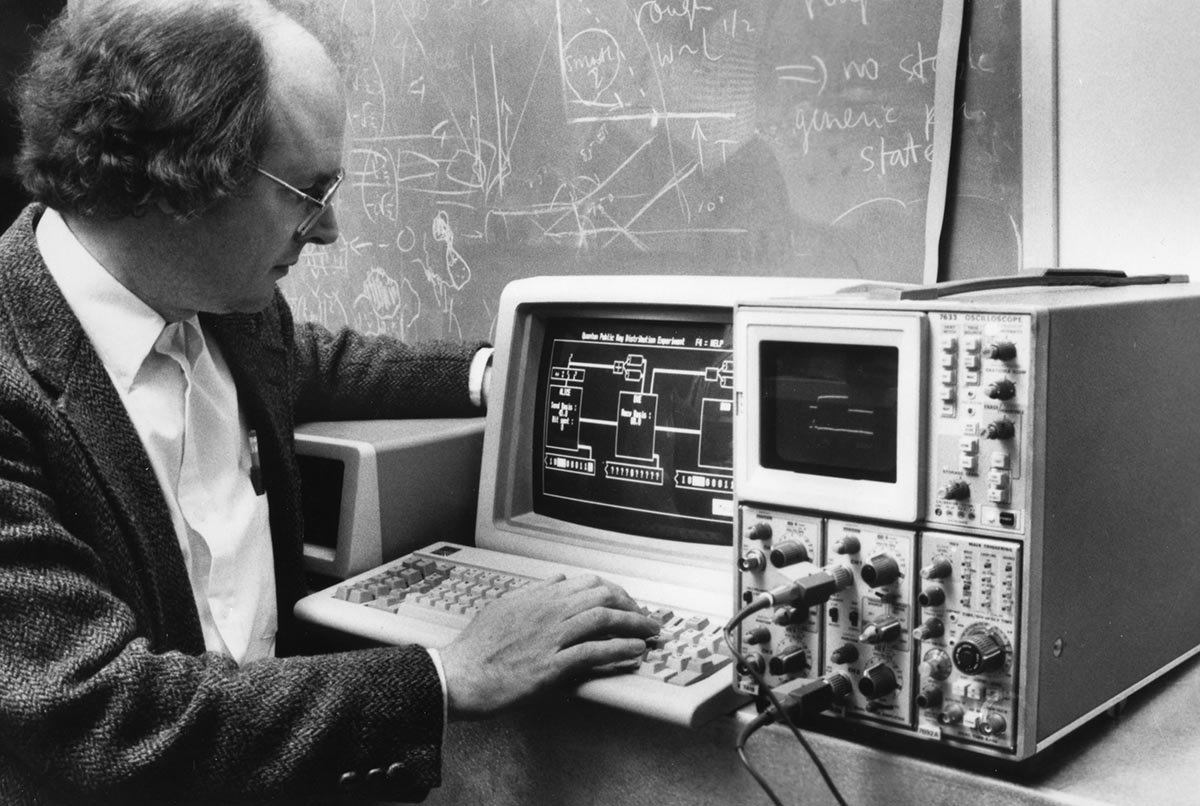
The image shows Charles H. Bennett, co-recipient of the 2025 Turing Award, whose pioneering work in quantum information theory has fundamentally changed how we understand and secure digital communications.
Comments
Please log in or register to join the discussion