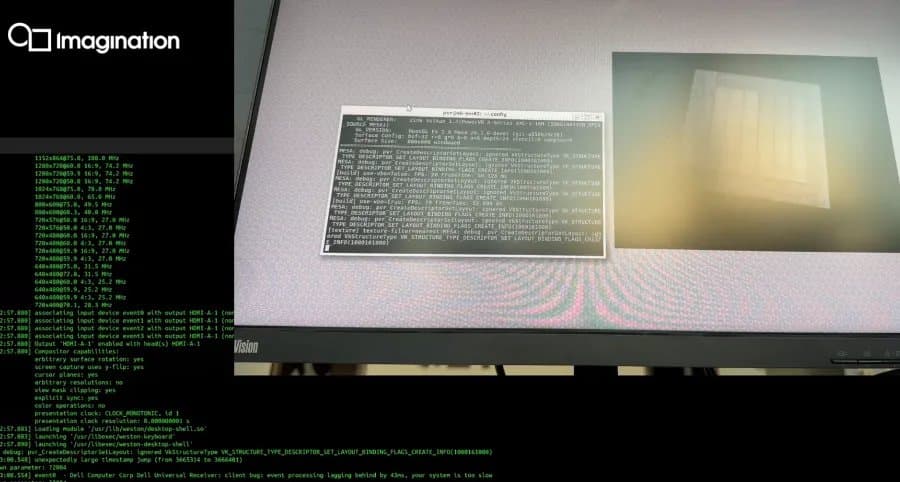
Imagination's PowerVR Vulkan driver now works seamlessly with Zink, enabling open-source OpenGL support on PowerVR hardware through Mesa 26.1.
Imagination Technologies has reached a significant milestone in their open-source graphics driver development, with their PowerVR Vulkan driver now fully compatible with Zink's OpenGL-on-Vulkan implementation. This achievement, set to ship with Mesa 26.1 in mid-Q2, marks the completion of Imagination's strategy to provide open-source graphics support for PowerVR hardware through a Vulkan-only driver stack.

The journey to this point has been several years in the making. Imagination has been steadily building out their open-source graphics driver stack, focusing initially on their DRM kernel graphics driver and a dedicated PowerVR Vulkan driver within Mesa. Their strategic decision to concentrate exclusively on Vulkan, rather than developing separate OpenGL and Vulkan drivers, was always intended to leverage Zink as a compatibility layer for OpenGL applications.
Zink, the generic OpenGL implementation that translates OpenGL calls into Vulkan commands, had a critical limitation that prevented it from working with PowerVR hardware: it only supported devices where the GPU and display controller were managed by the same kernel driver. This architecture is common in many integrated graphics solutions but doesn't apply to PowerVR, where Imagination provides only the GPU intellectual property while display management is handled separately.
Recent development work has addressed this gap. The PowerVR Vulkan driver team implemented all the missing pieces required for full Zink compatibility, with the final major hurdle being the extension of Zink itself to work with Mesa's Kernel Mode Setting Render Only (KMSRO) framework. KMSRO allows rendering to occur without direct display control, which is exactly the scenario presented by PowerVR hardware.
This achievement represents more than just technical compatibility—it validates Imagination's long-term strategy of investing in a Vulkan-only driver model. By relying on Zink for OpenGL support, Imagination can focus their development resources on a single, modern graphics API while still maintaining compatibility with the vast ecosystem of OpenGL applications.
The implications extend beyond PowerVR hardware. As Vulkan continues to gain adoption across desktop and gaming platforms, other hardware vendors may follow Imagination's lead and pursue similar Vulkan-only driver support models. This approach could streamline driver development efforts and reduce maintenance overhead while ensuring broad application compatibility through Zink.
Looking ahead, Imagination plans to pursue both Vulkan 1.2 and OpenGL ES compliance for their PowerVR graphics stack on this open-source driver foundation. The successful integration of Zink demonstrates that their open-source Linux graphics driver stack is maturing into a viable solution for real-world use cases.
For developers and users of PowerVR-based systems, this milestone means access to a complete open-source graphics stack with support for both modern Vulkan applications and legacy OpenGL software. The achievement also highlights the growing importance of compatibility layers like Zink in bridging the gap between emerging graphics APIs and established application ecosystems.
Comments
Please log in or register to join the discussion