
India's government ordered internet providers to restrict Telegram until June 22 after investigators linked the app to NEET exam-fraud networks. Network operators accepted bad BGP announcements, and users outside India, including in the UAE, lost access.

India's Ministry of Electronics and Information Technology ordered internet providers to restrict Telegram across India from June 16 through June 22, citing reports that exam-fraud networks used Telegram channels, groups, and bots to sell leaked NEET material.
Officials also told Telegram to disable message editing in India through June 30. The National Testing Agency said channel admins used edits to backdate posts and make leaks appear older than their real posting times. Telegram filed a challenge in Delhi High Court, and the court sought replies from the government, The Economic Times reported.
The Times of India reported that the restriction came days before the June 21 NEET-UG 2026 retest. The government said the order targets cheating networks that spread claims of leaked question papers.
The route leak
Telegram CEO Pavel Durov escalated the dispute after users outside India lost access. He accused Reliance of "sabotaging" Telegram through Border Gateway Protocol hijacking and urged network operators to reject unauthorized BGP announcements from AS18101.
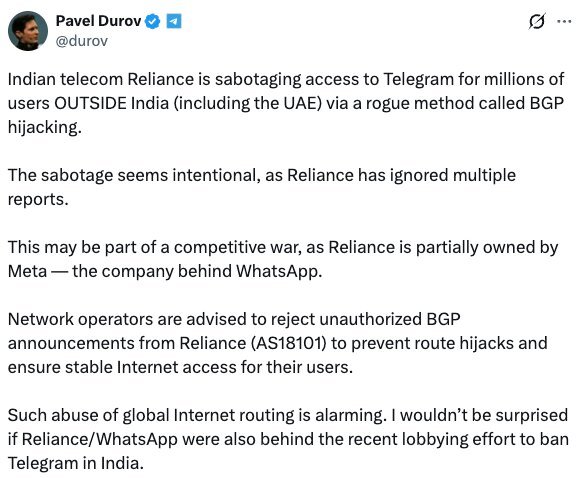
Reliance Jio denied any role in the BGP incident, The Economic Times reported. Company records associate AS18101 with Reliance Communications, an insolvent operator from the Anil Ambani group. Reliance Jio, the Mukesh Ambani carrier backed in part by Meta, has denied involvement.
Network operators use Border Gateway Protocol to advertise which networks can route traffic to specific IP prefixes. A network hijacks BGP when it advertises a prefix it has no right to originate. Other networks may accept that route and send traffic to the wrong place, which can drop connections or send traffic through an unintended path.
Observers who reviewed public routing data said operators behind AS18101 announced Telegram prefixes around the time India's block began. Doug Madory, director of internet analysis at Kentik, said AS18101 hijacked Telegram routes. Network researcher Anurag Bhatia checked the same public data. Technology policy researcher Pranesh Prakash traced the leak through FLAG Telecom, AS15412, a transit provider that accepted an RPKI-invalid route instead of filtering it.
Those analysts agree on the routing fault. They diverge from Durov on intent. Prakash said he had seen no evidence of sabotage and read the event as a domestic block that leaked into global routing. Madory and Bhatia compared it with Iraq's 2023 Telegram block, where a domestic block leaked routes outside the country.
Reporters need to identify who originated the route and who approved the blocking method. The public record supports a routing leak. It does not prove corporate sabotage.
India's exam fraud case
India tied the Telegram restriction to the National Eligibility-cum-Entrance Test, the medical entrance exam that draws millions of students. Investigators alleged that brokers circulated question papers before the May 3 exam through paid messaging groups and coaching networks in Rajasthan. Officials canceled the exam May 12 and scheduled the retest for June 21.
The Central Bureau of Investigation took over the probe and arrested several people, including NTA-appointed subject experts and coaching figures. The NTA said Telegram channels, groups, and bots helped sellers market access to leaked material and spread false claims about answer keys.
Officials described the nationwide block as a last resort after they failed to shut down the activity channel by channel. Durov said Telegram removed hundreds of channels sharing leaked material and scams in India in recent weeks. He urged officials to pursue insiders who leaked exam papers.
The Internet Freedom Foundation called the order disproportionate and "constitutionally incompatible." The group argues officials used a nationwide communication block against fraud by a small set of actors. It also argues that Section 69A orders leave affected users with scant public detail about who ordered a block and why.
Students bear the cost. NEET candidates use Telegram for lecture videos, notes, and coaching groups. Students who rely on those channels lose access to purchased courses and peer study groups during the final days before the retest.
MTProto proxy access
Telegram built MTProto proxies for censorship resistance. The Telegram proxy guide describes an app-level proxy that routes Telegram traffic through an intermediary node before it reaches Telegram servers. Telegram also publishes technical material on MTProto, the protocol family behind the app.
MTProto helps when an internet provider blocks Telegram IP ranges or accepts bad routes. It does less when a government orders Telegram itself to disable account features, such as message editing. You can use MTProto to restore reachability. You cannot use it to undo server-side policy limits.
Telegram encrypts your chats. The proxy operator can see your IP address and connection times. The operator cannot read message content or take over your account through the proxy setting alone.
Use a proxy from an operator you trust. Free proxy lists carry risk. Researchers studying free proxy ecosystems found unstable services and malicious behavior in long-running measurements. A VPN company you trust will see your traffic metadata if you put a VPN between your device and the proxy, so choose one with care.
Desktop setup
- Open Telegram Desktop and go to Settings > Advanced.
- Under Data and storage, choose Connection type.
- Select Use custom proxy, then Add proxy.
- Choose MTProto.
- Enter the server, port, and secret values from your proxy provider.
- Save the proxy and wait for Telegram to show it online.
Mobile setup
On iOS, open Settings > Data and Storage > Proxy > Add Proxy > MTProto.
On Android, open Settings > Data and Storage > Proxy Settings > Add Proxy > MTProto.
Enter the same server, port, and secret values. Keep more than one proxy source on hand because public proxies can disappear during large blocks.
Takeaways
Telegram users in India and the UAE can use MTProto proxies to route around ISP-level blocking and BGP fallout. Users who depend on Telegram for exam material should keep local copies of purchased notes, lecture files, and admission notices.
Network operators should enforce RPKI route-origin validation, reject invalid route announcements for Telegram prefixes, and monitor leaks from domestic censorship orders. RPKI validation helped contain this incident, according to Madory.
Administrators running coaching channels should mirror critical notices to email or websites during the restriction. Telegram's reach makes it useful for students, but a single platform creates a single point of failure when officials order a block.
Officials scheduled the access order to expire June 22. They set editing limits through June 30. Telegram's court challenge may shorten that schedule, and network operators could clean up the route leak before the legal order expires. Users who need Telegram now can use MTProto to route the app around the block while keeping Telegram's message encryption.
Comments
Please log in or register to join the discussion