
Microsoft research reveals how tailored feedback systems accelerate AI adoption, with informal conversations and team meetings emerging as universal channels while industry-specific patterns dictate secondary methods.

New Microsoft research analyzing feedback patterns across 1,800 global employees reveals that organizations successfully driving AI adoption share a critical trait: They've built industry-specific feedback systems that integrate with existing workflows. While 34% of employees still lack opportunities to provide input on AI tools, companies that prioritize listening see significantly higher adoption rates.
The Feedback-Adoption Flywheel
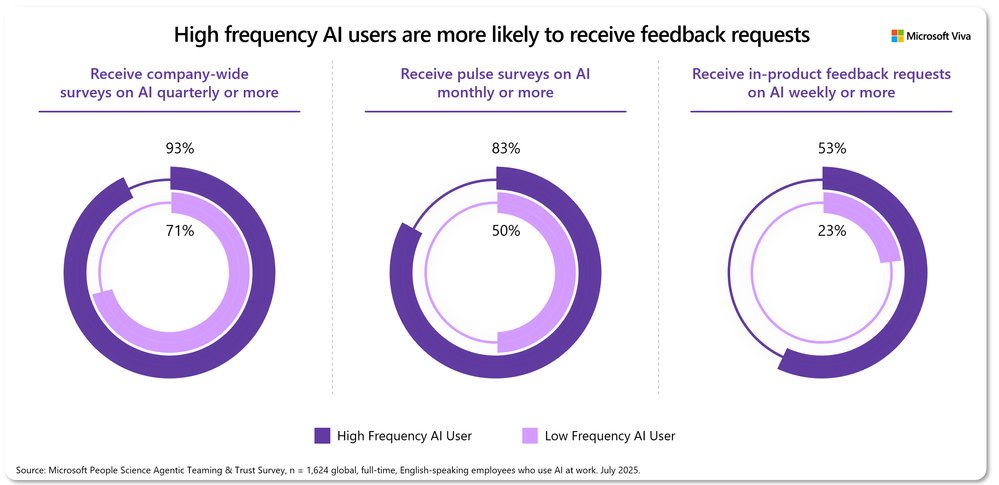
High-frequency AI users (daily users) are 2-3 times more likely to receive regular feedback requests than low-frequency users (monthly users). Specifically:
- 93% of frequent users receive quarterly company-wide AI surveys (vs. 71% of infrequent users)
- 83% get monthly pulse surveys (vs. 50%)
- 53% encounter weekly in-product feedback prompts (vs. 23%)
This creates a self-reinforcing cycle where feedback drives improvements that boost adoption, which in turn generates more actionable insights. "The fastest way to de-risk AI transformation is giving employees real ways to shape it," the report states. "Integrating feedback becomes a multiplier on change ROI."
Industry Channel Preferences Revealed
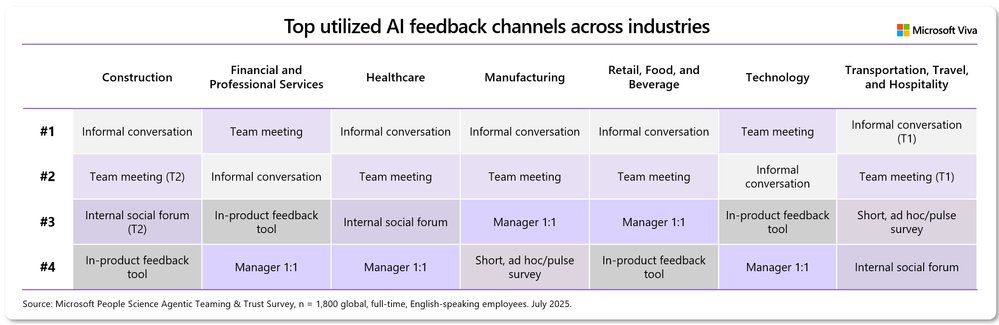
While informal conversations and team meetings ranked as the top two feedback channels universally, significant industry variations emerged:
| Industry | Primary Channels | Secondary Channels |
|---|---|---|
| Healthcare | Team meetings (62%) | Internal forums (58%) |
| Construction | Informal chats (67%) | In-product tools (61%), forums (59%) |
| Manufacturing | Team huddles (64%) | Pulse surveys (57%) |
| Retail/Food/Beverage | Shift handoff talks (59%) | In-product tools (55%) |
| Technology | Standups (71%) | In-product tools (68%) |
| Transportation/Hospitality | Shift briefings (63%) | Pulse surveys (60%), forums (58%) |
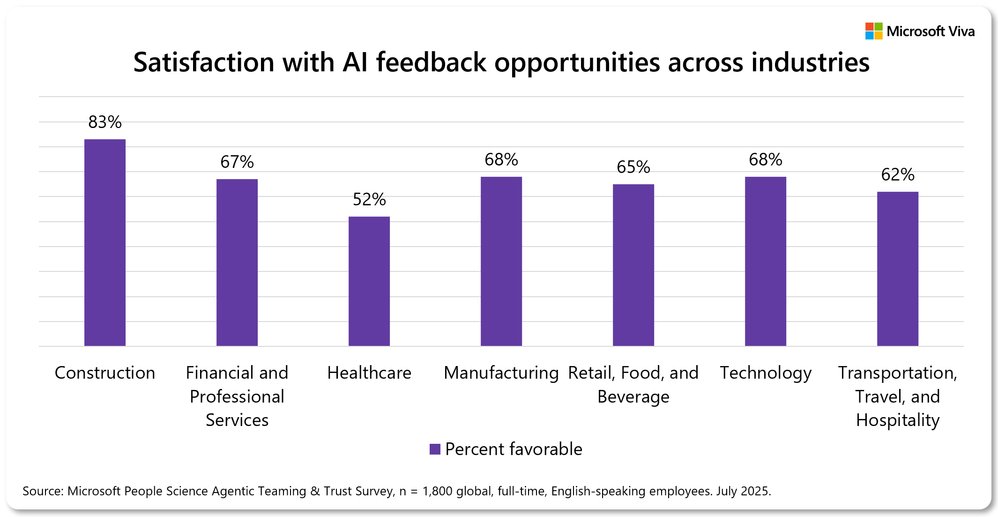
Healthcare stands out with only 52% of individual contributors reporting adequate feedback opportunities—well below the 66% cross-industry average—highlighting the need for specialized approaches in high-compliance environments.
Strategic Implementation Framework
For organizations building AI feedback systems:
Anchor in social interactions: Capture insights from meetings and informal chats using lightweight prompts like "What's one friction point you encountered today with our AI tool?"
Match channels to workflows:
- Desk-based sectors (Tech, Finance): Prioritize in-product feedback tools
- Shift-based operations (Healthcare, Manufacturing): Use mobile-friendly pulse surveys
- Frontline-heavy industries (Retail, Hospitality): Leverage internal forums accessible during downtime
Close the loop visibly: Route feedback directly to transformation owners (IT/HR/Product) and demonstrate how input translates into changes. Organizations that do this see 7x higher AI success rates.
The Behavioral Change Imperative
"AI integration is fundamentally a behavioral change, not just a technological one," notes the report. This explains why healthcare's clinical workflows require different feedback mechanisms than construction's mobile teams. Companies treating feedback as a continuous improvement engine rather than periodic checkpoint show significantly faster scaling from pilot programs to organization-wide value.
Comments
Please log in or register to join the discussion