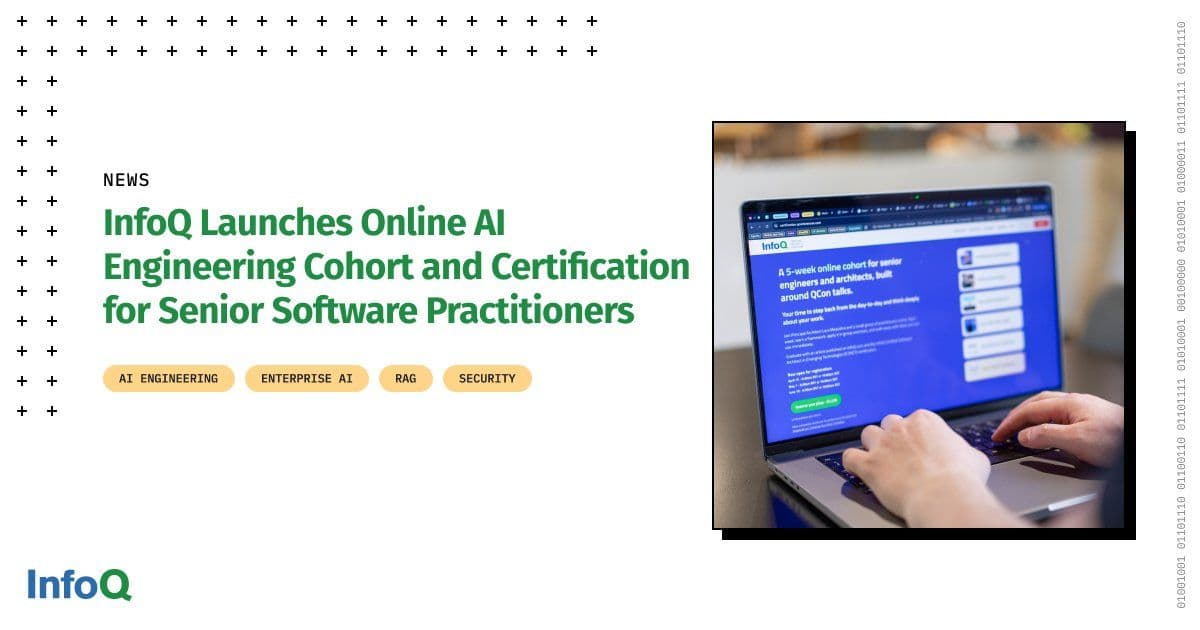
InfoQ has launched a five‑week, senior‑engineer‑focused certification program that brings together cross‑company peers to solve real‑world AI production problems. The curriculum emphasizes scalability, consistency models, and API design patterns needed to move AI prototypes into reliable services.
InfoQ’s Certified AI Engineering Cohort Tackles Production‑Scale AI Challenges
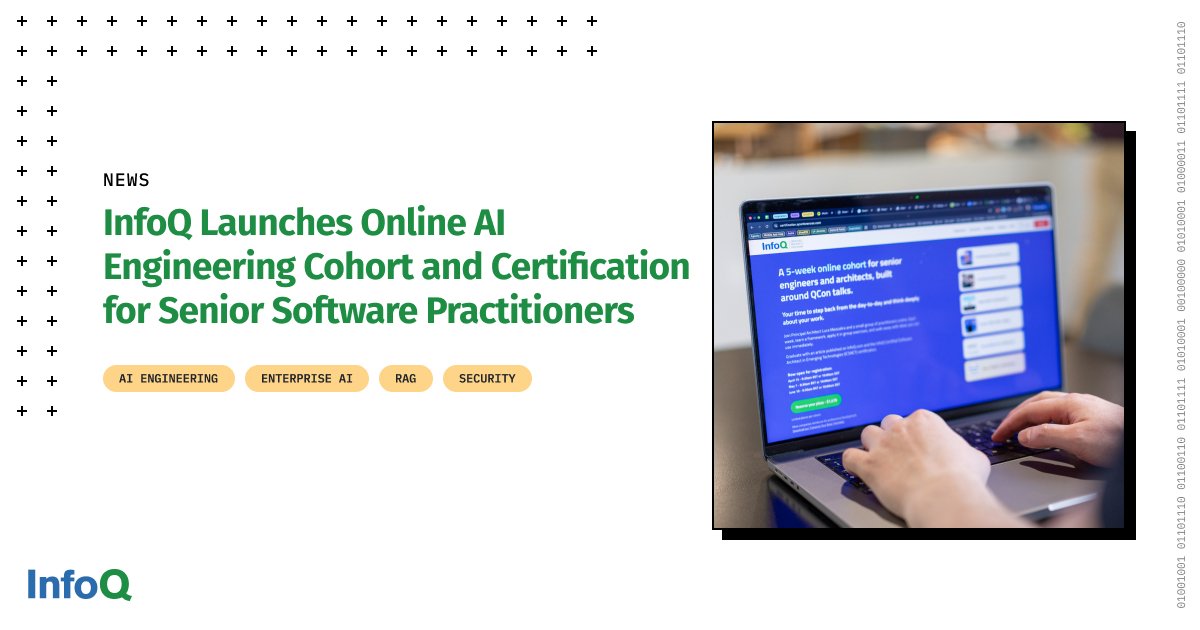
As senior engineers climb the technical ladder, they often find themselves isolated: fewer colleagues can critique the high‑stakes decisions that keep AI services reliable at scale. InfoQ’s new Certified AI Engineering Program attempts to close that gap by forming small, confidential peer groups that work through concrete production problems rather than textbook case studies.
The problem: From prototype hype to production reality
Most AI teams excel at building models that achieve impressive benchmark scores in a sandbox. The moment they need to serve those models to millions of users, the conversation shifts dramatically:
- Scalability – Can the inference pipeline handle traffic spikes without degrading latency?
- Consistency – Do we need strong guarantees that a request sees the same model version, or is eventual consistency acceptable?
- API contracts – How do we version model endpoints, expose feature‑store lookups, and surface observability data without breaking downstream services?
Without a community of experienced peers, senior engineers often make these decisions in a vacuum, leading to costly re‑architectures later.
Solution approach: A peer‑driven, framework‑first curriculum
The cohort runs for five weeks, four hours each Saturday, and is facilitated by Hien Luu, a senior engineering manager at Zoox who has built large‑scale MLOps pipelines on Ray and Spark. Each session applies a proven framework to a participant’s own project, ensuring that the learning is immediately actionable.
Week‑by‑week breakdown (with scalability focus)
| Week | Core topic | Scalability implication |
|---|---|---|
| 1 | Becoming an AI‑Native Engineering Team | Identifies where traditional reliability patterns (circuit breakers, bulkheads) must be extended to cover model drift and data freshness. |
| 2 | Designing and Building RAG / Context Pipelines | Discusses sharding strategies for vector stores, cache‑invalidation policies, and the trade‑off between latency and recall when scaling retrieval‑augmented generation. |
| 3 | Designing and Building AI Agents | Explores orchestration models (central scheduler vs. decentralized gossip) and how they affect throughput and fault isolation. |
| 4 | AI Platforms and Infrastructure | Contrasts monolithic inference services with federated edge‑to‑cloud deployments, highlighting cost‑aware routing and autoscaling policies. |
| 5 | AI Operational Excellence: Evals, Trust, and Reliability | Introduces consistency models for model versioning (strong vs. eventual) and API versioning strategies that prevent breaking changes in downstream microservices. |
Each week participants leave with a technical capstone article that documents the decisions they made, the alternatives they rejected, and the metrics they will use to validate the chosen design.
Trade‑offs and the engineering mindset
1. Strong consistency vs. availability
For fraud‑detection APIs, a stale model can cause financial loss, so teams often opt for strong consistency: every request is routed to the latest model version, enforced by a centralized model registry. The cost is higher latency and reduced availability during rollouts. In contrast, recommendation engines can tolerate eventual consistency, allowing a rolling update where a fraction of traffic sees the new model while the rest continues on the previous version. The cohort stresses measuring the business impact of each consistency level before committing.
2. Centralized vs. federated inference
A single, high‑capacity GPU cluster simplifies monitoring and version control but creates a single point of failure and can become a bottleneck under burst traffic. Federated inference—pushing lightweight models to edge nodes—reduces latency and spreads load, but introduces challenges around model drift detection and state synchronization across nodes. Participants learn to evaluate these trade‑offs using cost‑per‑inference and latency‑SLA models.
3. API design for evolving AI services
Traditional REST endpoints (/predict) quickly become insufficient when models expose multiple modalities (text, image, embeddings) and require streaming responses. The cohort recommends a hybrid API surface:
- REST for synchronous, low‑latency calls (e.g., feature flag checks).
- gRPC or HTTP/2 streaming for large payloads (e.g., video frame‑by‑frame inference).
- GraphQL‑style selection sets to let clients request only the fields they need, reducing bandwidth and keeping downstream contracts stable.
Versioning is handled at the API contract level (e.g., /v1/predict) and at the model registry level (semantic versioning of model artifacts). This dual versioning prevents breaking changes while still allowing rapid experimentation.
Why this matters for senior practitioners
- Risk mitigation – By exposing decisions to peers from other domains, engineers surface hidden failure modes before they hit production.
- Speed to market – Applying a vetted framework reduces the time spent on architectural debate, allowing teams to ship reliable AI services faster.
- Career growth – Graduates earn the InfoQ Certified AI Engineering badge, a signal to employers that they can navigate the complex trade‑offs of production AI.
Next steps and enrollment
The first cohort begins July 25, 2026. Interested senior engineers can reserve a spot through the InfoQ Online Certification Program page. The program also offers a “Convince Your Boss” template to help secure corporate sponsorship.
Author: Artenisa Chatziou
Comments
Please log in or register to join the discussion