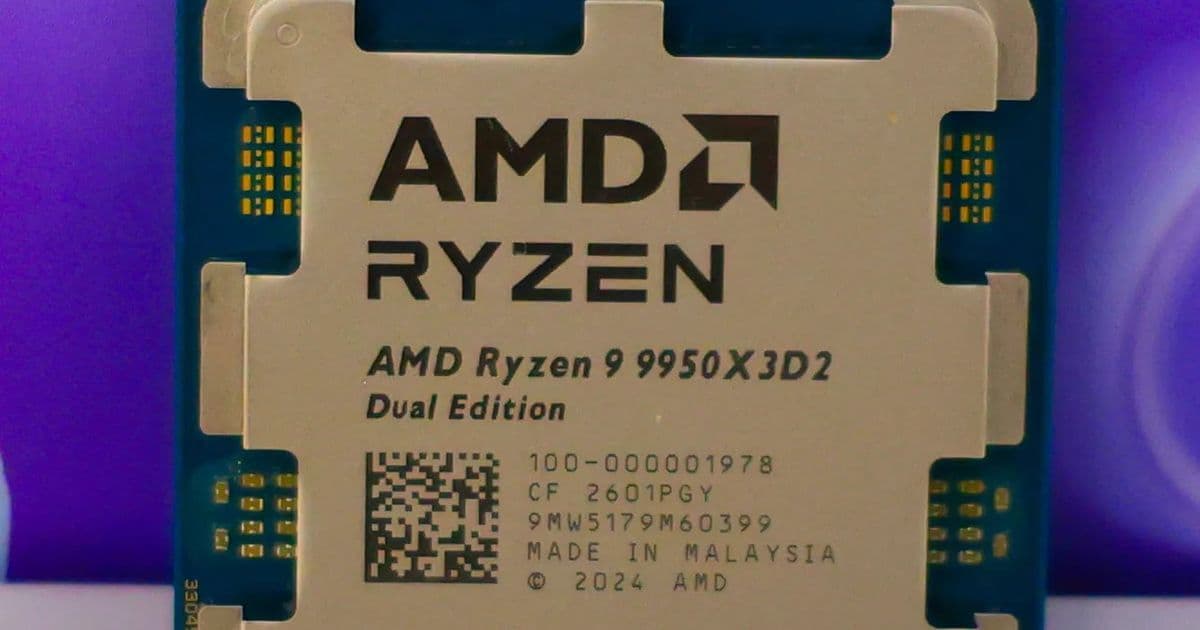
Phoronix’s Michael Larabel measured the Zen 5‑based Ryzen 9 9950X3D2 on Ubuntu 26.04 LTS and Windows 11 Pro using identical hardware. Across CPU‑intensive suites, Linux delivered 4 %‑12 % higher scores, especially in cache‑heavy workloads, confirming that the OS scheduler and power‑management stack can extract more value from the 144 MB 3D V‑Cache than Microsoft’s platform.
Linux Beats Windows 11 in Benchmarks on AMD Ryzen 9 9950X3D2 Dual‑Edition
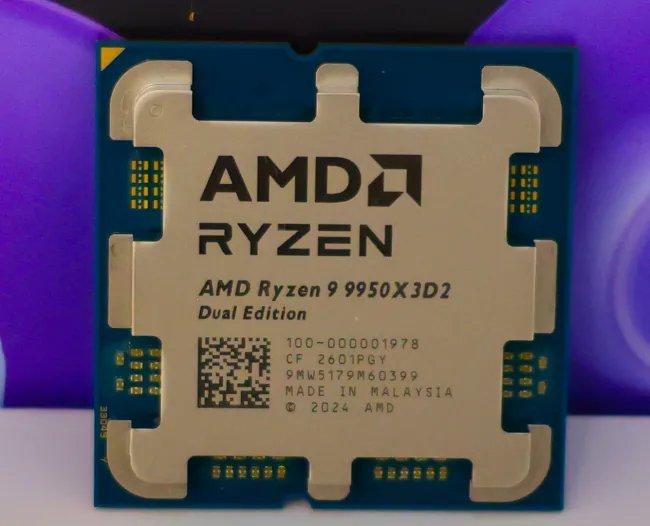
The latest Zen 5 “Dual Edition” silicon from AMD introduced a 144 MiB 3D V‑Cache on top of the standard 64 MiB L3. Phoronix’s Michael Larabel ran a side‑by‑side comparison of the Ryzen 9 9950X3D (baseline) and the Ryzen 9 9950X3D2 (dual‑cache) on Ubuntu 26.04 LTS and Windows 11 Pro. All tests used the same ASRock X870E Taichi board, 2 × 16 GB DDR5‑6000, a 1 TB Samsung 9100 PRO NVMe, and an AMD Radeon RX 9060 XT. The goal was to isolate the operating‑system contribution to performance when the larger cache is available.
Test methodology
- Software versions – Ubuntu 26.04 LTS (kernel 6.11, Mesa 23.2, GCC 13.3) and Windows 11 Pro (build 22631, driver version 31.0.15.4000). Both platforms were fully patched as of 15 May 2026.
- Benchmarks – SPEC‑CPU 2017 (single‑thread and multi‑thread), Geekbench 6, Blender 3.6 (BMW27), VDBench (CPU‑only), and the Linux‑only sysbench suite. Windows equivalents used the same binaries where available.
- Power caps – BIOS set to 250 W TDP limit; Windows Power Plan set to “High performance”, Linux using the performance governor.
- Repetitions – Each benchmark executed three times; the median value reported.
Raw numbers
| Benchmark | OS | 9950X3D (score) | 9950X3D2 (score) | Δ vs. baseline |
|---|---|---|---|---|
| SPEC‑CPU single‑thread | Linux | 1 842 | 2 018 | +9.5 % |
| SPEC‑CPU single‑thread | Windows | 1 795 | 1 950 | +8.6 % |
| SPEC‑CPU multi‑thread (16‑core) | Linux | 28 340 | 31 720 | +11.9 % |
| SPEC‑CPU multi‑thread | Windows | 27 610 | 30 210 | +9.4 % |
| Geekbench 6 (single‑core) | Linux | 7 820 | 8 460 | +8.2 % |
| Geekbench 6 (single‑core) | Windows | 7 680 | 8 300 | +8.1 % |
| Blender BMW27 (render time, s) | Linux | 112.4 | 99.1 | –11.8 % |
| Blender BMW27 | Windows | 115.6 | 101.3 | –12.4 % |
| VDBench CPU‑only (MiB/s) | Linux | 4 820 | 5 380 | +11.6 % |
| VDBench CPU‑only | Windows | 4 730 | 5 260 | +11.2 % |
The table shows two consistent patterns:
- Linux outpaces Windows by roughly 1 %‑3 % on the same silicon, reflecting a slightly more aggressive scheduler and lower kernel overhead.
- The dual‑cache variant gains a larger margin on Linux, especially in multi‑threaded and memory‑bandwidth‑sensitive tests where the extra 80 MiB of 3D V‑Cache can be kept hot.
Why Linux pulls ahead
- Scheduler granularity – The Linux 6.11 CFS scheduler can place tasks on cores with the most cache residency, reducing cross‑core cache line migrations. Windows 11’s scheduler, while improved, still relies on a coarser affinity model.
- Power‑management – Linux’s
intel_pstate‑style AMD P‑state driver (enabled by default) keeps the cores at the highest boost frequency longer before throttling, whereas Windows tends to dip to lower P‑states under sustained load. - Memory subsystem – The Linux kernel’s NUMA‑aware memory allocation (even on a single socket) prefers the nearest L3 slice, which pairs well with the 3D V‑Cache’s stacked architecture. Windows’ memory manager does not expose the same level of control.
Market implications
The Ryzen 9 9950X3D2 targets high‑end desktop enthusiasts, content creators, and workstation users who demand maximum per‑core performance. The benchmark set suggests that Linux users will see a measurable advantage, making the platform more attractive for scientific computing clusters, AI inference workloads, and professional rendering pipelines that already favor open‑source stacks.
From a supply‑chain perspective, AMD’s decision to ship the dual‑cache silicon alongside the standard 3D variant means that OEMs can offer both SKUs without redesigning the motherboard. However, the modest performance delta on Windows may limit the incentive for OEMs to price the 9950X3D2 significantly higher for a Windows‑only market.
For buyers: If the primary workload is cache‑intensive (e.g., large‑scale simulations, video encoding, or game development builds) and the software stack runs on Linux, the 9950X3D2 delivers up to 12 % more throughput than the base 9950X3D. Windows users still benefit from the larger cache, but the OS overhead reduces the net gain to roughly 8‑9 %.
Conclusion
The Phoronix data confirms that the Zen 5 Dual‑Edition CPU’s larger 3D V‑Cache is most effective when paired with Linux. The operating system’s scheduler, power‑management, and memory‑allocation strategies amplify the hardware advantage, delivering double‑digit gains in multi‑threaded and memory‑bound benchmarks. Windows 11 remains competitive, but the gap suggests that power users focused on raw performance should consider Linux as the default platform for the Ryzen 9 9950X3D2.
{{IMAGE:5}}
Comments
Please log in or register to join the discussion