After two consecutive Intel 285K CPU failures in his high-end Linux workstation, a seasoned developer switches to AMD's Ryzen 9950X3D. Detailed benchmarks reveal 10-15% performance improvements in compilation workloads, but with a 20-25% increase in power consumption across all operating states.
For Linux power user Michael Stapelberg, Intel's flagship 285K processor became a recurring nightmare. His second CPU failure during a routine CUDA compilation job on NixOS—where the system became unresponsive with fans at maximum speed—marked the final straw. 'After reading electronics store reviews filled with similar CPU replacement stories, I concluded Intel's current generation lacks stability,' Stapelberg wrote in his technical postmortem.
The Fatal Workload
The failure occurred during a document processing batch job using layout-parser and tesseract. Though initially suspected as a Linux kernel issue, the 4-hour, 300W workload (peaking at 100°C) ultimately revealed underlying hardware fragility. Stapelberg emphasized these temperatures fell within Intel's 110°C specification, and proactive room cooling (25-28°C ambient) ruled out Europe's heat wave as the primary culprit.
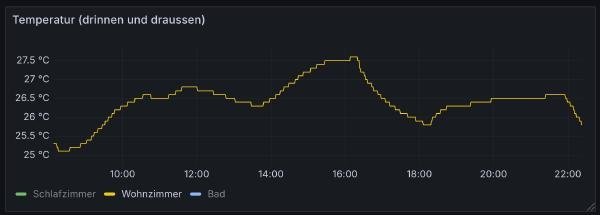 Temperature data from HomeMatic sensors showed controlled ambient conditions during the fatal workload
The AMD Alternative
Stapelberg selected AMD's Ryzen 9 9950X3D for its dual advantages: raw speed and Linux 6.13+'s cache/frequency core scheduling. Paired with an ASUS TUF X870+ motherboard (chosen for single-chipset efficiency), the new setup delivered measurable gains:
| Workload | Intel 12900K (2022) | Intel 285K (2025) | AMD 9950X3D (2025) |
|---|---|---|---|
| Go 1.24.3 compilation | ≈35s | ≈26s | ≈24s |
| gokrazy/rsync tests | ≈0.5s | ≈0.4s | ≈0.5s |
| Linux kernel compilation | 3m 13s | 2m 7s | 1m 56s |
The Power Trade-off
Stapelberg's meticulous power measurements revealed AMD's operational cost:
| CPU | Mainboard | Idle Power | Idle + Monitor |
|---|---|---|---|
| Intel 12900K | ASUS PRIME Z690-A | 40W | 60W |
| Intel 285K | ASUS PRIME Z890-P | 46W | 65W |
| AMD 9950X3D | ASUS TUF X870-PLUS WIFI | 55W | 80W |
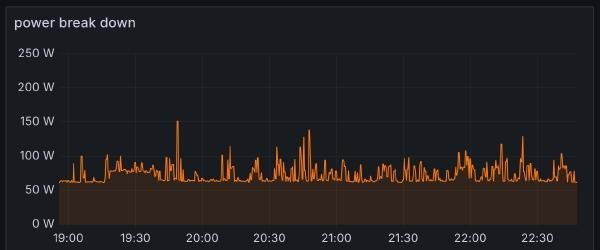 Intel 285K power profile showing lower baseline consumption
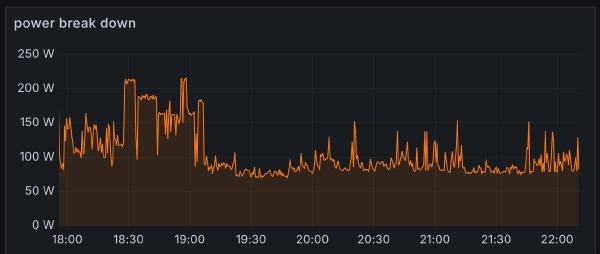 AMD 9950X3D exhibiting higher baseline and sustained load spikes
Household energy monitoring showed a 10-20% daily increase (9 kWh → 10-11 kWh) post-switch. While AMD delivered faster builds, its higher idle draw and aggressive boost behavior impact both electricity costs and thermal management.
Shifting Loyalties
Stapelberg's move ends a 17-year Intel preference driven by Linux compatibility and efficiency. 'From mobile CPUs in desktop cases to the i9-9900K, Intel enabled high-performance, quiet Linux systems,' he noted. Though disappointed by Intel's reliability regression, he recalls positive AMD experiences dating back to K6 processors and his Ryzen 7 home server.
The switch highlights a pivotal moment for high-performance computing on Linux: raw speed now resides with AMD, but efficiency-minded developers may still hope for Intel's recovery or AMD's power optimizations. As Stapelberg concludes: 'Competition drives innovation—I'd love to see both companies firing on all cylinders again.'
Comments
Please log in or register to join the discussion