Intel launches Arc Pro B70 and B65 workstation GPUs with 32GB VRAM, targeting AI workloads and professional applications with competitive pricing against Nvidia's RTX Pro 4000.
Intel is expanding its Arc Pro lineup with two new Battlemage-based GPUs that bring significantly more memory and compute power to professional workloads. The Arc Pro B70 and B65 cards target AI inference, content creation, and other professional applications rather than gaming, marking Intel's first deployment of larger Battlemage silicon configurations.
Arc Pro B70: 32GB VRAM and 22.9 TFLOPS of FP32 Performance
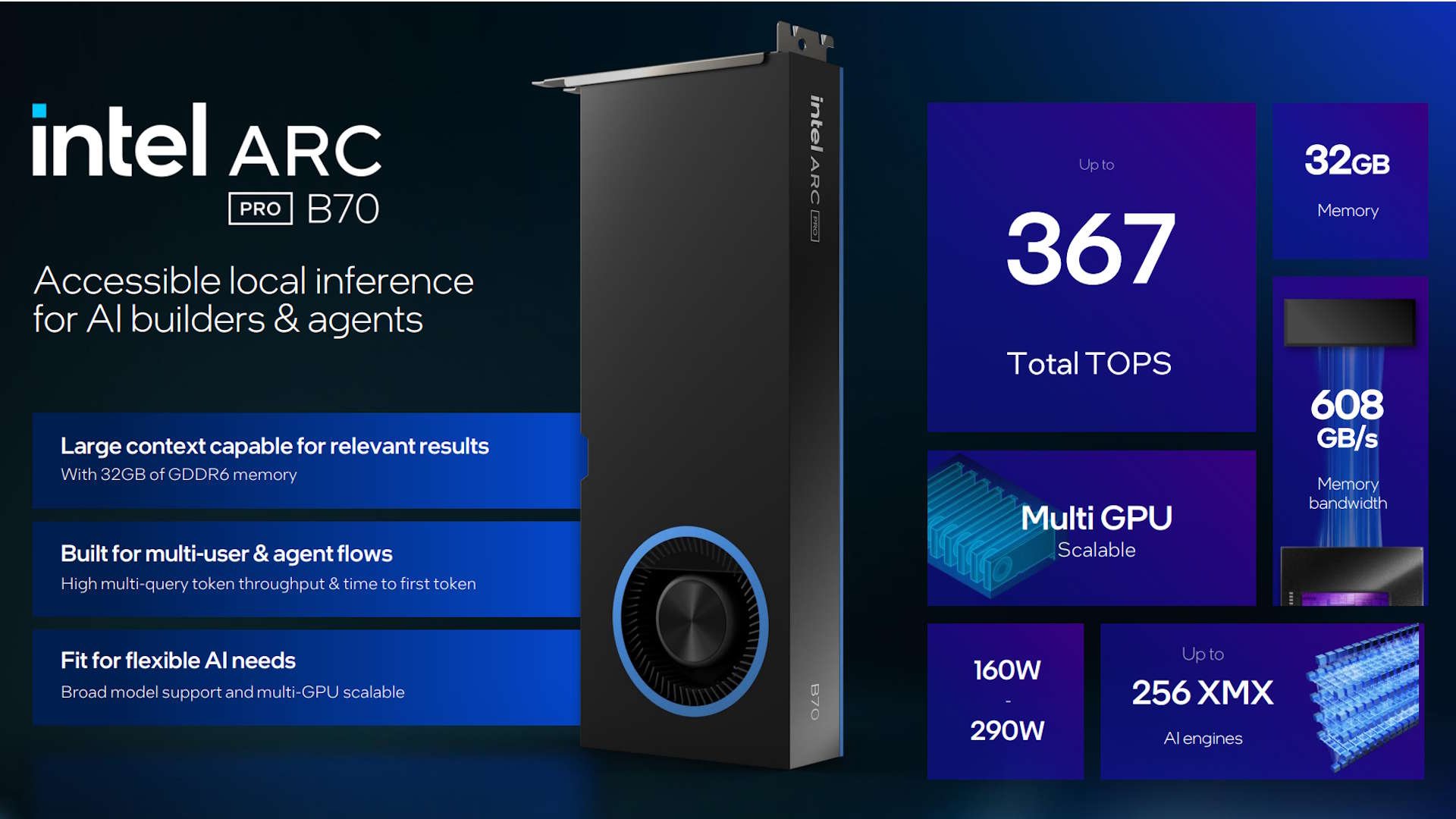
The Arc Pro B70 represents Intel's most powerful professional GPU to date. It features 32 Xe Cores running at 2800 MHz, delivering 22.9 TFLOPS of FP32 compute performance. Intel pairs this with 32GB of 19 Gbps GDDR6 memory on a 256-bit bus, providing 608 GB/s of memory bandwidth.
This combination of large VRAM capacity and high memory bandwidth is particularly important for large language model (LLM) inference workloads. Being able to fit both models and context in GPU-local memory is critical for achieving optimal performance in AI applications.
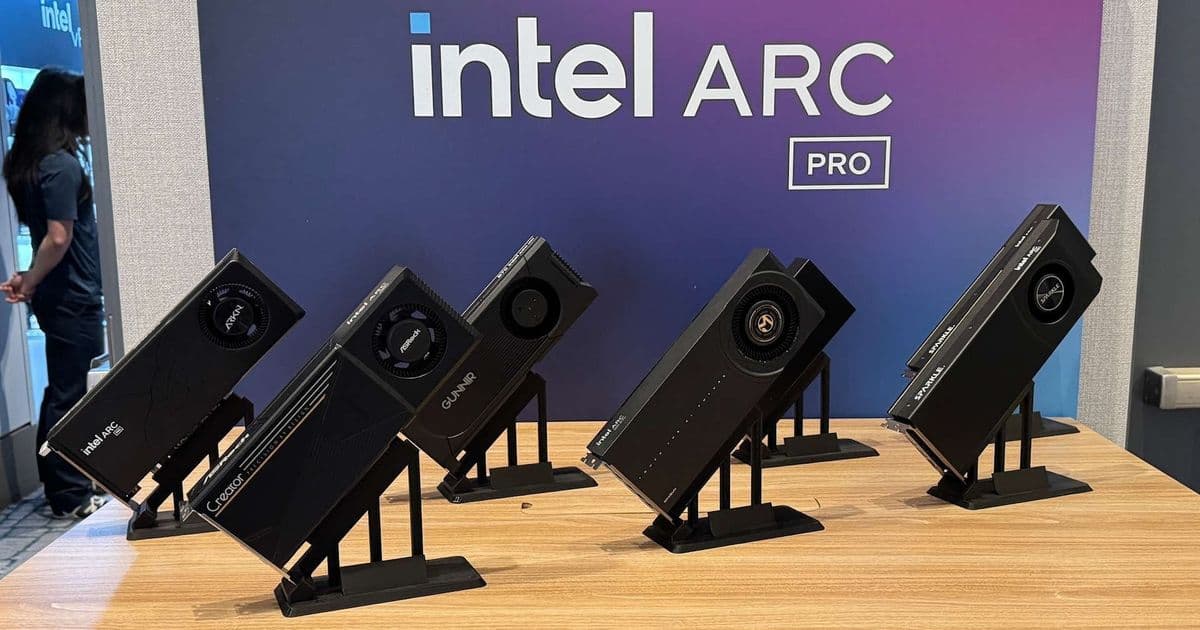
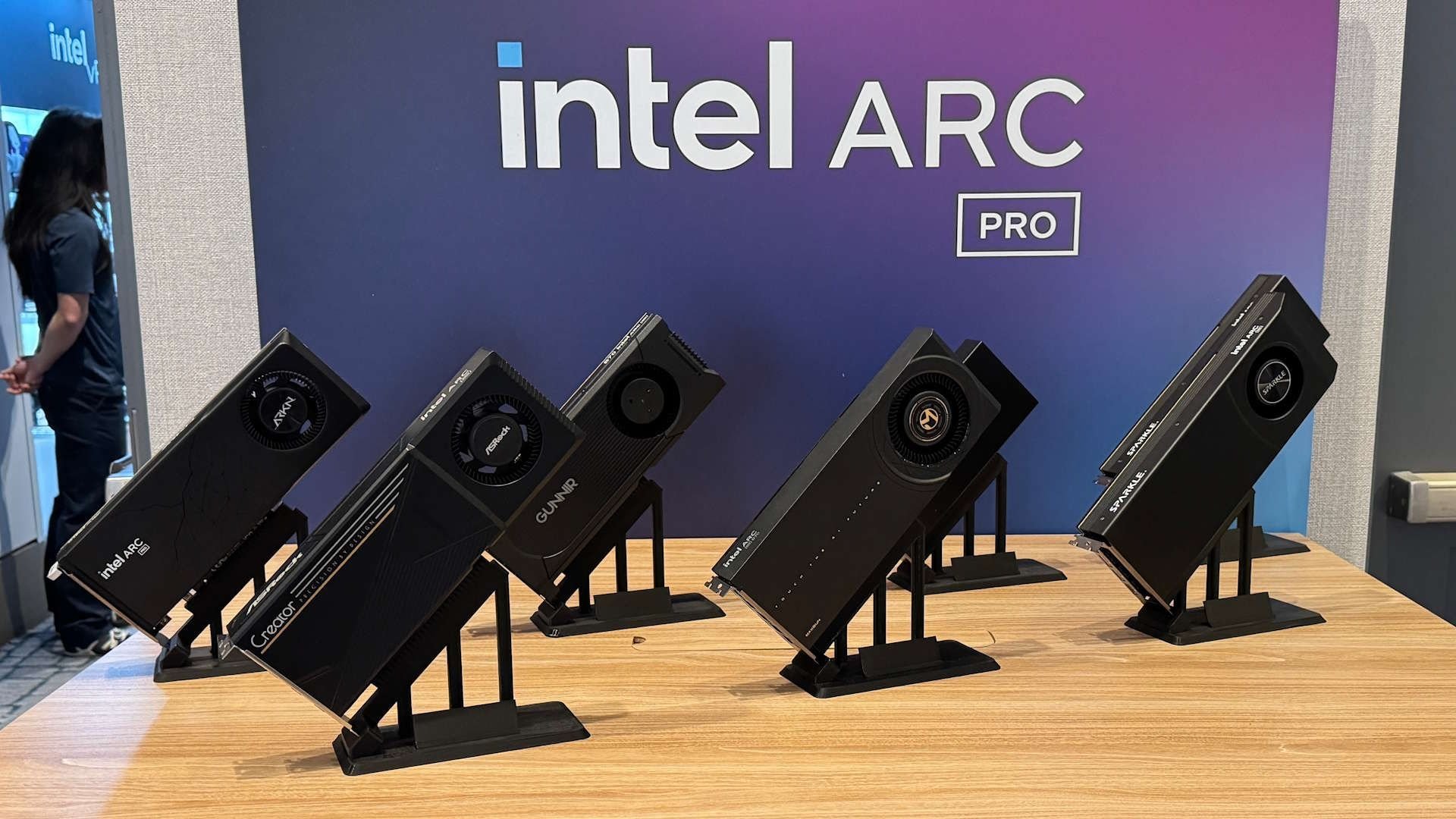
The B70 supports a flexible power envelope ranging from 160W to 290W, accommodating various cooling designs and system form factors. Intel's reference design starts at $949, with partner cards available from ARKN, ASRock, Gunnir, Maxsun, and Sparkle.
Arc Pro B65: Same Memory, Less Compute
Intel is also launching the Arc Pro B65, which maintains the 32GB memory configuration and 608 GB/s bandwidth of the B70 but reduces compute to just 20 Xe Cores. This configuration is essentially identical to the existing Arc Pro B60 at the compute level.
The B65 targets users who need the memory capacity and bandwidth for professional applications but don't require the full compute power of the B70. This could appeal to local LLM enthusiasts seeking maximum memory capacity at a lower price point. Intel hasn't announced pricing for the B65 but says it will be available in mid-April.
Competitive Positioning Against Nvidia's Workstation Lineup
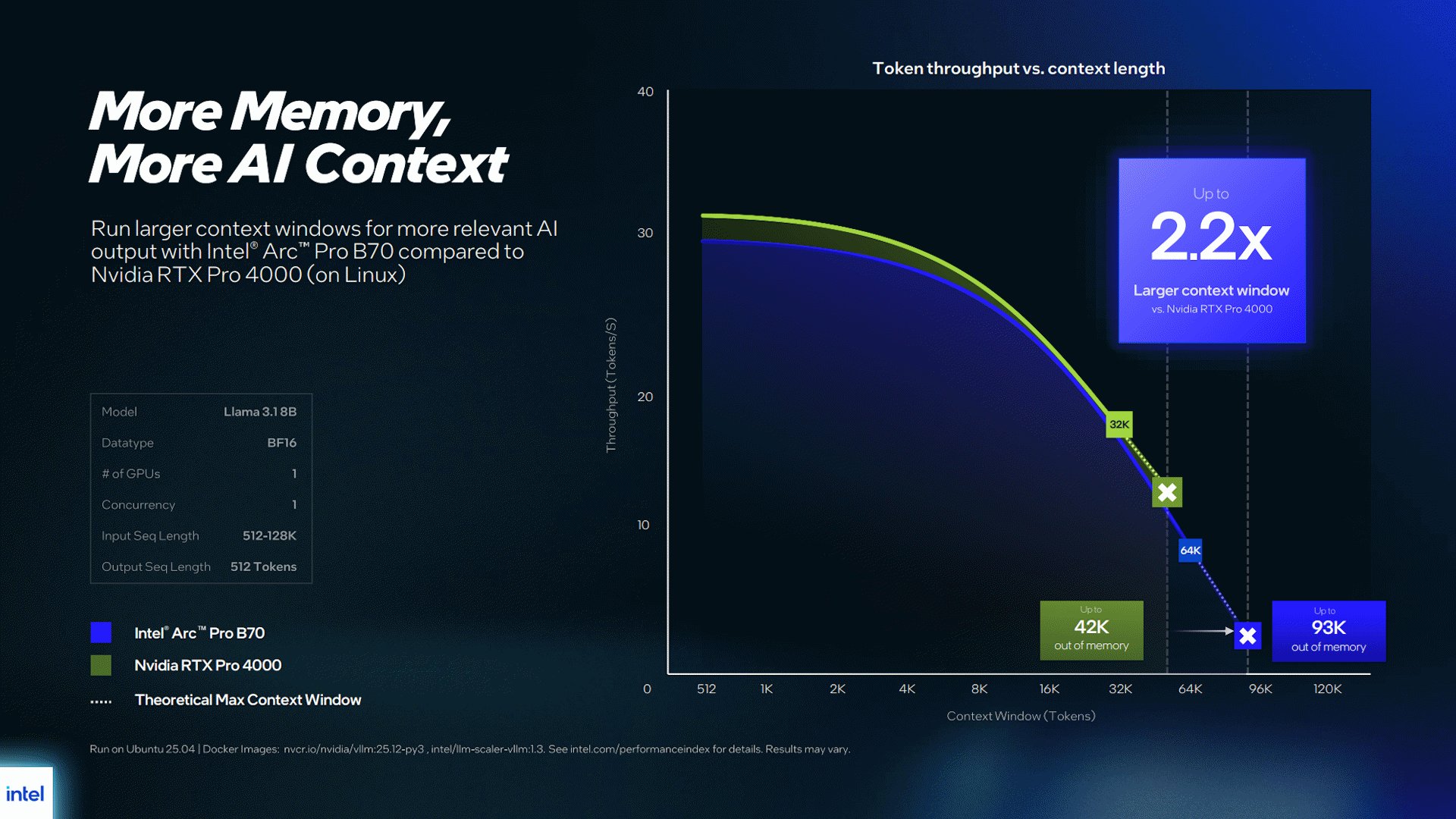
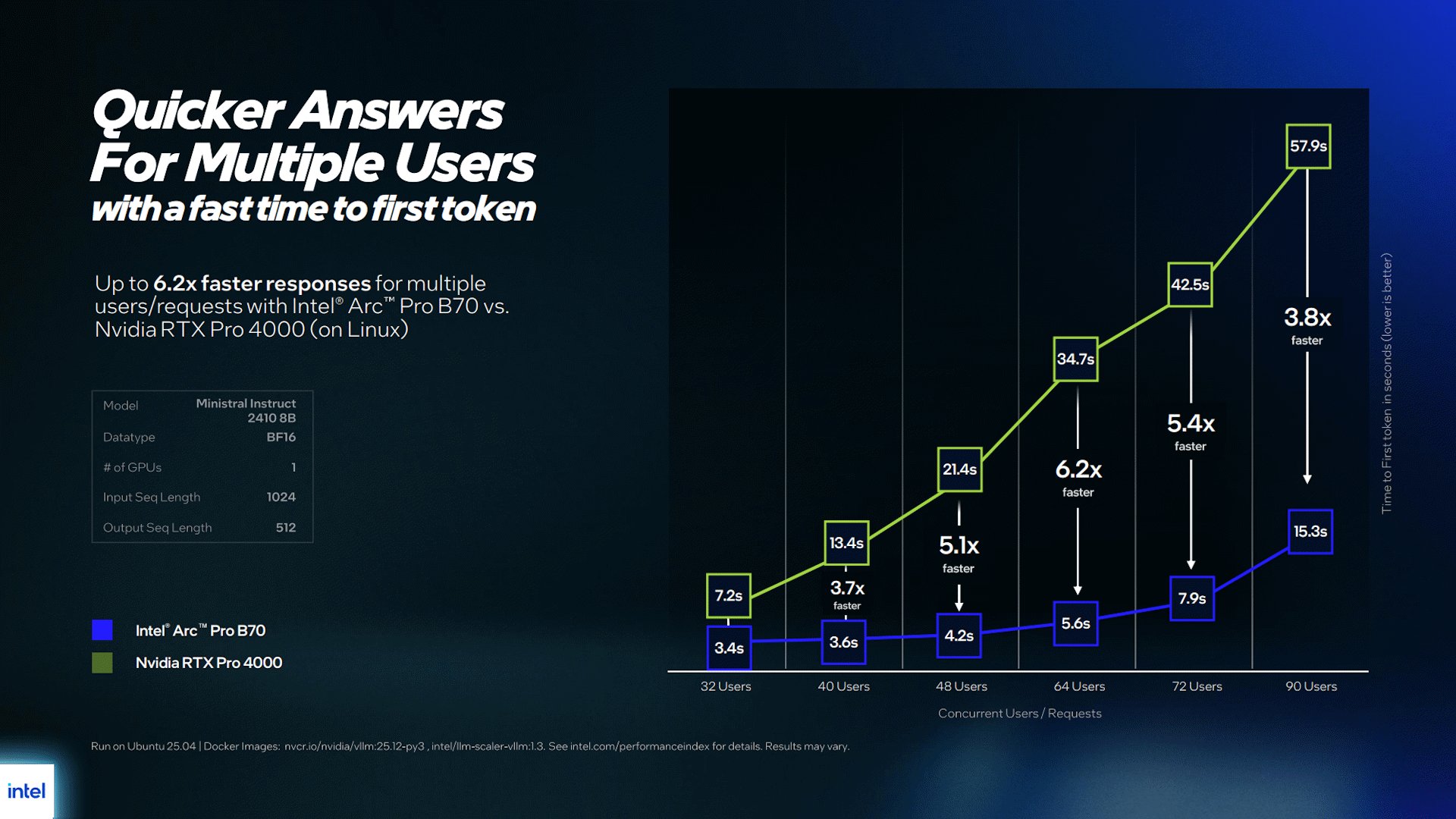
Intel positions the B70 against Nvidia's $1,800 RTX Pro 4000 24GB, the second-cheapest Blackwell workstation card. Intel highlights several advantages of the B70 in its comparison:
- Larger 32GB vs 24GB memory capacity for bigger context windows
- Better time-to-first-token latency for multiple concurrent users
- Superior cost-per-token across various models
However, the comparison has some limitations. Intel primarily uses BF16 quantization in its benchmarks, which may not reflect the performance advantages of Nvidia's Blackwell cards with lower-precision formats like NVFP4. The XMX matrix acceleration in Battlemage only extends down to FP16 and INT8, while Blackwell supports a much wider range of reduced-precision formats.
Multi-GPU Scaling and Platform Advantages
Intel emphasizes its software stack's multi-GPU support, allowing users to scale up LLM serving across multiple Arc Pro cards. This approach can increase memory capacity for larger context windows, bigger models, or both. Intel's presentation showed configurations extending up to four GPUs.
From a pure cost perspective, the B70's $949 price point makes it an attractive option. Any number of B70s would cost less than a single RTX Pro 4000, resulting in a lower cost-per-token calculation. The B70 also undercuts AMD's $1,299 Radeon AI Pro R9700, another option for 32GB local AI cards.
Software Ecosystem and Market Considerations
Despite the hardware advantages, Intel faces significant challenges in the AI and professional GPU market. Nvidia's CUDA ecosystem remains dominant, and buyers considering Arc Pro solutions must account for potential time and costs involved in handling application support and stability issues.
For organizations just starting experimental on-premise AI servers for local usage, Intel's platform offers a relatively low cost of entry. However, more experienced AI developers looking to scale applications both locally and in the cloud will likely prefer Nvidia's offerings for compatibility, scalability, and total cost of ownership reasons.
Gaming Market Implications
The decision to target professional and AI markets with these larger Battlemage configurations has implications for gaming enthusiasts. Given current silicon and memory supply constraints, combined with the midrange performance these GPUs might achieve in gaming scenarios, Intel likely cannot sell gaming-focused versions of this silicon profitably.
The AI and professional markets allow for higher prices and better margins, aligning with Intel CEO Lip-Bu Tan's stated goals for the company. While anything could happen in the dynamic tech landscape, these larger Battlemage GPUs appear destined to remain in professional applications rather than gaming rigs.
The Arc Pro B70 and B65 represent Intel's most significant push into the professional GPU market to date, offering competitive specifications and pricing for AI and content creation workloads. Whether this strategy will help Intel gain meaningful market share against Nvidia's entrenched position remains to be seen, but it provides more options for professionals and AI developers working with Intel's hardware-software stack.
Comments
Please log in or register to join the discussion