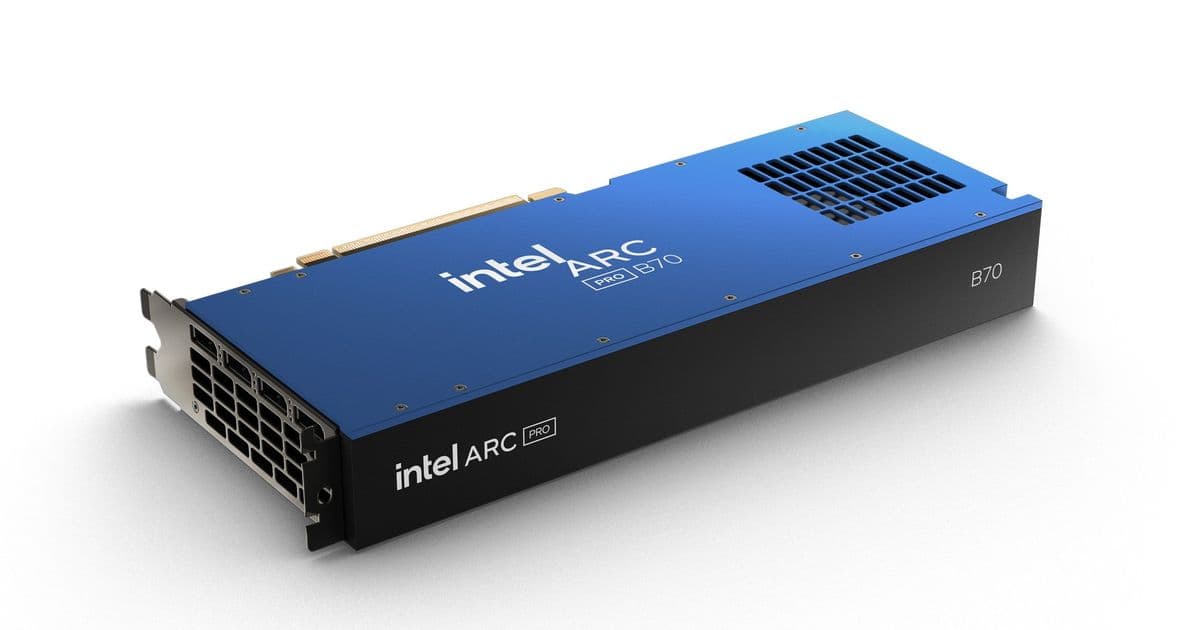
Intel's new Arc Pro B70 and B65 cards bring 32GB of VRAM to budget-conscious AI developers, challenging NVIDIA and AMD's higher-priced workstation offerings.
Today Intel is expanding their Arc B-series video card lineup in a big way, with the launch of a pair of new Arc Pro graphics cards: the Arc Pro B70 and the Arc Pro B65. Joining Intel's existing Arc Pro B-series video cards, the latest cards out of Intel are also the company's most powerful cards yet, reaching significant new highs in performance and memory capacity for Intel's Arc graphics series.
The latter point is especially important given the target workstation audience: with Intel offering 32GB of VRAM on both cards, the company is positioning these as a more budget-friendly option for AI developers than rival cards from NVIDIA and AMD.
Big Battlemage Under the Hood
Diving right in, the Arc Pro B70 and Arc Pro B65 are Intel's new mid-to-high-end champion cards for the professional market. Strictly speaking, these cards are designed for both graphics work and GPU/AI compute. But being pragmatic here during a time of seemingly insatiable demand for AI hardware, Intel is pitching these cards at the AI market first and foremost.
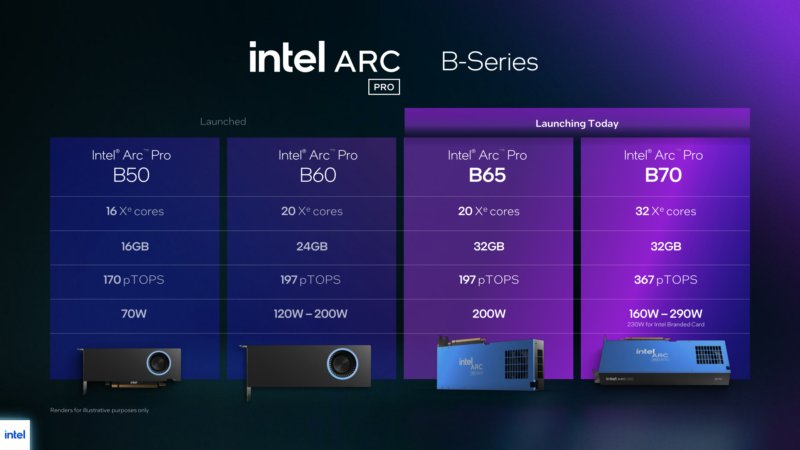
Under the hood, both of these cards are based on Intel's previously elusive "Big Battlemage" GPU – also known as BMG-G31 – which is Intel's largest Battlemage architecture configuration. G31 itself doesn't bring any new features to the Arc Pro family, but it is a larger and more powerful GPU than the G21 GPU used in Intel's other discrete products, meaning it brings more performance to the table in virtually every way.
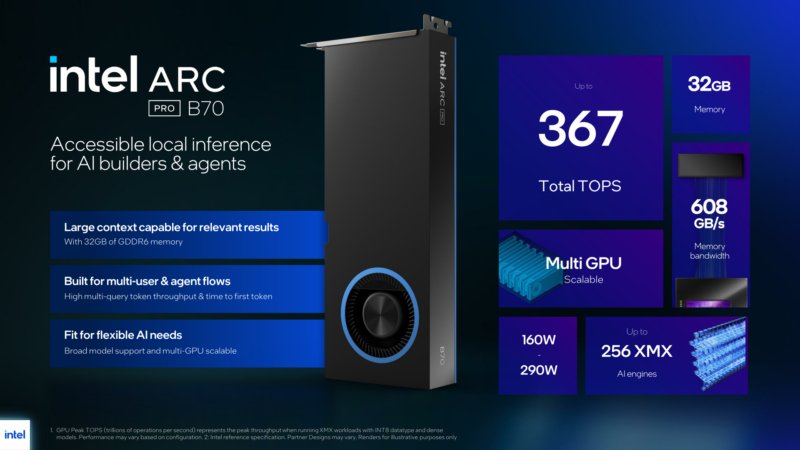
On the compute front, G31 scales Battlemage up to 32 Xe cores and 32 ray tracing units, all of which are enabled on the Arc Pro B70, while Arc Pro B65 gets 20 cores. Meanwhile both of the new Arc Pro video cards get access to the full compliment of memory the GPU can be paired with, which is 32GB of GDDR6 memory that is attached to a 256-bit memory bus and running at 19Gbps – or a total memory bandwidth of 608GB/second.
And, being that these are Pro cards, they also come with Intel's workstation-grade features such as (soft) ECC memory support, as well as support for SR-IOV, which is something that tends to be of particular interest to homelab users.
Power and Professional Features
As for power usage, both cards are rated to draw on the order of a couple hundred Watts of power. Intel's reference Arc Pro B70 card carries a 230W TDP rating, while AIB partner cards can be configured anywhere between 160W and 290W. Meanwhile the Arc Pro B65, which doesn't have an Intel reference card, has a single design point of 200W.
Overall, the memory capacity for these cards is arguably Intel's biggest strength right now. As a result, that is what Intel is banking on to help sell these cards. NVIDIA and AMD have a deeper product stack and more powerful cards overall, but their respective 32GB Pro cards start at $1350 and $3000 respectively, Intel's $949 B70 is well positioned to be a budget-friendly play, and B65 will be even cheaper still.
Competitive Positioning: More Memory for More AI
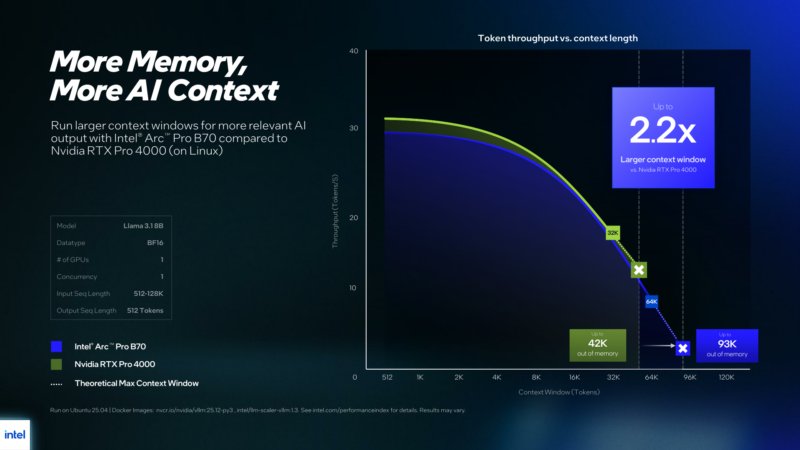
With an edge on memory capacity, Intel is pushing the new Arc Pro cards hard for the AI market, where top-capacity cards have been in high demand for years now. As Intel sees it, having the edge in memory capacity potentially gives them a significant advantage in AI inference performance, as it allows for larger models and/or a larger context window to be stored locally on the card.
Compute performance outside of memory-bound scenarios is going to be a bit more of a mixed bag, however. At a peak theoretical throughput of 367 TOPS for INT8 (non-sparse) precision, on paper Intel is more than competitive on an iso-precision basis. However, the Battlemage architecture lacks FP4 support (a limitation AMD shares), which means that Intel can't match NVIDIA's low-precision throughput – a feature that NVIDIA has been heavily investing into with this generation. As a result, Intel is still on the outside looking in, in some respects.
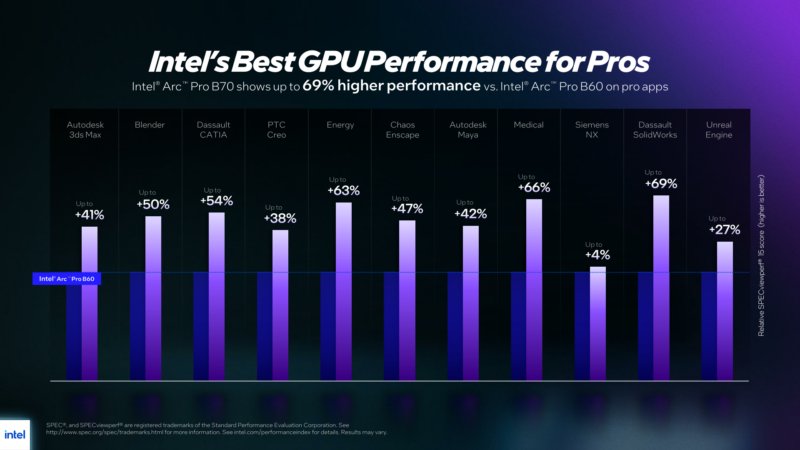
In any case, within the Intel ecosystem the new Arc Pro cards should be a significant step up from their mid-tier counterparts. Under SPECviewperf 15, the Arc Pro B70 delivers a geomean average performance increase of 38% over the existing Arc Pro B60 and a peak performance increase of 69%, well in line with what we'd expect from a larger and better fed Battlemage GPU.
Multi-GPU Scalability for AI Workloads
Besides the performance offered by an individual Arc Pro video card, Intel is also counting on multi-GPU scalability to further carry the cards over the competition. The 32GB of VRAM per card means that it's possible to pool them together as a group of accelerators with 128GB of VRAM, which is the magic number for running the larger version of several inference models. As well as affording for those larger context windows, of course.
Partners, Pricing, and Availability
Somewhat unexpectedly for a high-end workstation card from the smallest of the three vendors, Intel has lined up a pretty sizable contingent of partners who will all be providing their own versions of the Arc Pro B70 alongside Intel's reference card. And in the case of the Arc Pro B65, Intel is leaving things up to partners entirely, meaning they will be making all of the B65 cards we see on the market.
ARKN, ASRock, Gunnir, Maxsun, and Sparkle are all slated to be releasing the new Arc Pro cards.
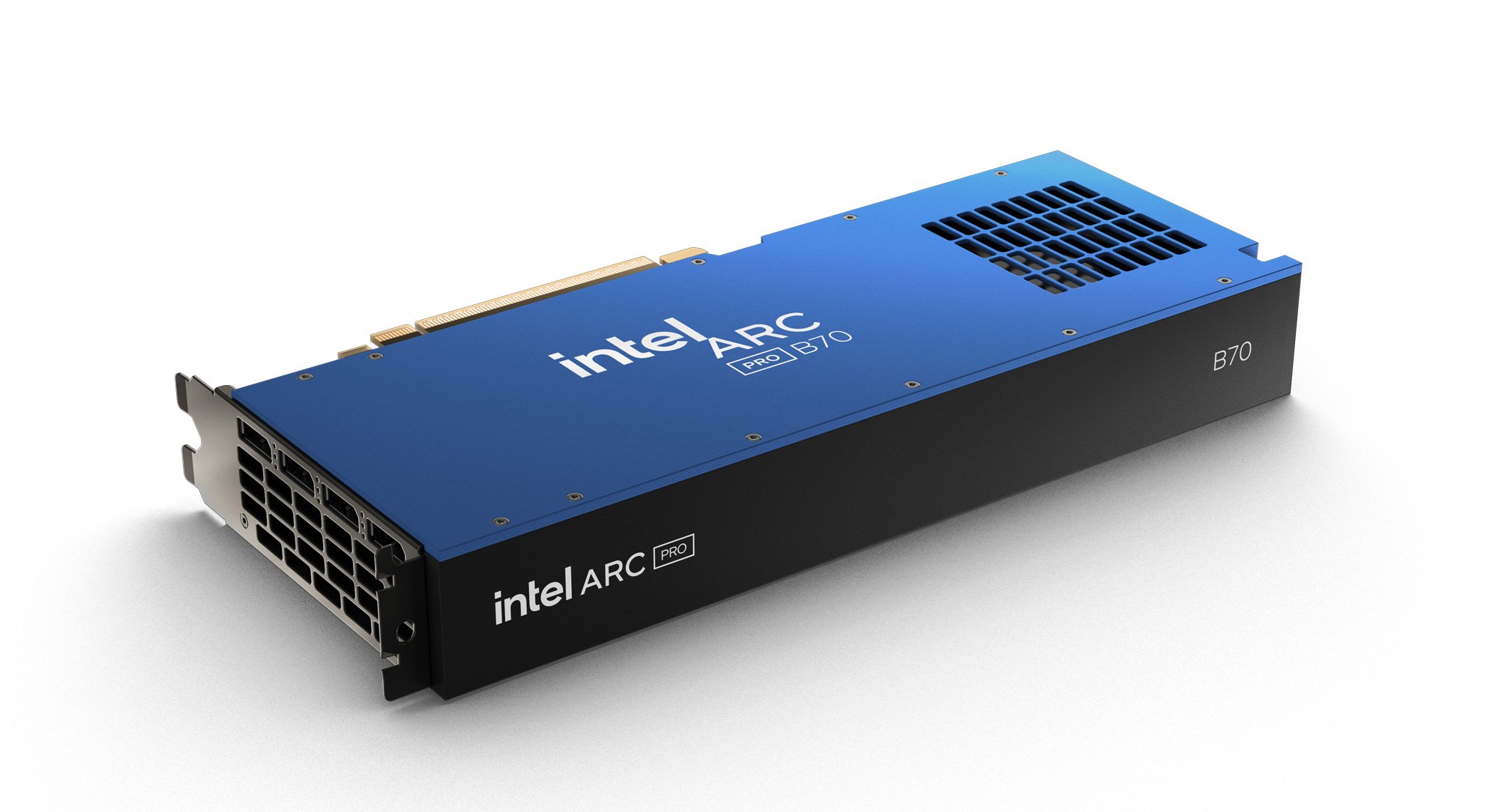
Officially, the Arc Pro B70 is supposed to be available today. But looking around, while Newegg is taking orders for the cards starting today, they won't start shipping from the retailer until next Thursday. Meanwhile the Arc Pro B65 has a looser release date, with Intel stating that the cards will be available starting in mid-April.
Similarly, while the B70 has an anchor price of $950 for Intel's reference card (with AIBs free to set their own prices), Intel isn't giving any formal pricing guidance for the B65. That one will be up to the AIBs to decide on. Though with the Arc Pro B60 currently selling for $660, it wouldn't be surprising to see B65 cards priced in the $700 to $800 range, especially as they have the same 32GB of VRAM as the flagship B70.
Expect to see more on these cards in the coming weeks as the family starts shipping and B65 cards get announced.
Comments
Please log in or register to join the discussion