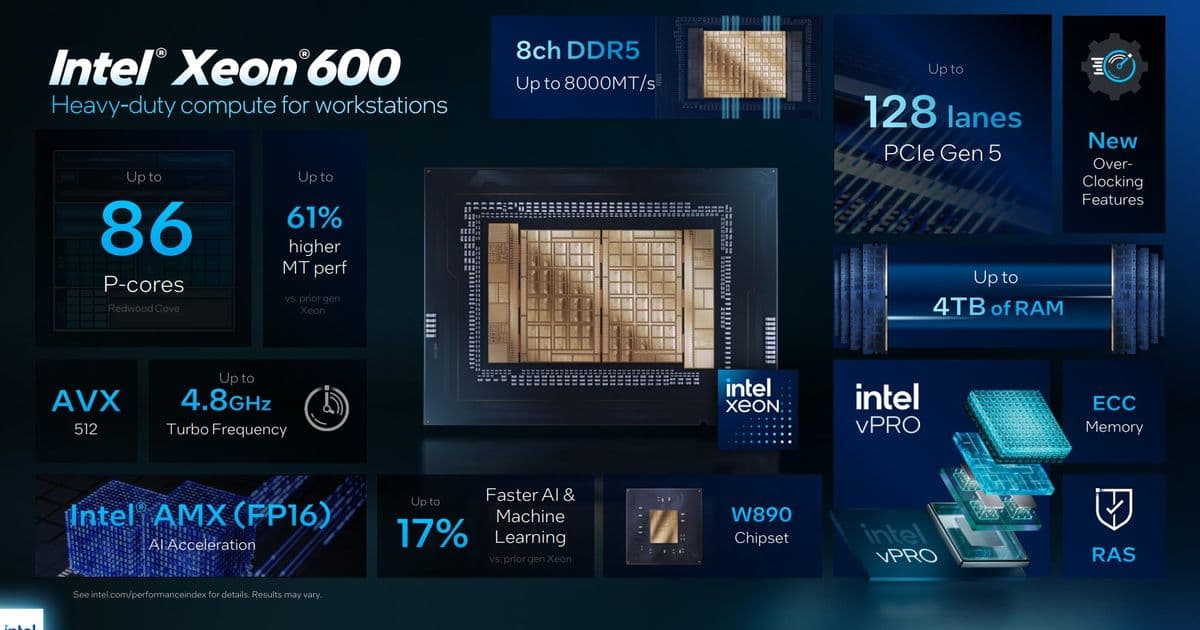
Intel officially releases Xeon 600 workstation CPUs with up to 86 cores and 336MB cache, alongside Core Ultra Series 3 vPro processors for business use, both featuring AI acceleration and the new vPro platform with enhanced security and management capabilities.
Intel has officially launched its Xeon 600 workstation processors and Core Ultra Series 3 vPro CPUs for business use, marking a significant expansion of the company's AI-optimized computing portfolio.
Xeon 600 Workstation CPUs: Up to 86 Cores and 336MB Cache
The Xeon 600 range, previously known as Granite Rapids-WS, includes 11 SKUs with core counts ranging from 12 to 86 cores. The flagship 698X model features 86 Redwood Cove P-cores with Hyper-Threading support, delivering 172 threads of processing power. These chips are built exclusively on Intel's P-core architecture and include Intel AMX for AI acceleration, FP16 support, and AVX-512 capabilities.
Key specifications include:
- Up to 336MB L3 cache on high-end models
- Support for up to 4TB ECC memory across 8 channels at 8000MT/s
- 128 PCIe 5.0 lanes for maximum I/O bandwidth
- Base TDP ranging from 150W to 350W
- Pricing from $499 to $7,699
Core Ultra Series 3 vPro: Panther Lake for Business
Alongside the workstation lineup, Intel is launching Core Ultra Series 3 processors with vPro certification for business use. These chips, formerly known as Panther Lake, are built on Intel's 18A process node and feature the company's first chiplet design for client processors.
Core Ultra Series 3 vPro highlights:
- Up to 16 cores (4 P-cores + 8 E-cores + 4 LP-E cores)
- NPU 5 AI accelerator with up to 50 TOPS performance
- Xe3 integrated graphics with up to 12 cores
- Support for up to 96GB LPDDR5x-9600 memory
- 12 PCIe 5.0 lanes
- Pricing starts at $332 for the Core Ultra 5 332 model
All-New vPro Platform with AI Integration
Intel is introducing an expanded vPro platform that goes "all-in" on AI capabilities. The new platform includes several key enhancements:
vPro Certified Apps and Accessories Program: Intel is partnering with ISVs and OEMs to validate applications and accessories for vPro use. Early results show significant performance improvements:
- Up to 59% reduction in CPU utilization for FlexxAgent
- 56% improvement in power efficiency for Riverbed Aternity
- 74% reduction in background activity for Absolute Secure Endpoint
Intel Device IQ: This new feature collects PC telemetry and applies local AI to trigger remediation directly on devices through partnerships with Lakeside, Riverbed, Control Up, and Flexxible.
Enhanced Security: The platform adds Total Storage Encryption (TSE) and Intel Threat Detection Technology, which uses AI to detect malware in real-time. Additionally, CrowdStrike Falcon Data Protection leverages the onboard NPU to protect sensitive data during AI workloads.
Extended Support: Intel is extending the servicing window for Core Ultra Series 3 machines with vPro to 10 years, providing long-term stability for enterprise deployments.
Market Implications and Availability
The Xeon 600 and Core Ultra Series 3 vPro launches position Intel strongly in both workstation and business PC markets. The company claims up to 61% faster multithreaded performance and 9% better single-threaded performance compared to last-generation Sapphire Rapids-WS chips.
Over 125 designs supporting vPro are in development from major OEMs including Acer, Asus, Dell, HP, Fujitsu, Panasonic Connect, and Dynabook. Commercial systems will begin rolling out on March 31.
The integration of AI acceleration at both the CPU (AMX) and NPU levels, combined with the enhanced vPro platform, demonstrates Intel's strategy to make AI capabilities standard across its enterprise product lines. This approach could prove particularly valuable as businesses increasingly adopt AI-powered applications and require robust security and management features.
With both product lines supporting the latest connectivity standards including Wi-Fi 7 R2, Bluetooth Core 6, and Thunderbolt 4 with Thunderbolt 5 support, Intel is ensuring these platforms remain relevant throughout their extended support lifecycle.
Comments
Please log in or register to join the discussion