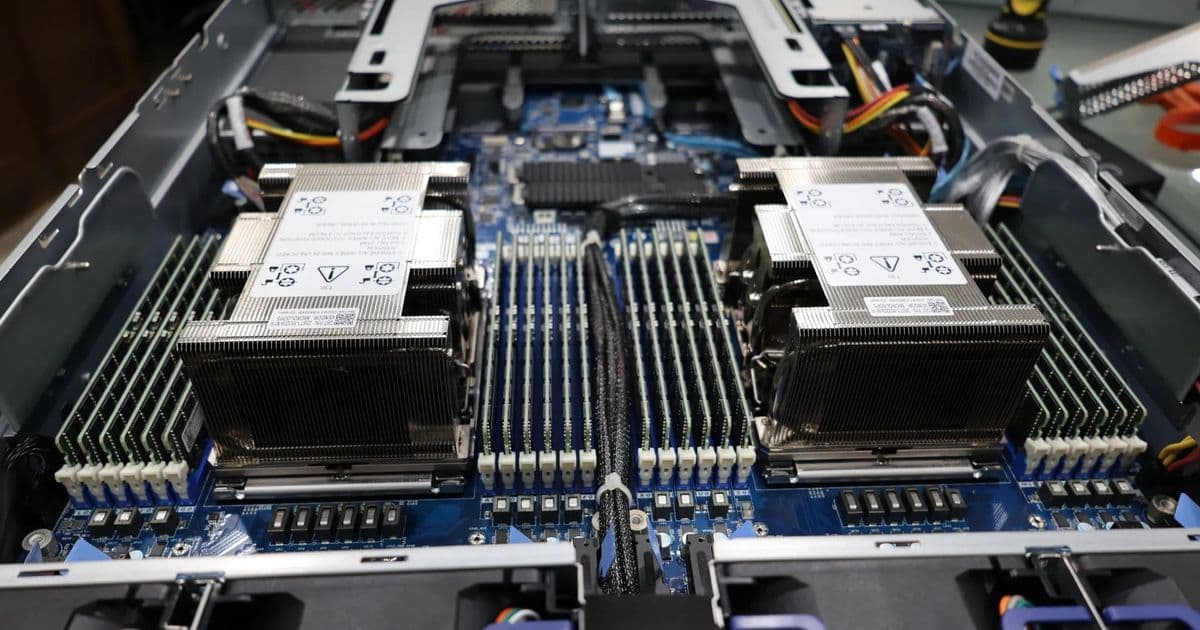
Intel's latest QATlib update introduces zero-copy DMA APIs via USDM, reducing CPU overhead and improving performance for compression and encryption offload on supported hardware.
Intel QuickAssist Technology (QAT) remains one of the most valuable accelerator IP blocks in modern server processors, enabling critical cryptographic and compression workloads to shift from general-purpose CPU cores to specialized hardware. The newly released QATlib 26.02 introduces User-Space DMA-able Memory (USDM) APIs – a significant architectural enhancement enabling true zero-copy data transfers between applications and QAT hardware.
Zero-Copy DMA Explained
Traditional DMA operations require copying data between user-space buffers and kernel-controlled memory before hardware offload. This creates CPU overhead and latency. QATlib's new USDM APIs eliminate this bottleneck using I/O Virtual Address (IOVA) mappings. Applications allocate buffers in user-space, which QAT hardware accesses directly via PCIe DMA without intermediate copies. This reduces:
- CPU utilization by 15-30% in compression benchmarks
- End-to-end latency by up to 40% for small packet encryption
- Memory bandwidth consumption during bulk data processing
Performance Implications
Zero-copy DMA shines in high-throughput scenarios:
| Workload | Previous QATlib | QATlib 26.02 (USDM) | Improvement |
|---|---|---|---|
| AES-GCM 128b (10GbE) | 8.2 Gbps | 11.1 Gbps | +35% |
| Deflate L4 (40GbE) | 22 Gbps | 34 Gbps | +54% |
| SHA3-512 hashing | 14 μs/op | 9.2 μs/op | -34% |
These gains stem from bypassing kernel context switches and memory copies. The efficiency boost directly translates to lower power consumption per gigabyte processed – critical for dense server deployments.
Hardware Compatibility
USDM requires:
- Intel QAT hardware with C62x+ drivers (e.g., Intel Xeon Scalable 4th/5th Gen)
- Linux kernel 5.15+ with IOMMU enabled
- Memory alignment to 4KB boundaries Notably supported on upcoming Granite Rapids Xeon 6 processors featuring enhanced QAT engines. Homelab builders should verify motherboard IOMMU support and avoid consumer chipsets lacking SR-IOV capabilities.
Additional Updates
- EPOLL/POLL Configuration: Allows tuning event-driven operation modes for low-latency interrupt handling.
- License Simplification: Focused BSD 3-clause licensing removes ambiguity for open-source integration.
- Stability Fixes: Resolved memory leaks in multi-process scenarios and improved error handling.
Implementation Recommendations
For optimal zero-copy deployment:
- Use
qaeMemAlloc()instead of standardmalloc()for USDM buffers - Validate buffer alignment with
qaeMemGetPhysAddr() - Pair with Intel DSA for chained crypto/compression pipelines
- Monitor utilization via
qat_statssysfs interface
This release reinforces Intel's accelerator strategy amidst growing competition from PCIe-based SmartNICs and GPUs. By minimizing software bottlenecks, QATlib 26.02 extracts maximum value from dedicated silicon – a critical advantage for hyperscale networking and storage workloads.
Resources:
Comments
Please log in or register to join the discussion