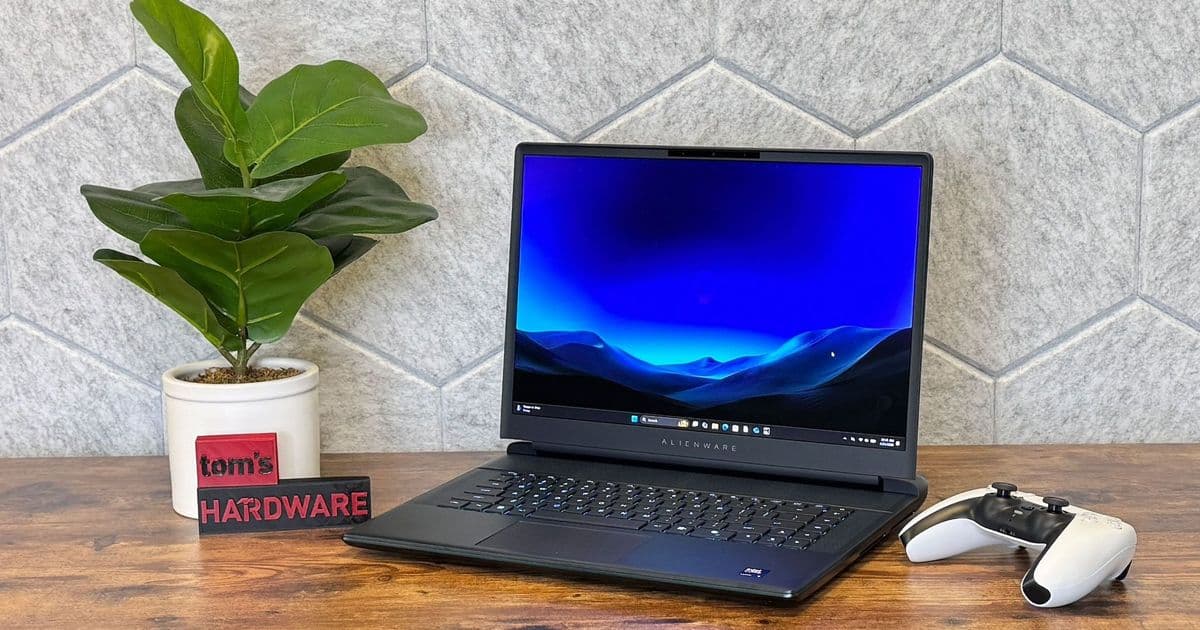
Alienware's latest 16-inch gaming laptop showcases Intel's modest CPU refresh and Nvidia's latest GPU architecture, highlighting the current state of high-performance mobile computing components and their supply chain implications.
The Alienware 16 Area-51 represents the current state of high-performance mobile computing, featuring Intel's latest Core Ultra 9 290HX Plus processor and Nvidia's GeForce RTX 5080 Laptop GPU. This system provides valuable insights into the current semiconductor landscape, where incremental improvements rather than revolutionary changes dominate the market.
Intel's Arrow Lake Refresh: Modest Gains in Mobile Computing
The centerpiece of this year's Alienware update is Intel's Core Ultra 9 290HX Plus, a refreshed version of the Arrow Lake architecture. Our testing revealed only marginal performance improvements over last year's Core Ultra 9 275HX, with Geekbench 6 scores showing single-core increases from 3,126 to 3,216 and multi-core gains from 20,498 to 20,754.
These modest improvements reflect the challenges Intel faces in delivering significant architectural gains with each refresh cycle. The Arrow Lake architecture, built on Intel's 10nm Enhanced SuperFin process, represents a careful balance between performance and power efficiency. The 290HX Plus maintains the same core configuration as its predecessor but benefits from minor clock speed optimizations and architectural tweaks.
In real-world gaming scenarios, the performance difference between this year's and last year's models was negligible. During Resident Evil 9 testing at 1440p with ray tracing enabled, both systems performed within the same frame rate ranges, with the newer model occasionally outperforming by just a few frames per second in specific scenarios.
Nvidia RTX 5080: Mobile GPU Architecture in Focus
The Alienware 16 is equipped with Nvidia's GeForce RTX 5080 Laptop GPU, featuring 16GB of GDDR7 memory, 175W TGP (Total Graphics Power), and a 1,500 MHz boost clock. This GPU represents the upper tier of Nvidia's current mobile offerings, sitting just below the RTX 5090 found in some competing systems.
Our benchmark testing revealed that while the RTX 5080 delivers strong gaming performance, the step-up to the RTX 5090 (as found in the MSI Raider 16 Max HX) provides noticeable gains in most titles. This performance hierarchy reflects Nvidia's strategy of segmenting its mobile GPU offerings to address different market segments and price points.
The GDDR7 memory in the RTX 5080 represents an important advancement in mobile graphics memory technology. With higher bandwidth than previous GDDR6 implementations, GDDR7 helps mitigate the memory bandwidth limitations that have historically constrained mobile GPUs compared to their desktop counterparts.
Manufacturing Process and Thermal Management Challenges
The Alienware 16's thermal management system, featuring four fans, highlights the ongoing challenges in high-performance mobile computing. During our Metro Exodus stress test, the CPU reached average temperatures of 82.8°C, while the GPU maintained 62.11°C. The chassis surface temperatures reached concerning levels, with the keyboard center hitting 105.5°F and the bottom hottest point reaching 114.5°F.
These thermal characteristics underscore the fundamental trade-offs in mobile semiconductor design. As chip manufacturers push for higher performance, the power density increases, making effective thermal management critical. The Alienware's substantial size and weight (7.49 pounds before the power adapter) directly reflect the engineering compromises necessary to manage these thermal constraints.
The system's 360W power adapter further illustrates the power requirements of modern high-performance mobile components, representing a significant portion of the total system weight and bulk.
Memory and Storage: DDR5 and PCIe Gen 5 in Practice
The Alienware 16 features 32GB of DDR5-6400 memory and a 2TB PCIe Gen 5 SSD. Our testing showed the SK Hynix SSD achieving impressive file transfer speeds of 2,738.90 MBps, significantly outperforming many competing systems.
DDR5 memory technology continues to mature, with the 6400 MHz speed representing a sweet spot between performance and power efficiency. The memory subsystem's performance directly impacts gaming frame rates and productivity tasks, making it a critical component in high-end systems.
PCIe Gen 5 storage represents the current state of the art in consumer storage interfaces, offering theoretical bandwidth of up to 14 GB/s. While real-world performance doesn't always reach these theoretical maximums, the technology provides substantial improvements over previous generations, particularly for large file transfers and sequential workloads.
Display Technology Evolution: OLED Enters the Premium Gaming Space
Perhaps the most significant change in this year's Alienware 16 is the introduction of an anti-glare OLED display option. This 16-inch, 2560 x 1600 panel with 240Hz refresh rate represents a significant advancement over previous LCD implementations, offering superior contrast ratios and color reproduction.
Our testing showed the OLED display covering 93.7% of DCI-P3 color volume and 132.2% sRGB, outperforming last year's non-OLED model and the MSI Raider's display in color accuracy. However, the OLED panel measured 368.6 nits of brightness, compared to 515.8 nits in last year's model, reflecting the ongoing trade-offs between OLED technology and brightness requirements.
The inclusion of OLED in premium gaming laptops marks an important shift in display technology, as manufacturers respond to consumer demand for better visual experiences. However, the technology still faces challenges in brightness, power consumption, and potential burn-in concerns that may limit its adoption in mainstream products.
Supply Chain Implications and Market Positioning
The Alienware 16's configuration options, ranging from $1,949.99 to $8,009.99, illustrate the current semiconductor market's segmentation and pricing strategies. The base model features a Core Ultra 7 255HX with an RTX 5060, while the most expensive configuration includes a Core Ultra 9 275HX, RTX 5090, 64GB of RAM, and 12TB of RAID 0 storage.
This pricing strategy reflects the current supply chain dynamics, where high-end components command significant premiums. The availability of Intel's latest HX-series processors and Nvidia's RTX 50-series GPUs appears stable, suggesting that manufacturing processes have matured sufficiently to meet demand for these high-performance components.
The laptop's 3 hours and 33 minutes of battery life represents a regression from last year's model (4:10), highlighting the power demands of current high-performance components. This battery performance is particularly notable given that both systems appear to feature Nvidia's Advanced Optimus technology, suggesting that the performance gains in newer components may come at the cost of power efficiency.
Conclusion: Incremental Advancements in High-Performance Mobile Computing
The Alienware 16 Area-51 exemplifies the current state of high-performance mobile computing, where incremental improvements rather than revolutionary changes define the market. Intel's modest CPU refresh and Nvidia's latest GPU architecture deliver meaningful but not game-changing performance gains, reflecting the maturation of semiconductor manufacturing processes.
The system's thermal characteristics, power requirements, and size limitations underscore the fundamental engineering challenges in mobile computing. As manufacturers push for higher performance, they must balance these factors against consumer demands for portability and battery life.
The introduction of OLED technology in premium gaming laptops represents a significant advancement in display technology, though it still faces challenges in brightness and power consumption. Meanwhile, the memory and storage subsystems continue to evolve, with DDR5 and PCIe Gen 5 representing important steps forward in performance.
In the broader semiconductor landscape, the Alienware 16 reflects a market where component manufacturers are finding it increasingly challenging to deliver exponential performance gains with each generation. Instead, they focus on incremental improvements, efficiency gains, and feature enhancements to drive value in high-end products.
Comments
Please log in or register to join the discussion