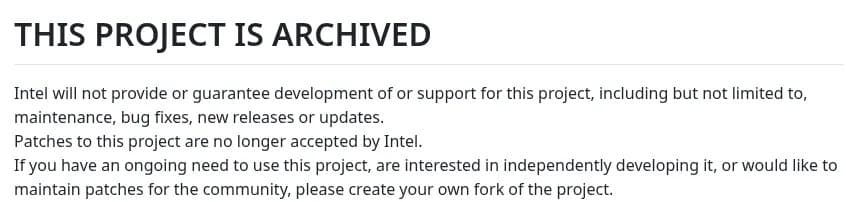
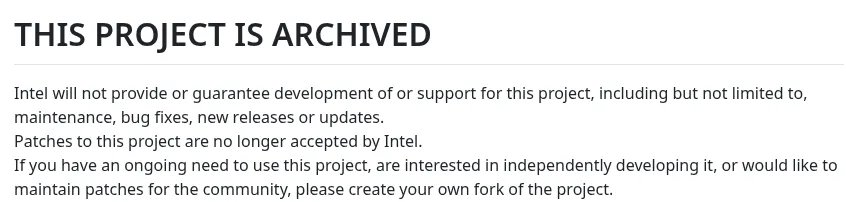
Intel has quietly archived around two dozen open-source projects since late 2025, marking a significant retreat from its once-prominent role in the open-source community as the company faces financial headwinds and workforce reductions.
Intel has significantly scaled back its open-source contributions, archiving approximately two dozen GitHub repositories since late 2025 as part of a broader strategic shift away from peripheral open-source initiatives. The move represents a stark departure from Intel's former position as one of the most active corporate contributors to the open-source ecosystem.
The archived projects span a diverse range of applications, from AI and machine learning tools to developer utilities and benchmarking suites. Among the most notable casualties is GPGMM (General Purpose GPU Memory Management), a C++ library designed for modern graphics and compute APIs that was sunset just this past week. The library served as a memory management solution for applications and runtimes working with contemporary GPU workloads.
Another significant project to meet its end was Polite Guard, an NLP language model Intel announced nearly a year ago for classifying text as polite or impolite. While not central to Intel's core semiconductor business, the company had positioned Polite Guard as a tool that could "significantly boost customer satisfaction and loyalty" by ensuring polite text in customer interactions. The project was archived in mid-December alongside many others.
Intel UI Icons, which provided convenient access to Intel's brand icons for web embedding, was shuttered at the end of January. The OpenVINO Extension for Stable Diffusion, which showcased Intel's OpenVINO AI toolkit for use with the popular image generation model, also met the same fate despite OpenVINO itself remaining actively maintained.
Some of the archived projects had considerably longer histories. HiBench, a big data benchmarking suite for Hadoop and similar technologies that Intel had maintained for 14 years, was discontinued just before Christmas. Node-DC-EIS, which provided Data Center Employee Information Services in Node.js to showcase Xeon processor workloads, had been active for a decade before being archived.
The open-omics-scanpy project, providing scalable single-cell analysis code in Python, and various OP-TEE (Open Trusted Execution Environment) projects were also among those discontinued. The OP-TEE discontinuation included both release binaries and the out-of-tree OP-TEE Linux driver.
While some projects like FineIBT Userspace had seen their work largely upstreamed before archiving, and others like VCDP linux-kmd represented out-of-tree media driver code of lesser importance, the collective impact represents a significant contraction of Intel's open-source footprint.
The timing of these archivals is particularly noteworthy, coming in the wake of Intel's Open-Source Strategy Is Changing At Odds With The Ethos Of Open-Source, which documented the company's shifting approach to open-source development. The discontinuation of projects follows other recent open-source setbacks, including the abandonment of Clear Linux and the Gaudi user-space code.
Industry analysts suggest the move reflects Intel's current financial challenges and workforce reductions. Many of these projects had become unmaintainable or had gone months without code commits before formal archiving. As Intel faces difficult headwinds in its core business, maintaining peripheral open-source projects that weren't central to its semiconductor operations has become increasingly untenable.
The retreat marks a significant shift for a company that was once celebrated as one of the most significant contributors to the open-source ecosystem. While Intel maintains that critical projects like OpenVINO will continue to receive support, the archiving of these two dozen projects signals a more selective and strategic approach to open-source engagement moving forward.
The full list of archived projects includes:
- GPGMM (General Purpose GPU Memory Management)
- Polite Guard (NLP language model)
- Intel UI Icons
- OpenVINO Extension for Stable Diffusion
- HiBench (big data benchmarking suite)
- Node-DC-EIS (Data Center Employee Information Services)
- open-omics-scanpy (single-cell analysis)
- OP-TEE Release Binaries
- FineIBT Userspace
- VCDP linux-kmd (media driver code)
- And numerous other lesser-known or never-completed projects
The move raises questions about the future of corporate open-source contributions in an era of economic uncertainty and strategic refocusing, particularly for companies facing significant challenges in their core markets.
Comments
Please log in or register to join the discussion