After a year of blanket D3cold disablement due to stability issues, Intel's Linux driver will restore the power-saving feature for most Battlemage GPUs while maintaining the block on problematic NUC platforms.
Intel is preparing to restore D3cold support for most Battlemage GPUs in the upcoming Linux kernel cycle, marking a significant shift from the blanket disablement that has been in place for the past year. The change addresses stability issues that previously made the deep-sleep power state transition problematic for Intel's Arc B-Series graphics cards.
The D3cold Dilemma
D3cold represents the lowest-power, deep-sleep substate of D3, allowing GPUs to enter an extremely low-power mode when idle. However, when Intel first enabled Battlemage support in the Linux kernel's Xe graphics driver, stability issues emerged during the D3cold to D0 power state transition. The GPU would become inaccessible, creating a frustrating experience for users.
The initial solution was straightforward but heavy-handed: disable D3cold entirely for all Battlemage GPUs. While this eliminated the stability problems, it also prevented users from benefiting from the power savings that D3cold provides, particularly important for laptop users and energy-conscious desktop builders.
A More Targeted Approach
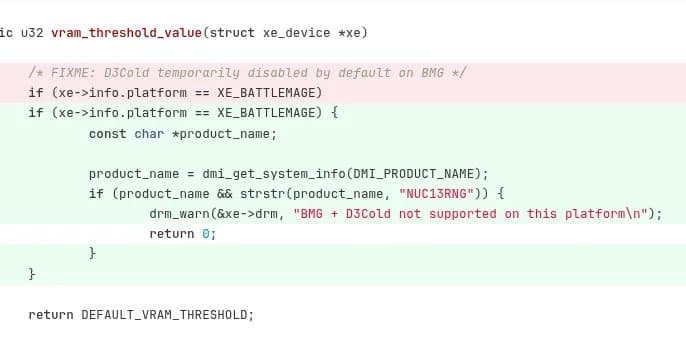
The upcoming Linux 6.20~7.0 kernel cycle brings a more nuanced solution. Rather than maintaining a universal block, Intel's driver developers are implementing platform-specific restrictions. The new approach disables D3cold only on platforms known to have issues, with the NUC13RNG (ASUS NUC 13 Extreme Kit) being the primary exception.
This NUC model, which features a PCIe x16 Gen 5 slot for dedicated graphics, has demonstrated specific compatibility problems with Battlemage GPUs in D3cold mode. By targeting only the problematic platforms, Intel can restore power-saving functionality to the vast majority of Battlemage users while maintaining stability for those few systems that need the restriction.
Testing and Validation
The decision to lift the blanket ban comes after extensive testing on various platforms. According to the driver developers, other tested platforms are performing well with Battlemage GPUs handling D3cold transitions without issues. This testing gives confidence that the more permissive approach will work for most users.
The patch is currently part of the drm-xe-next-fixes branch, preparing for the Linux merge window that opens next week. This timeline suggests the change will be included in the next kernel release, bringing the power-saving benefits to users relatively soon.
Impact for Users
For most Battlemage GPU owners, this change means they'll regain the ability to use D3cold, potentially reducing power consumption when their GPU is idle. This is particularly beneficial for:
- Laptop users looking to maximize battery life
- Desktop users aiming to reduce overall system power draw
- Systems running 24/7 that can benefit from idle power savings
- Environments where thermal management and noise reduction are priorities
Users with the ASUS NUC 13 Extreme Kit will continue to have D3cold disabled, but this represents a small fraction of the overall Battlemage user base.
The Broader Context
This change reflects a maturing driver ecosystem for Intel's Arc graphics cards. The initial conservative approach of disabling a feature entirely is giving way to more sophisticated, platform-aware solutions as the driver team gains experience with the hardware's behavior across different systems.
It also demonstrates Intel's commitment to improving the Linux graphics experience, moving from basic functionality to optimizing power management and performance. As Battlemage GPUs become more established in the market, such refinements will continue to enhance their appeal to Linux users, particularly those building gaming systems or workstations where power efficiency matters.
The restoration of D3cold support represents a win for the Linux community, balancing the need for stability with the desire for power efficiency. It's a practical example of how driver development evolves through real-world testing and user feedback, ultimately delivering better experiences for everyone involved.
Comments
Please log in or register to join the discussion