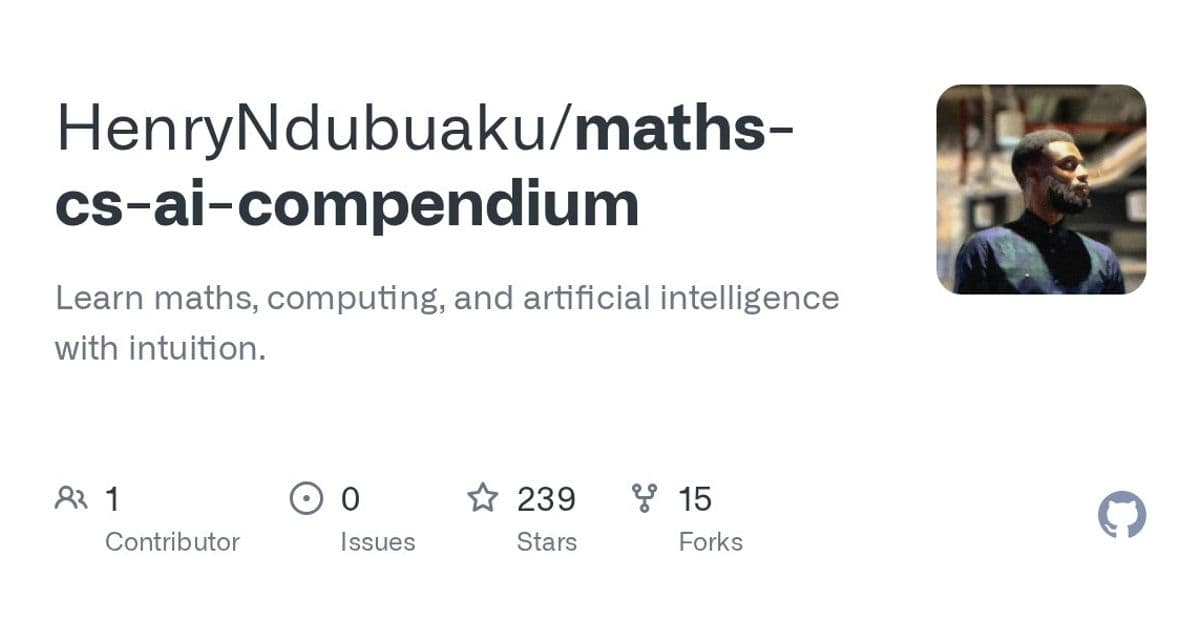
Henry Ndubuaku's unconventional 'maths-cs-ai-compendium' offers intuition-first explanations of complex technical concepts, with 6 chapters already available and 12 more planned.
Intuition-First AI Textbook Emerges from GitHub, Proving Valuable for Top Tech Interviews
When friends successfully interviewed at DeepMind, OpenAI, and Nvidia using personal notes, Henry Ndubuaku realized he had something valuable. Those notes have now evolved into the maths-cs-ai-compendium, a comprehensive open-source resource aiming to revolutionize how we learn mathematics, computing, and artificial intelligence.
Beyond Traditional Textbook Limitations
Technical education has long been plagued by resources that prioritize dense notation over understanding, assume prior knowledge, and quickly become outdated in fast-evolving fields like AI. The result is often a superficial understanding that fails to serve practitioners when they encounter real-world challenges.
"Most textbooks bury good ideas under dense notation, skip the intuition, assume you already know half the material, and quickly get outdated in fast-moving fields like AI," explains the repository's overview. This approach creates significant barriers for those trying to build genuine expertise rather than just memorizing formulas for exams.
The compendium positions itself as an alternative: "an open, unconventional textbook covering maths, computing, and artificial intelligence from the ground up. Written for curious practitioners looking to deeply understand the stuff, not just survive an exam/interview."
From Practical Experience to Educational Resource
Unlike many educational resources that emerge from academic settings, this compendium has roots in practical industry experience. The author developed the material while working in AI/ML, creating notebooks that prioritized intuition-first explanations, real-world context, and thorough understanding of complex concepts.
The validation came unexpectedly when friends used these notes to prepare for interviews at top AI companies. The success of these candidates—"They all got in and currently perform well in their roles"—convinced the author to transform personal notes into a public educational resource.
Building Knowledge from Foundation to Application
The repository outlines an ambitious 18-chapter structure designed to take learners from fundamental concepts to advanced applications:
- Chapters 1-6 (Available): Mathematical foundations including vector spaces, matrices, calculus, statistics, probability, and machine learning basics
- Chapters 7-12 (Coming): Specialized AI domains including computational linguistics, computer vision, audio processing, multimodal learning, autonomous systems, and computing fundamentals
- Chapters 13-18 (Coming): Advanced topics including systems design, optimization, inference, and emerging research areas
The progression suggests a deliberate approach to building knowledge systematically, with each chapter likely building on previous ones. This contrasts with many resources that jump between topics without establishing proper foundations.
The Intuition-First Methodology
What distinguishes this compendium is its explicit commitment to building intuition before introducing formalism. Rather than starting with complex notation and theorems, the approach appears to begin with conceptual understanding and practical relevance.
This methodology addresses a common frustration in technical education: resources that present formulas without explaining why they matter or how they connect to real problems. By focusing on intuition first, the material aims to create deeper, more durable understanding that practitioners can apply flexibly in novel situations.
The repository also includes specific formatting guidelines that reflect this pedagogical approach. For mathematical notation, it recommends fenced code blocks rather than LaTeX-style delimiters, which may improve readability in the GitHub environment. It also encourages the use of SVG images for diagrams, suggesting a commitment to clear visual communication.
Community as Co-Creator
Recognizing the vast scope of the material and the value of diverse perspectives, the repository has established clear mechanisms for community contribution:
- Content suggestions: Via GitHub issues
- Corrections and improvements: Through pull requests
- Visual enhancements: Creating SVG diagrams in the ../images/ directory
- Research sharing: Adding experimental findings to the research blog section
This collaborative approach could help address one of the limitations of single-author resources: the inability to comprehensively cover all aspects of rapidly evolving fields like AI.
The author has even included a formal citation format for academic use, suggesting the resource is intended to have credibility in both educational and professional contexts. This attention to scholarly standards adds to the project's legitimacy.
Addressing Multiple Audiences
The compendium appears designed to serve several different learner types:
- Self-taught practitioners: Those building AI expertise outside formal education programs
- Students supplementing coursework: Looking for alternative explanations to complement traditional materials
- Career switchers: Professionals transitioning into AI roles
- Interview candidates: Preparing for technical interviews at top AI companies
By focusing on intuition and understanding rather than exam preparation, the resource aims to serve all these groups effectively.
Early Reception and Potential Impact
With six chapters already available and positive anecdotal evidence from successful interviews, the project shows early promise. If it continues to develop according to its roadmap, it could address significant gaps in current technical education resources.
The combination of intuition-first explanations, comprehensive coverage, and community input could create a valuable alternative to traditional textbooks that often fail to keep pace with the rapid evolution of AI and computing.
Getting Involved
The maths-cs-ai-compendium is available directly on GitHub, where readers can access existing chapters and contribute to future development. The repository includes detailed contributing guidelines for those who wish to help expand or improve the content.
As with many ambitious open-source projects, its ultimate impact will depend on the engagement of the community. Whether it achieves its goal of becoming a comprehensive, intuition-first resource for technical education remains to be seen, but its early chapters and clear vision suggest it could fill an important niche in the ecosystem of AI educational resources.
Comments
Please log in or register to join the discussion