Apple's iOS 26 touts flashy new AI and UI features like Live Translation and Liquid Glass, but a closer look reveals Android has offered remarkably similar capabilities for years. This analysis dissects five key iOS 26 features already familiar to Android users, examining the nuances of each platform's approach and what it signals about mobile OS convergence.
Apple’s unveiling of iOS 26 at WWDC 2025 showcased a significant redesign and a suite of new AI-powered features, generating considerable buzz. The Liquid Glass aesthetic and tools like Live Translation and Visual Intelligence promise a smarter, more fluid iPhone experience. However, for seasoned Android users, particularly those on Google Pixel or Samsung Galaxy devices, the demos likely evoked a strong sense of déjà vu. A detailed examination reveals that core functionalities presented as iOS innovations are, in fact, long-standing staples of the Android ecosystem.
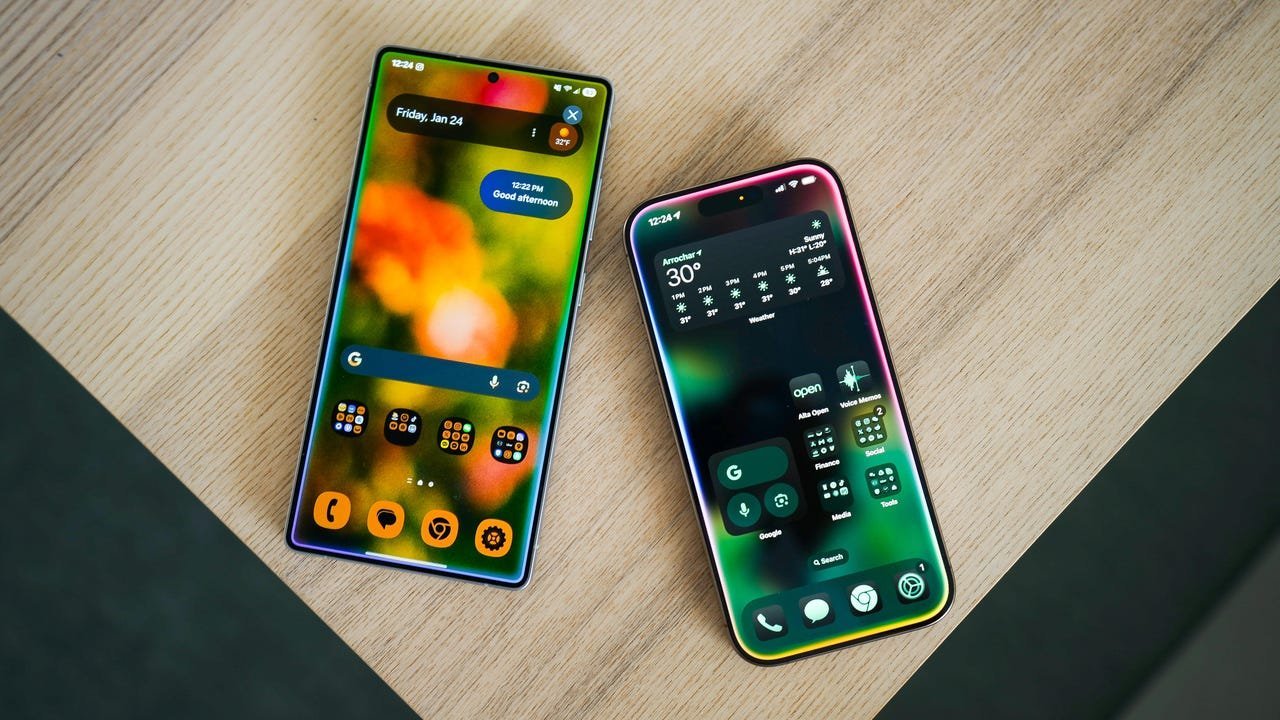 Caption: Kerry Wan/ZDNET - The ongoing feature parity race between Android (Samsung Galaxy S25 Ultra shown) and iOS continues with Apple's latest update.
Call Screening & Hold Assist: Pixel Pioneered It iOS 26 introduces background call answering with real-time transcription for unknown numbers and Hold Assist, which mutes hold music and alerts the user when an agent returns. While Apple adds nuanced voice detection, the fundamental concept of reclaiming time from robocalls and hold queues is far from new. Google's Call Screen debuted on the Pixel 3 in 2018, filtering spam calls before they ring and providing transcripts. Hold for Me arrived on Pixel in 2020, leveraging Duplex AI to wait silently on hold – features that have since expanded across the wider Android landscape.
Spam Detection: Android's Mature Defense iOS 26 silences suspected spam messages, routing them to an 'Unknown Senders' folder to avoid cluttering the main inbox. This is a welcome step, yet it mirrors functionality Android users have enjoyed since Google Messages introduced on-device spam filtering in 2018. Android goes further, integrating robust spam call filtering directly into the Phone app and, more recently, employing real-time on-device AI during calls to warn users of potential scams – a feature Apple has yet to match in scope.
Live Translation: Google's Long-Standing Strength Apple's Live Translation, enabling real-time speech and text conversion across Messages, FaceTime, and calls (even through AirPods), is undoubtedly powerful. However, Google's Live Translate feature arrived on the Pixel 6 in 2021, offering offline translations in over 20 languages. Translation integration with Pixel Buds followed soon after, enabling spoken translations directly in-ear. The concept stretches back even further to Google's first-generation Pixel Buds in 2017, utilizing Google Assistant for real-time conversation translation. Apple's execution is elegant, but the underlying capability is a well-established Android hallmark.
Visual Intelligence: Circle to Search Got There First iOS 26 allows users to circle or scribble on objects within screenshots to initiate searches across apps, helping identify products or items in images. This functionality feels immediately familiar to Android users because Google launched the nearly identical 'Circle to Search' feature widely in January 2024. Circle to Search works universally across any screen content without requiring a screenshot first, offering a potentially more seamless user experience for visual lookup.
Genmoji & Image Playground: Emoji Mashups Aren't New Apple's Genmoji lets users combine emojis or use text prompts to generate custom AI stickers. While the AI generation adds flexibility, the core idea of creating novel emoji combinations for messaging isn't revolutionary. Android's Gboard has offered 'Emoji Kitchen' since 2020, providing hundreds of thousands of pre-designed emoji mashups. Furthermore, Gboard introduced AI-powered 'Pixel Studio' sticker generation in 2024, demonstrating that playful, customized visual communication is well-trodden ground on Android.
The Liquid Glass Déjà Vu: Echoes of Material Design Perhaps iOS 26's most visually striking element is Liquid Glass, a design language emphasizing translucent layers, morphing icons, and physicality inspired by VisionOS. While undoubtedly polished, its aesthetic sparked immediate comparisons among Android enthusiasts to icon packs and themes popularized by third-party launchers like GO Launcher and ADW in Android's early 2010s. More significantly, Liquid Glass's core philosophy – striving to make digital interfaces feel natural and alive through real-world metaphors – closely mirrors the goals of Google's Material Design, first introduced in 2014. The upcoming Material 3 Expressive design language in Android 16 further refines this approach with adaptive layouts, bold personalization, and motion informed by physics, demonstrating both platforms are converging on similar visions for humanizing interfaces, albeit with distinct visual executions.
The narrative emerging from iOS 26 isn't solely about Apple playing catch-up, but rather highlighting the increasing feature parity and convergent evolution in mobile operating systems. Apple often brings a high degree of polish and system-wide integration when it adopts concepts pioneered elsewhere. Conversely, Android frequently serves as an incubator for innovative, sometimes experimental, features that later gain mainstream recognition when embraced by Apple. This healthy competition ultimately benefits users on both platforms, driving continuous improvement. While iOS 26's Liquid Glass and AI features represent significant advances for the iPhone, Android users can rightly view them not as entirely novel, but as affirmations of paths their platform has been exploring for years.
Source: Analysis based on original reporting by Jason Howell, ZDNet (July 25, 2025)
Comments
Please log in or register to join the discussion