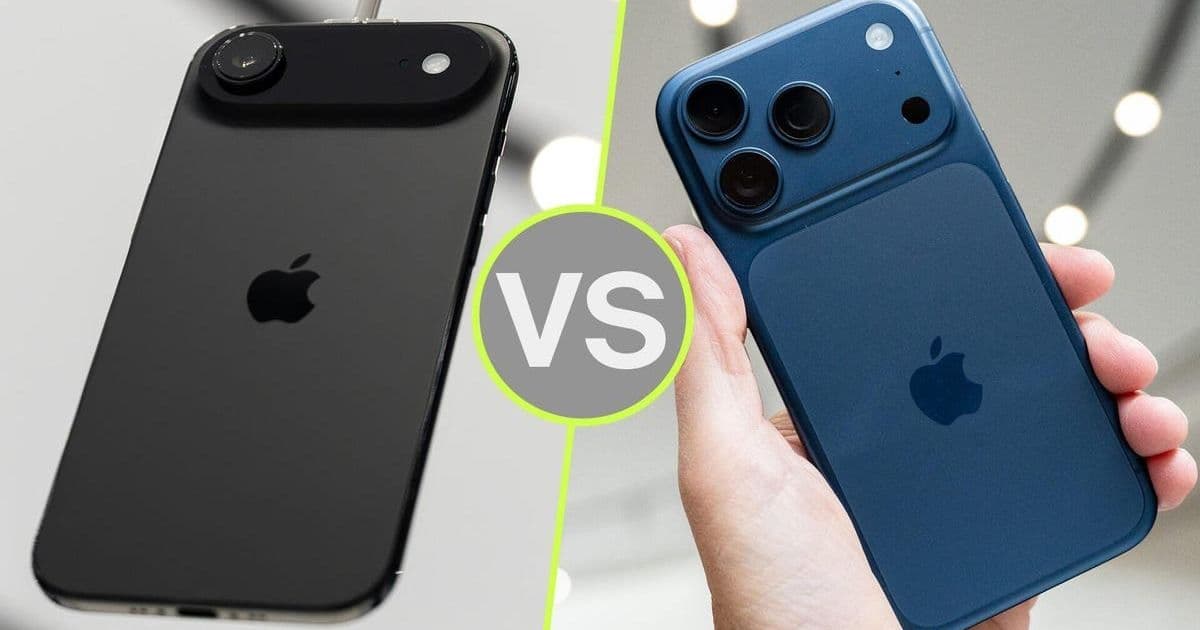
Apple's iPhone 17 lineup pits the ultra-slim iPhone Air against the powerhouse iPhone 17 Pro Max, forcing developers and tech leaders to choose between revolutionary design and uncompromising performance. Our deep dive reveals how titanium frames, eSIM-only architecture, and vapor chamber cooling redefine mobile priorities—and why your workflow dictates the winner.
The Great iPhone Divide: When Thinness Meets Titanium
Apple's iPhone 17 series marks a pivotal shift: no longer iterating on a single vision, but splintering into distinct philosophies. The iPhone Air, at a razor-thin 5.6mm, challenges the very notion of smartphone bulk, while the iPhone 17 Pro Max doubles down on raw capability with a vapor-cooled chipset and pro-grade camera system. For developers and engineers, this isn't just a consumer choice—it's a case study in engineering trade-offs that ripple across app optimization, accessory ecosystems, and hardware aspirations.
Under the Hood: A Shared Brain, Divergent Bodies
| Feature | iPhone 17 Air | iPhone 17 Pro Max |
|---|---|---|
| Thickness | 5.6mm | 8.1mm |
| Frame | Grade 5 Titanium | Aluminum Unibody |
| Display | 6.5" Super Retina XDR | 6.9" Super Retina XDR (3,000 nits) |
| Battery Life | 27h video playback | 39h video playback |
| Camera | Single 48MP Fusion Main | Triple 48MP (Main, UW, Tele) |
| Cooling | Passive | Vapor Chamber |
| Connectivity | eSIM-only | Dual eSIM + Physical SIM slot |
| Storage | Up to 1TB | Up to 2TB |
Both models run Apple's A19 Pro chipset paired with the N1 networking chip and C1X modem—ensuring Wi-Fi 7 and Bluetooth 6 support. Yet, as one senior Apple engineer noted anonymously, "The Air isn't a stripped-down Pro; it's a reimagining of density." This shared silicon foundation masks radical divergences in thermal management and radio design, critical for AR developers or real-time data apps.
The iPhone Air: When Less is Engineered More
The Air’s titanium frame isn't just marketing fluff—it's a deliberate pivot toward durability without mass. Grade 5 titanium offers a 40% strength-to-weight advantage over aluminum, enabling that unprecedented thinness while surviving drops. Combined with Ceramic Shield 2 (3x scratch resistance), it targets mobile professionals who prioritize portability without sacrificing resilience. As Cesar Cadenas notes in the ZDNET analysis, this design ethos extends to the camera: a single 48MP lens that computationally mimics multiple focal lengths, reducing complexity for users but demanding smarter software optimization from app developers.
The eSIM gamble: Apple’s eSIM-only approach frees internal space but pressures carriers. For enterprises managing global deployments, this could streamline logistics—or create headaches in regions with spotty eSIM adoption. It's a bet on a SIM-less future that developers must account for in connectivity-heavy applications.
The iPhone 17 Pro Max: Power Unleashed, Heat Contained
The Pro Max’s vapor chamber cooling isn't just for gamers—it sustains peak A19 Pro performance during prolonged tasks like 4K video rendering or ML inference, a boon for creators and engineers testing resource-intensive apps. Its 48MP triple-camera array supports ProRes RAW and Log 2 color, effectively turning the device into a field-ready production tool. As Jason Hiner’s imagery highlights, the 6.9-inch display’s 3,000-nit brightness and 120Hz ProMotion make it ideal for outdoor UX testing or detailed design work.
Genlock’s hidden value: The oft-overlooked genlock feature synchronizes multiple iPhones for multi-angle shoots—a nod to Apple’s push into collaborative creative workflows. For developers, this hints at new APIs for synchronized AR experiences or real-time data capture.
The Verdict: Your Workflow is the Decider
- Choose the Air if you value extreme portability, develop for constrained environments, or prioritize battery-efficient apps. Its eSIM reliance and simplified camera system demand leaner, smarter code.
- Opt for the Pro Max if your work involves computational photography, extended rendering sessions, or leveraging iOS 26’s advanced ML capabilities. The vapor chamber and expanded storage cater to power users pushing hardware limits.
Alternatives like the base iPhone 17 (retaining ProMotion at lower cost) or last year’s iPhone 16 Pro (still potent for AI tasks) offer compromise—but this dichotomy signals Apple’s broader strategy: fragmenting the iPhone line to capture extremes of the market. For the tech industry, it’s a reminder that innovation isn’t monolithic; sometimes, it’s as thin as a credit card or as expansive as a 6.9-inch canvas.
Source: ZDNET
Comments
Please log in or register to join the discussion