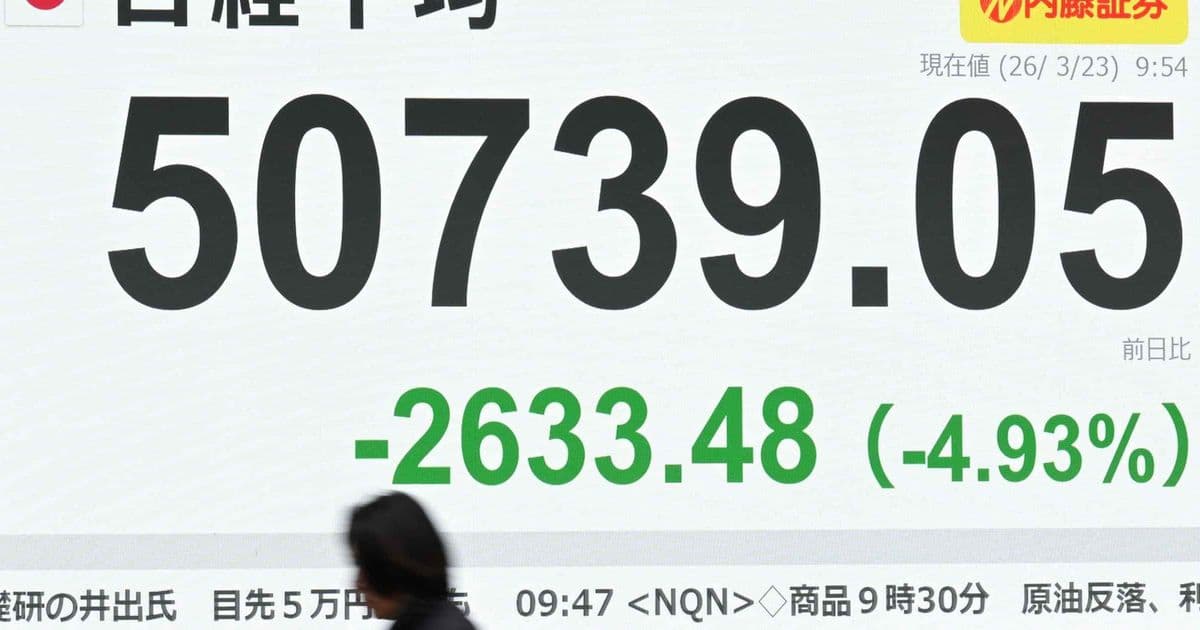
Japan's stock market suffered its worst single-day drop in months as escalating US-Iran tensions triggered a tech sector sell-off and raised fears of global economic disruption.
Japan's Nikkei 225 index plunged 5% on Monday morning, marking its steepest decline since the global market turmoil of early 2025 as escalating tensions between the United States and Iran sent shockwaves through Asian markets.
The sell-off was triggered by renewed fears of a wider Middle East conflict after the US and Israel launched coordinated strikes on Iranian nuclear facilities over the weekend. The attacks came in response to Iran's alleged development of nuclear weapons capable of striking European cities, according to US intelligence sources cited by Nikkei Asia.
Tech stocks bore the brunt of the sell-off, with major Japanese technology companies seeing their shares fall between 7% and 12%. Semiconductor manufacturers, which rely heavily on stable energy supplies and global supply chains, were particularly hard hit. The tech sector's vulnerability to geopolitical shocks has become increasingly apparent as companies grapple with rising energy costs and supply chain disruptions.
Energy markets reacted violently to the news, with oil prices surging past $95 per barrel for the first time since November 2024. The Strait of Hormuz, through which roughly 20% of global oil supplies pass, remains a potential flashpoint as Iran has threatened to close the strategic waterway in response to further military action.
Bank of Japan Governor Kazuo Ueda acknowledged the growing economic risks in a brief statement, noting that "rising oil prices could significantly drag on economic growth and inflation expectations." The central bank's policy meeting later this week is now expected to focus heavily on how to respond to the emerging energy crisis.
Currency markets showed surprising resilience, with the yen holding steady around 158 to the dollar despite the equity market turmoil. Traders appear to be betting that the Bank of Japan may need to accelerate its timeline for interest rate hikes if energy prices continue climbing.
The market rout extended beyond Japan, with other Asian indices also falling sharply. Hong Kong's Hang Seng dropped 3.8%, while South Korea's KOSPI fell 4.2%. The coordinated nature of the sell-off suggests investors are increasingly concerned about the global economic implications of a prolonged Middle East conflict.
Adding to market anxiety, the US government announced it would allow purchases of Iranian oil at sea with a 30-day sanctions waiver, a move designed to prevent energy prices from spiraling even higher. However, traders remain skeptical that this measure will be sufficient to stabilize markets if the conflict escalates further.
Technology companies with significant exposure to Middle Eastern markets or energy-intensive operations saw some of the largest declines. Semiconductor manufacturers, data center operators, and electric vehicle makers were among the worst performers as investors reassessed the sector's vulnerability to energy price shocks.
The timing of the market turmoil is particularly challenging for Japanese companies, many of which were already grappling with rising labor costs and supply chain disruptions from previous global events. The combination of these factors has led some analysts to warn that the current market correction could be more severe and prolonged than initially expected.
Looking ahead, market participants will be closely watching for any signs of de-escalation in the Middle East. However, with both sides appearing to dig in their heels, the risk of further market volatility remains high. The coming weeks could prove crucial in determining whether this represents a temporary market correction or the beginning of a more sustained period of economic uncertainty.
For investors, the key question now is whether to view the current market weakness as a buying opportunity or a signal to reduce exposure to risk assets. With geopolitical risks at the forefront and energy markets in turmoil, many are adopting a wait-and-see approach until there is more clarity on the path forward for US-Iran relations and global energy supplies.
Comments
Please log in or register to join the discussion