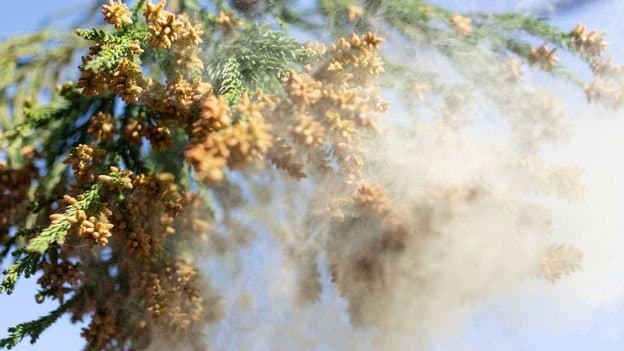
Massive cedar and cypress plantations planted after World War II now release unprecedented pollen loads, driving hay‑fever rates above 40 % of the population. The government’s new plan to thin and diversify these monocultures faces ecological, economic, and climate‑related hurdles.
Japan’s post‑war forest policy fuels a nationwide allergy crisis
Every spring millions of Japanese commuters pull masks over their noses and eyes, not because of a new virus but because of clouds of cedar and cypress pollen drifting from the country’s vast plantation forests. Recent videos of what looks like “smoke” rolling off evergreen stands are in fact pollen plumes, a visual reminder of a problem that began with a policy decision made in the 1950s.
What is being claimed?
- The Ministry of Agriculture, Forestry and Fisheries (MAFF) has declared seasonal allergies a national social problem and set a target to cut pollen emissions by 50 % within 30 years.
- The first concrete step is to reduce the area planted with Japanese cedar (sugi) by 20 %.
- Local governments such as Kobe are already converting plantation blocks back to mixed broadleaf forests.
What is actually new?
1. Scale of the plantation problem
- After the war, Japan’s mountains were stripped for fuel, prompting a massive reforestation drive. The state chose two fast‑growing native evergreens – Japanese cedar (sugi) and Japanese cypress (hinoki) – because they could be planted quickly and supplied timber for reconstruction.
- Today those plantations cover roughly 10 million ha, about 20 % of Japan’s land area and one‑third of all forested land.
- Both species produce copious, lightweight pollen that is released in a single, short burst when the trees reach about 30 years old – the age most of these stands are now at.
2. Health and economic impact
- National surveys estimate 43 % of the Japanese population suffers from moderate to severe allergic rhinitis, compared with 26 % in the UK and 12‑18 % in the US.
- The Ministry of Health reports that during peak pollen weeks productivity losses amount to roughly $1.6 bn per day due to sick leave and reduced consumer spending.
3. Policy response
- In 2023 the government announced a 30‑year pollen‑reduction roadmap. The official document (available on the MAFF website) lists three pillars: (1) thinning of sugi/hinoki stands, (2) replanting with low‑pollen or non‑pollen varieties, and (3) expanding mixed‑species natural forest zones.
- A new annual tax of ¥1,000 per resident was introduced in 2024 to fund sustainable forestry projects. Early reports from the Ministry’s fiscal brief show ¥120 bn allocated to pilot thinning operations in 2024, but detailed impact data are not yet public.
Limitations and practical challenges
Ecological trade‑offs
- Even if the targeted 20 % reduction is achieved, 80 % of the monoculture will remain, so pollen levels will still be high.
- Cutting large swaths without immediate replanting risks soil erosion and landslide exposure, especially in steep terrain. Researchers at Kyoto University have modeled that unmanaged clear‑cuts could increase runoff by up to 35 % in affected catchments.
Economic and logistical hurdles
- The timber market has shifted: cheap imports from Southeast Asia mean domestic wood is less competitive. Removing sugi/hinoki therefore does not guarantee a market for the harvested timber.
- Small municipalities often lack the technical capacity to design and monitor multi‑species regeneration. A 2023 survey by the Japan Forest Research Institute found that only 38 % of local forestry offices have staff trained in mixed‑species silviculture.
Climate‑related uncertainty
- Pollen production is temperature‑sensitive. A study in Nature Climate Change (2022) showed that a 2 °C rise could increase annual cedar pollen output by 15 % in Japan, potentially offsetting gains from thinning.
- At the same time, sugi plantations currently sequester about 45 % of Japan’s forest carbon stock. Reducing their area could lower short‑term carbon uptake unless replacement trees grow quickly enough to compensate.
Case studies of on‑the‑ground work
Kobe’s 180‑ha restoration
- The city began a 15‑year phased conversion in 2020, selectively felling sugi and hinoki while leaving existing broadleaf patches to seed naturally.
- Monitoring reports (city press release, 2023) show a 30 % increase in bird species richness and the return of amphibians such as pond turtles after just five years.
- Harvested wood is being used for district heating, furniture, and charcoal that meets Japan’s low‑emission standards.
Nishiawakura’s circular economy
- In Okayama Prefecture, a community‑run project turned 84 % of its cedar‑cypress forest into a mixed‑use system: felled logs feed biomass boilers for eel farms, while residual timber is crafted into chopsticks and small‑scale timber products.
- The initiative has reduced local allergy medication sales by an estimated 12 %, according to a health‑clinic survey.
Outlook
Japan’s allergy problem is a textbook example of how a well‑intentioned post‑war reconstruction policy can generate long‑term public‑health externalities. The current government plan is a step in the right direction, but the scale of the challenge means that forest‑level interventions alone will not solve the crisis. A realistic path forward will likely combine:
- Targeted thinning of the most pollen‑productive stands, guided by high‑resolution pollen‑dispersion models (e.g., the JWA forecasting service).
- Large‑scale mixed‑species replanting that balances carbon sequestration, biodiversity, and low pollen output.
- Economic incentives for local timber processing that keep harvested wood in the domestic supply chain without encouraging over‑harvest.
- Health‑system integration, such as subsidized immunotherapy tablets and real‑time pollen alerts, to mitigate symptoms while the forest transition unfolds.
Only by addressing the ecological, economic, and health dimensions together can Japan hope to lower its hay‑fever burden without compromising its climate goals.

Caption: A typical sugi plantation near Kobe, where pollen clouds regularly drift into the city.
Further reading
Comments
Please log in or register to join the discussion