Astronomers confirm the most distant galaxy ever observed, revealing unexpected brightness and challenging models of early universe reionization.
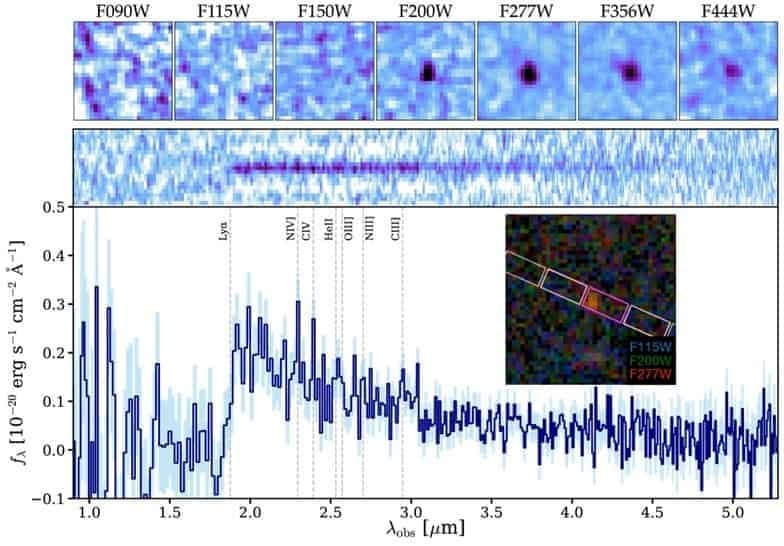
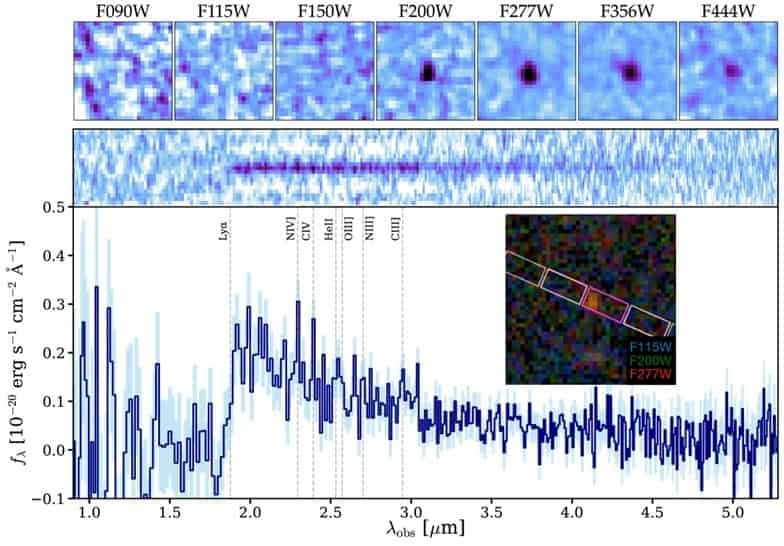
Astronomers have confirmed the discovery of the most distant galaxy ever observed, a luminous cosmic structure dating back to just 280 million years after the Big Bang. The galaxy, designated MoM-z14, was identified through spectroscopic observations with the James Webb Space Telescope (JWST) and represents a significant leap in our understanding of the early universe.
Located in the COSMOS legacy field, MoM-z14 sits at a redshift of zspec = 14.44, pushing the observational frontier further than ever before. The confirmation came through NIRSpec/prism spectroscopy, which revealed a sharp Lyman-α break and approximately 3σ detections of five rest-UV emission lines. These spectral features provide definitive evidence of the galaxy's extreme distance and offer insights into its physical properties.
What makes this discovery particularly remarkable is the galaxy's unexpected brightness. With an absolute UV magnitude of MUV = -20.2, MoM-z14 is far more luminous than theoretical models predicted for such an early cosmic epoch. This finding challenges our understanding of galaxy formation in the first few hundred million years after the Big Bang.
The "Mirage or Miracle" survey, which spans approximately 350 arcmin2, suggests that the number density of bright zspec ≈ 14-15 sources is more than 100 times larger than pre-JWST consensus models predicted. The statistical analysis indicates this population could be 182+329-105 times more abundant than expected, suggesting that early galaxy formation may have been more efficient than previously thought.
Several physical characteristics of MoM-z14 provide clues about its nature and formation history. The galaxy exhibits extremely high equivalent widths of UV lines (approximately 15-35 Å), which signal a rapidly rising star-formation history. Analysis suggests a roughly 10-fold increase in star formation over the last 5 million years, with the ratio of recent to older star formation rates (SFR5 Myr/SFR50 Myr) estimated at 9.9+3.0-5.8.
Despite its brightness, MoM-z14 is remarkably compact, with a circularized effective radius of only 74+15-12 parsecs. This extreme compactness, combined with its elongated shape (axis ratio b/a = 0.25+0.11-0.06), suggests that an active galactic nucleus (AGN) is not the dominant source of its UV light. Instead, the stellar processes appear to be the primary driver of its luminosity.
The galaxy's steep UV slope (β = -2.5+0.2-0.2) indicates negligible dust attenuation and a young stellar population. This spectral characteristic, along with the absence of a strong damping wing in the spectrum, provides tentative evidence that the immediate surroundings of MoM-z14 may be partially ionized. This is particularly intriguing because most reionization models predict that the universe should have been nearly 100% neutral at this redshift.
Perhaps most fascinating is the chemical composition revealed by the observations. The nitrogen emission and highly super-solar [N/C] ratio greater than 1 hint at an abundance pattern similar to local globular clusters. This suggests that MoM-z14 may contain or be associated with the formation of extremely massive stars, sometimes called supermassive stars, which are thought to have been common in the early universe but are not observed in the local cosmos.
The implications of this discovery extend far beyond a single galaxy. Since this abundance pattern is also common among the most ancient stars born in the Milky Way, astronomers may be directly witnessing the formation of such stars in dense clusters. This provides a potential connection between galaxy evolution across the entire sweep of cosmic time, linking the first galaxies to the ancient stellar populations we observe in our own galaxy today.
This discovery represents a major milestone in observational cosmology and demonstrates the transformative power of JWST in exploring the cosmic dawn. As astronomers continue to probe these extreme early epochs, each new discovery reshapes our understanding of how the first galaxies formed and evolved in the infant universe.
Comments
Please log in or register to join the discussion