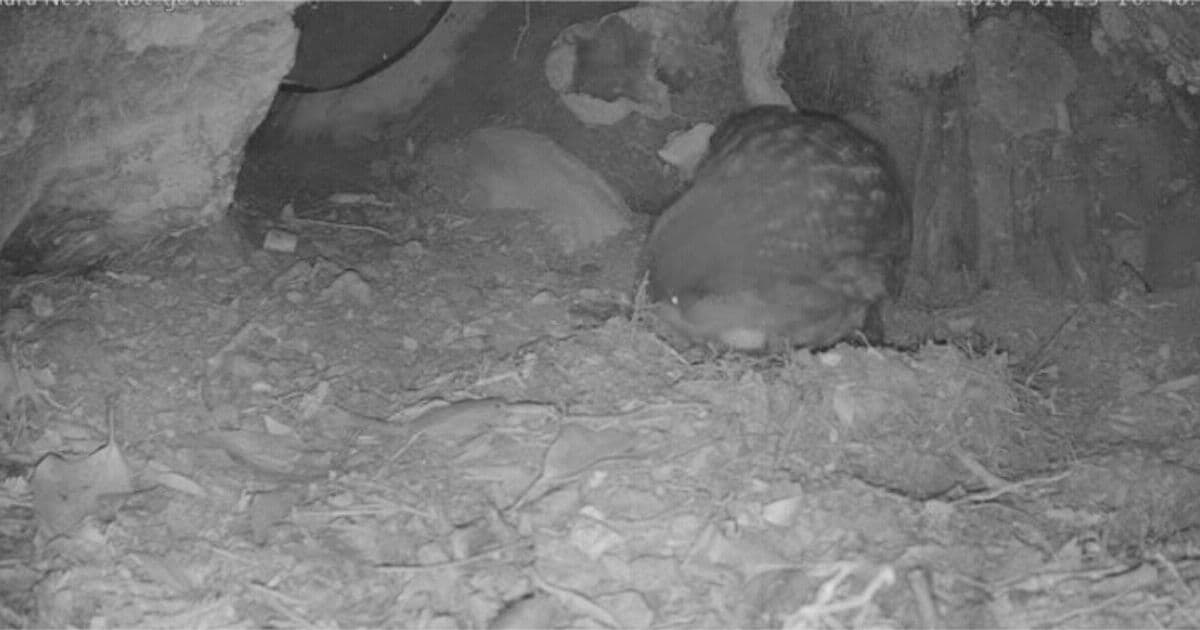
The New Zealand Department of Conservation has launched a live stream of Rakiura, a 23-year-old kākāpō, nesting in her underground cavity on Rakiura Island. The stream provides a rare window into the breeding behavior of this critically endangered species, with the first egg of the season laid on January 22nd.
The New Zealand Department of Conservation has activated a live stream of Rakiura, a 23-year-old kākāpō, nesting in her underground cavity on Rakiura Island. This marks a critical update for the 2026 breeding season, offering an unprecedented real-time view into the reproductive behavior of one of the world's rarest birds.
Rakiura is a legendary kākāpō. She hatched on February 19, 2002, on Whenua Hou (Codfish Island), the offspring of Flossie and Bill. Her name derives from the te reo Māori name for Stewart Island, the origin of most founding kākāpō. She has chosen this same nesting site for all seven breeding seasons since 2008—a large cavity under a rātā tree. Her reliability has allowed conservationists to modify the site over the years, adding a well-placed hatch for monitoring eggs and chicks while maintaining safety and dryness.
Rakiura's breeding record is substantial. She has nine living descendants—three females and six males—across six breeding seasons: Tōitiiti (2008), Tamahou and Te Atapō (2009), Tia and Tūtoko (2011), Taeatanga and Te Awa (2014), and Mati-mā and Tautahi (2019). She also has many grandchicks. On January 22nd, 2026, at 4:30 PM NZ time, she laid her first egg of the season. The livestream commenced shortly after she committed to this nest.
The stream is hosted on YouTube, providing global access to this conservation effort. The technical implementation is straightforward: a camera positioned at the nest site, streaming to a public platform. This approach leverages existing infrastructure—YouTube's robust streaming capabilities—to minimize development overhead while maximizing reach.
The use of live streaming for conservation monitoring is not new, but its application to kākāpō breeding is particularly valuable. Kākāpō are nocturnal, flightless parrots, and their breeding behavior is difficult to observe directly. A live stream allows researchers and the public to monitor activity without disturbing the birds. The stream also serves an educational purpose, raising awareness about the species' critically endangered status.
From a technical perspective, the stream's reliability depends on stable power and connectivity on Rakiura Island, which is remote. The Department of Conservation likely uses a combination of solar power and satellite or cellular backhaul. The camera itself is probably a ruggedized, weatherproof unit capable of low-light performance, given the kākāpō's nocturnal habits.
The live stream also enables crowdsourced monitoring. While automated systems can detect activity, human observers can identify subtle behaviors—incubation shifts, feeding, or signs of distress—that algorithms might miss. This hybrid approach combines automation with human expertise.
The stream's launch coincides with a broader trend in conservation technology: using real-time data to inform management decisions. For kākāpō, which number fewer than 250 individuals, every breeding season is critical. Live monitoring allows for rapid response to issues like egg abandonment or predation attempts.
The stream is available at the Kākāpō Cam YouTube channel. The Department of Conservation's kākāpō program details are documented on their official website. For those interested in the technical implementation, the Kākāpō Recovery Program provides additional context on monitoring methods.
The use of live streaming for conservation is a practical application of existing technology. It requires minimal custom development—standard cameras, streaming software, and a platform like YouTube. The value lies in the data collected and the engagement it generates. For a species as rare as the kākāpō, every bit of public attention helps secure funding and support.
The stream also highlights the importance of long-term monitoring. Rakiura's consistent nesting behavior provides a stable dataset for studying breeding success, chick survival, and environmental impacts. Over years, this data can inform habitat management and breeding interventions.
In summary, the Kākāpō Cam is a straightforward yet powerful tool for conservation. It leverages existing technology to provide real-time insights into a critical breeding season. For researchers, it offers a non-invasive monitoring method. For the public, it creates a connection to a species on the brink of extinction. The stream's success will be measured not just in views, but in the data it yields and the conservation actions it supports.
Comments
Please log in or register to join the discussion