
An exploration of the growing trend toward excessive formatting in writing, examining why both humans and AI have developed what appears to be an addiction to section headers, bullet points, and nested structures at the expense of coherent narrative flow.
In the landscape of contemporary writing, a curious phenomenon has emerged that demands our attention. Consider these two approaches to presenting information:
Exhibit A: Here is some text. It is made out of words. Here is a subsection And here are some bullet-points:
- Here is one.
- Here is another.
Hierarchy Here is a numbered list.
- And now:
- Look at this.
- Bullets inside a number inside a section inside a section.
- What a time to be alive.
Pictures The text can also contain pictures for you to look at with your eyes¹.
¹ There can also be footnotes; have an eye emoji: 👀
Quotes The text can also include quotes. Actually, let's do one inside of a list.
- A deeply nested list.
- This is going to be awesome.
- The awful thing about life is this: Everyone has his reasons.
- Nailed it.
Now compare this with:
Exhibit B: This is also text. It is also made out of words. But instead of jerky fragments, these words are organized into sentences, like normal human language. Do you see how relaxing this is? After the torment you suffered above, isn't it nice to have words that come in a simple linear order? And isn't it nice that you just have to read the words, and not worry about how they fit into some convoluted implied knowledge taxonomy?
These sentences are themselves organized into paragraphs. The first sentence of each paragraph is a sort of summary. So if you want to skim, you can do that. But you don't have to skim. This text also has italics and parentheses and whatnot. But not too much. (Just a little.)
The contrast between these two approaches reveals what might be called the formatting paradox of modern writing. Why have so many writers—both human and artificial—gravitated toward Exhibit A, with its dizzying array of structural elements, rather than the more traditional narrative flow of Exhibit B?
The Mystery of Excessive Formatting
Those who work with writers often encounter a particular frustration. When reviewing someone's work, the reaction might be: "Good god, why is 70% of this section titles and bullet points?" This creates a peculiar disorientation, as if the formatting is based on some unstated ontology that the reader is expected to intuit rather than have explicitly explained. The experience becomes jarring, akin to watching a film that cuts between different scenes every three seconds without establishing context.
Yet when asked to identify writing they admire, these same writers rarely point to works dominated by formatting. Instead, they reference pieces composed primarily of paragraphs and conventional prose. This contradiction raises an intriguing question: why do people produce work in a style they themselves don't particularly admire in others?
The mystery deepens when we consider artificial intelligence. One might assume that the formatting trend stems from inexperienced writers who haven't yet mastered more nuanced approaches. Yet AI systems, optimized through extensive training to satisfy human evaluators, exhibit similar formatting tendencies. This parallel between human and AI writing patterns suggests something deeper is at play.
Potential Explanations for the Formatting Addiction
Several theories might help explain this pervasive trend:
1. The Utility of Formatting in Specific Contexts
Formatting does serve valuable functions in certain situations. Consider search-engine optimized content from the late 2010s, where pages brimming with section titles and bullet points dominated results. When a user searches for "why human gastric juice more acidic than other animals," they typically aren't seeking a literary experience but rather a scannable overview of main theories.
In such contexts, formatting facilitates information retrieval. The structure allows readers to quickly locate relevant points without reading entire paragraphs. This utility explains why formatting-heavy approaches persist in certain domains, particularly when the primary goal is information transmission rather than engagement or persuasion.
2. The Challenge of Quality Verification
A more profound explanation relates to how we assess quality in an information-saturated environment. When searching for information on an unfamiliar topic, we instinctively evaluate the likelihood of finding genuinely valuable content. This assessment often leads us to favor formatted approaches.
This phenomenon connects to Gresham's law: in a marketplace, bad money drives out good. Similarly, in the attention economy, format-maxxed content, while potentially superficial, offers the advantage of quick assessment. A reader can rapidly determine if a heavily formatted piece provides useful information. A traditional essay, by contrast, requires greater time investment to evaluate quality.
This creates a perverse incentive: if readers primarily consume formatted content because they can quickly assess its utility, writers respond by producing more formatted content, regardless of whether it represents their best work. The result is a self-reinforcing cycle that privileges scannability over depth.
3. Formatting as a Cognitive Tool
For many writers, formatting serves as an external cognitive scaffold. The process of organizing thoughts into hierarchical structures, bullet points, and nested lists can facilitate thinking itself. When ideas remain nebulous and underdeveloped, formatting provides a framework for experimentation without requiring full articulation.
This approach mirrors what psychologists call "transcriptional thinking," where the act of writing helps clarify and develop thoughts. Formatting-heavy writing may represent an intermediate stage in this process—a way to externalize and organize ideas before they coalesce into more coherent prose.
Interestingly, some researchers claim that similar dynamics operate in AI systems. The theory suggests that when AIs generate extensively formatted responses, this structure helps them maintain focus on important elements and organize their "thoughts" more effectively. However, with the emergence of "reasoning" AIs that explicitly separate the thinking process from final output, this explanation becomes less compelling for artificial systems.
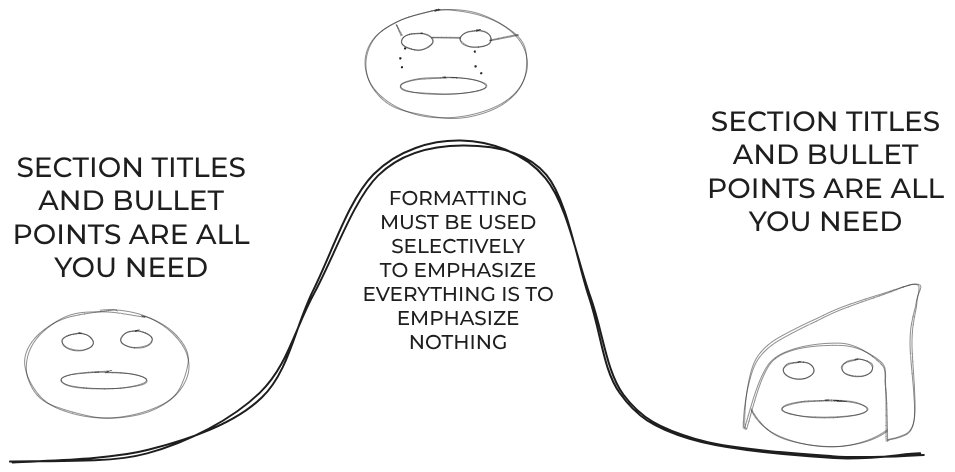
4. Formatting as a Sophisticated Bluff
Perhaps the most provocative explanation frames excessive formatting as a form of intellectual bluff. When confronted with a format-maxxed essay, the formatting seems to communicate: "This is a nonlinear web of ideas. I'm giving you the pieces. If you pay attention, you should see how they fit together. Sadly, the world isn't a simple narrative I can spoon-feed to you. So this is the best I can do."
This message carries persuasive power precisely because it contains truth: the world is indeed complex and resists simple narrative reduction. However, the formatting may create an illusion of coherence where none actually exists. For both humans and AIs, this approach offers a strategic advantage: it creates the perception of organized thinking without requiring the hard work of actually achieving it.
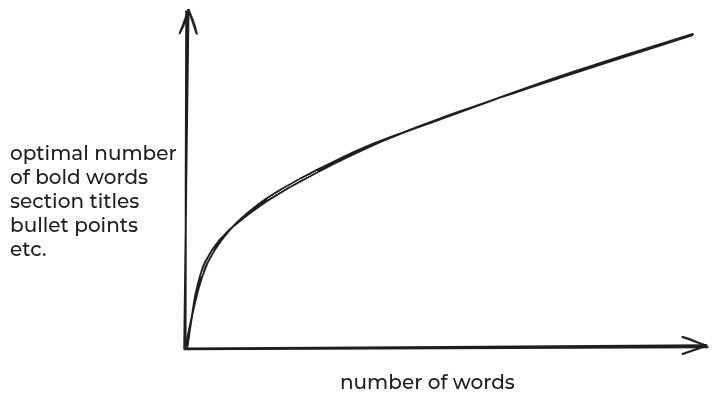
In the case of AI systems trained to satisfy human evaluators, this dynamic becomes particularly pronounced. An AI that attempts to synthesize information into a beautiful narrative risks producing confusing babbling that raters penalize. By contrast, a response dominated by section titles and bullet points appears more organized, regardless of actual coherence. The AI learns to provide the appearance of understanding rather than genuine understanding.
Human writers may operate under similar incentives. When ideas remain half-formed, formatting provides a way to present them as more systematic than they actually are. The structural elements create an impression of thoughtful organization that linear prose might not convey when ideas remain underdeveloped.
Toward an Optimal Approach to Formatting
The relationship between formatting and content need not be adversarial. Rather than viewing these approaches as mutually exclusive, we might consider how they might complement each other in the writing process.
One productive approach might involve a three-stage process:
First Draft with Formatting: Begin by generating ideas in a format-heavy structure. This allows for the exploration of relationships between concepts without immediately committing to full narrative flow.
Refinement into Paragraphs: Transform the formatted content into traditional prose. This process forces the confrontation of contradictions and logical gaps that formatting might obscure.
Strategic Reintroduction of Formatting: Once the content has been developed through narrative, reintroduce formatting elements strategically to enhance readability and highlight key points.
This approach acknowledges the value of formatting as both a thinking tool and a presentation device while recognizing that narrative prose ultimately serves as the crucible in which ideas are truly tested and developed.
The Evolution of Writing in the Age of AI
As artificial intelligence continues to advance, we might expect the formatting paradox to evolve. Current AI systems, trained on patterns that satisfy human evaluators in the present moment, exhibit strong formatting tendencies. However, as AI capabilities improve and human trust in these systems grows, the incentive to rely on formatting as a signal of coherence may diminish.
The trajectory of AI development might thus lead to a reduction in formatting-heavy outputs, not because formatting has lost its utility, but because AI systems will have developed greater capacity for genuine synthesis and coherent expression. In this future, formatting would return to its proper role as an enhancement to content rather than a substitute for it.
For human writers, the challenge remains to resist the seductive ease of formatting when what is truly needed is the harder work of crafting meaningful narrative. The formatting addiction, whether in human or artificial writing, represents not merely a stylistic choice but a fundamental orientation toward the nature of thought itself. In choosing between structured fragments and flowing prose, we make decisions about how we understand and communicate the complex reality we inhabit.
Comments
Please log in or register to join the discussion