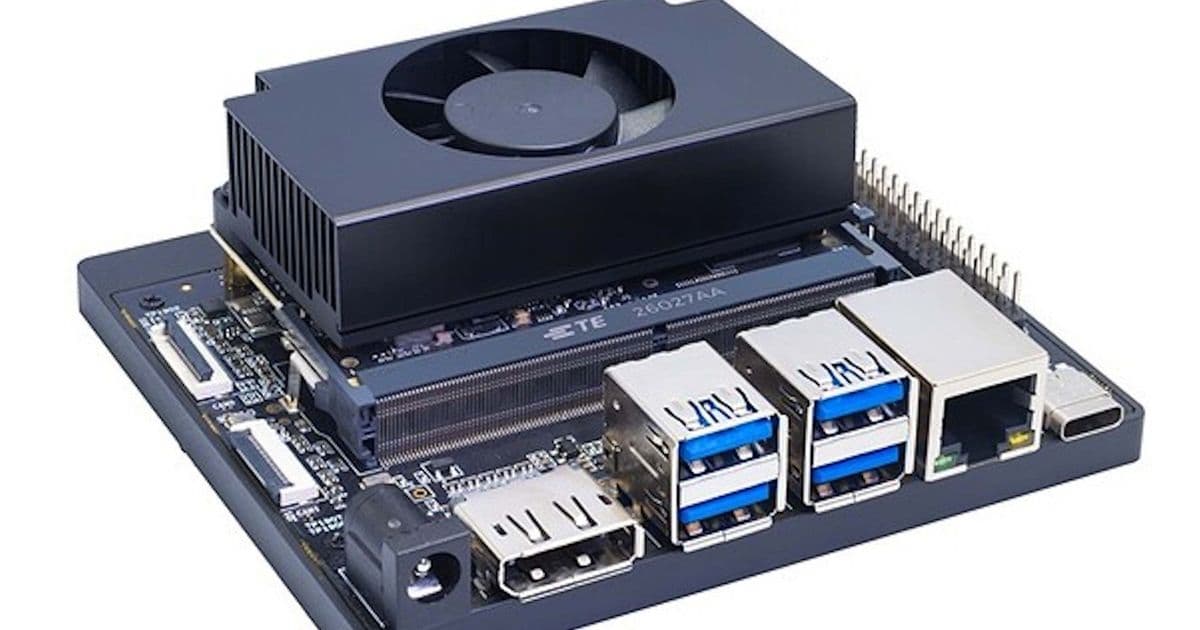
The Banana Pi BPI-SM10 emerges as a compelling single-board computer with impressive AI capabilities, positioning itself as a strong alternative to the Raspberry Pi 5 with specialized AI acceleration hardware.
High AI Performance: New RISC-V SBC is a Powerful Raspberry Pi 5 Alternative
The single-board computer (SBC) market continues to evolve with innovative solutions, and the new Banana Pi BPI-SM10 stands out as a notable entry that combines traditional SBC functionality with specialized AI acceleration capabilities. This new offering from Banana Pi represents a significant step forward in computational power for embedded systems, particularly for AI workloads that have traditionally been challenging for mainstream SBCs.
What's New: Compute Module and Carrier Board Design
Unlike typical single-board computers that integrate all components onto a single board, the BPI-SM10 takes a modular approach. It consists of a compute module and a corresponding carrier board. Only the carrier board exposes the familiar ports and connectors we associate with SBCs, while the compute module contains the core processing components.
The carrier board includes practical connectivity options that make it suitable for various applications:
- Four USB 3.0 ports for high-speed peripheral connections
- Gigabit Ethernet for reliable network connectivity
- DisplayPort and MIPI-DSI for video output capabilities
- Multiple M.2 slots for installing SSDs, enabling fast storage expansion
- A GPIO pin header maintaining compatibility with standard SBC accessories
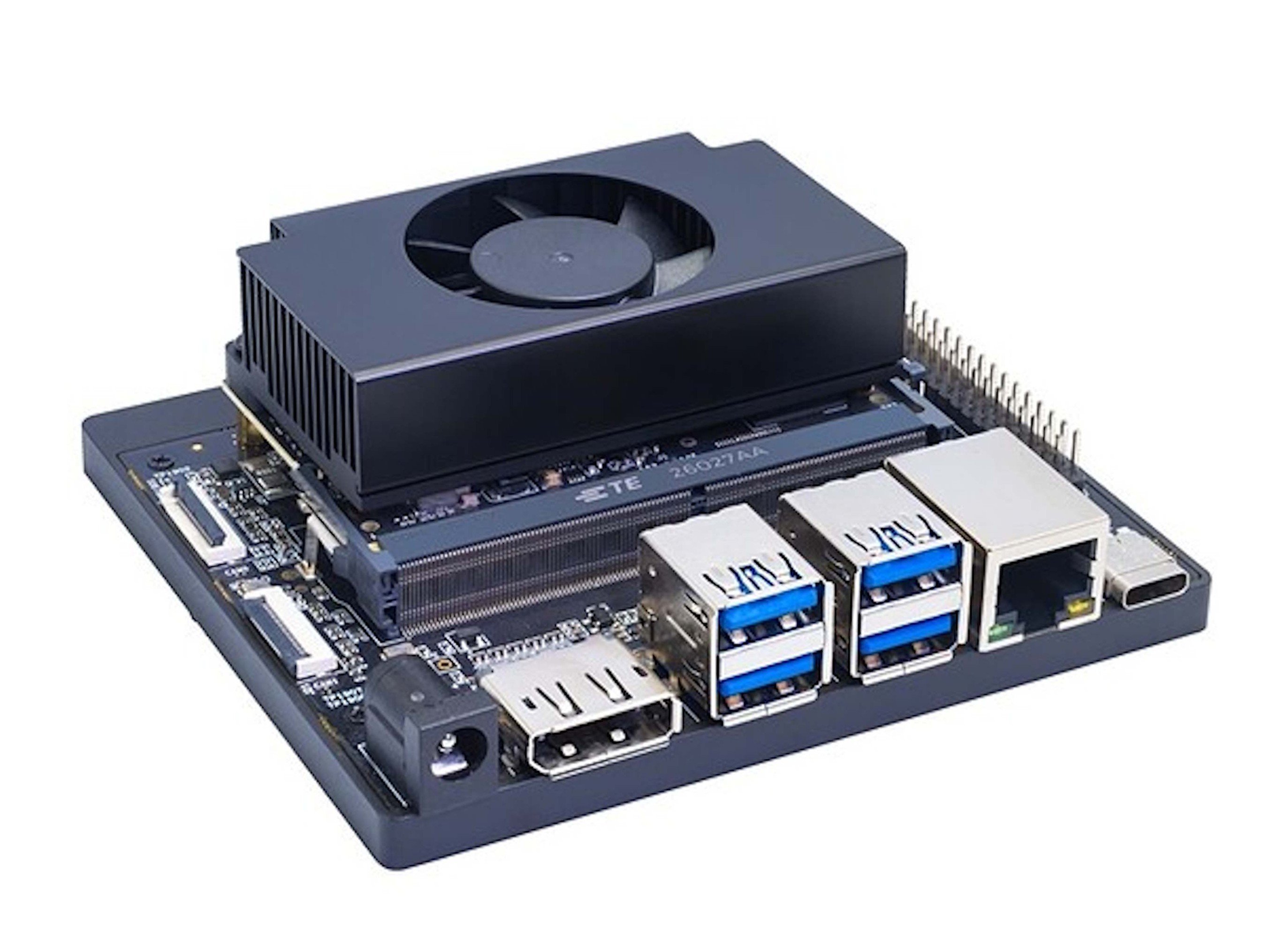
This modular design offers flexibility, as Banana Pi indicates the compute module could potentially be used with other carrier boards, opening possibilities for specialized applications or form factors.
Hardware Specifications: Focus on AI Performance
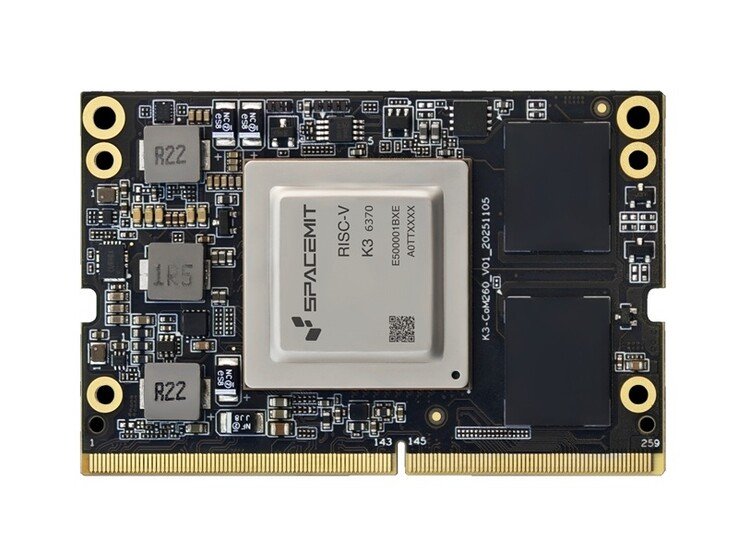
The heart of the BPI-SM10 is the SpacemiT K3 processor, which combines traditional compute cores with specialized AI acceleration hardware. The processor configuration includes:
- Eight X100 compute cores arranged in two clusters of four cores each
- Maximum clock speed of 2.4 GHz
- Shared L2 cache between cores in each cluster
- Eight A100 cores specifically designed for AI model acceleration
The AI acceleration capabilities are particularly impressive, with performance rated at up to 60 TOPS (Tera Operations Per Second). This raw computational power enables the system to handle complex AI tasks that would be impractical on more conventional SBCs like the Raspberry Pi 5.
Banana Pi provides a practical benchmark for AI performance, stating that the system can run Large Language Models (LLMs) with 30 billion parameters at more than 10 tokens per second. This level of performance makes the BPI-SM10 suitable for real-time AI applications including natural language processing, computer vision, and edge AI inference.
Memory options include LPDDR5 with capacities of 8GB, 16GB, or 32GB, providing ample memory bandwidth for both traditional computing tasks and AI workloads. The system operates with a power consumption between 18 and 35 watts, making it relatively efficient for its class of performance.
How It Compares to Raspberry Pi 5 and Alternatives
When compared to the Raspberry Pi 5, the BPI-SM10 offers several advantages, particularly for AI applications. The Raspberry Pi 5, while a significant improvement over its predecessors with its quad-core ARM Cortex-A76 processor and up to 8GB of RAM, lacks dedicated AI acceleration hardware. The BPI-SM10's 60 TOPS AI performance far exceeds what can be achieved through software-based AI acceleration on the Pi 5.
The modular design also provides advantages over the all-in-one approach of the Raspberry Pi. The ability to swap compute modules or use the same module with different carrier boards offers flexibility for specialized applications or form factors that might not be practical with a fixed SBC design.
Nvidia's Jetson platform remains a key competitor in the high-performance SBC space for AI applications. Products like the Jetson Nano or Jetson Orin offer similar levels of AI performance but typically come with a higher price point and potentially higher power consumption. The BPI-SM10, with its RISC-V architecture and competitive specifications, could position itself as a more cost-effective alternative for developers and hobbyists looking to experiment with AI on edge devices.
The inclusion of multiple M.2 slots is another significant advantage over the Raspberry Pi 5, which offers limited storage expansion options. This makes the BPI-SM10 more suitable for applications requiring substantial local storage, such as video processing systems or AI applications with large model or dataset requirements.
Who It's For: Target Applications and Users
The Banana Pi BPI-SM10 is particularly well-suited for several use cases:
AI Development and Research: The dedicated AI acceleration cores make it ideal for developers working on machine learning models, computer vision applications, or natural language processing projects.
Edge Computing Devices: With its balance of performance, power efficiency, and connectivity, the BPI-SM10 can serve as the brain for edge computing devices that need to process AI workloads locally without cloud connectivity.
Industrial Applications: The robust connectivity options and modular design make it suitable for industrial control systems, monitoring devices, and other embedded applications requiring specialized interfaces.
Educational Institutions: For universities and technical schools looking to provide hands-on experience with AI hardware, the BPI-SM10 offers a more affordable entry point than professional-grade AI development boards.
Hobbyists and Makers: While more powerful than traditional SBCs, the BPI-SM10 maintains a level of accessibility that makes it suitable for advanced hobbyists looking to push the boundaries of what's possible with single-board computers.
Availability and Future Potential
As of the time of writing, the Banana Pi BPI-SM10 is not yet available, but its announcement has generated significant interest in the SBC community. The modular design suggests that Banana Pi may plan to expand the ecosystem with additional carrier boards or specialized compute modules in the future.
The adoption of RISC-V architecture in this product represents an interesting development in the SBC space. RISC-V offers advantages in terms of open architecture and potential customization, though it currently has less software support compared to the ARM architecture used in the Raspberry Pi. As RISC-V continues to mature, products like the BPI-SM10 could help drive broader adoption of this processor architecture in embedded systems.
Conclusion
The Banana Pi BPI-SM10 represents a compelling evolution in the single-board computer market, particularly for applications requiring AI acceleration. Its combination of traditional SBC functionality with specialized AI processing hardware, modular design, and competitive specifications positions it as a strong alternative to the Raspberry Pi 5 and other SBCs in the market.
While the exact pricing and availability details are still pending, the BPI-SM10's capabilities suggest it will appeal to developers, researchers, and advanced users looking for more computational power, particularly for AI workloads, than what's available in mainstream SBCs. The system's balance of performance, connectivity options, and power efficiency makes it suitable for a wide range of applications from edge computing to industrial automation.
As the SBC market continues to evolve, products like the BPI-SM10 demonstrate the increasing sophistication of these small yet powerful computing devices, expanding the possibilities for what can be achieved with embedded systems.
Comments
Please log in or register to join the discussion