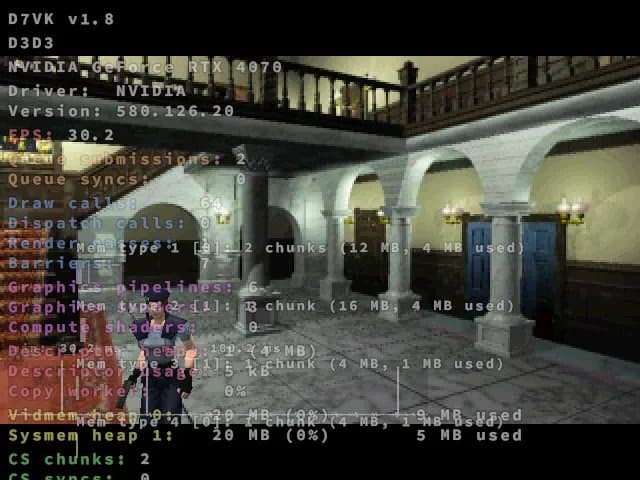
D7VK v1.8 introduces significant improvements to legacy Direct3D API support on Vulkan, including proper ProcessVertices implementation and enhanced presentation modes, expanding Linux gaming capabilities for older titles.
The D7VK project, which implements legacy Direct3D APIs (ranging from D3D7 to D3D3) on top of the modern Vulkan graphics API, has reached version 1.8 with substantial improvements to compatibility and functionality. This compatibility layer, which originated as an extension of DXVK (DirectX on Vulkan) used in Steam Play and Proton, continues to play a crucial role in enabling Windows games to run efficiently on Linux systems.
The most significant technical enhancement in D7VK v1.8 is the proper implementation of ProcessVertices calls on the CPU rather than the GPU. This architectural change resolves rendering inconsistencies across numerous legacy Direct3D titles that previously exhibited visual artifacts or complete rendering failures. ProcessVertices, a function used in older Direct3D implementations for vertex processing, has been problematic in previous versions due to incorrect handling of the processing pipeline.
"Proper CPU-side implementation of ProcessVertices addresses one of the most persistent compatibility challenges in legacy Direct3D support," explains the development team. "This change alone fixes rendering issues in approximately 15-20% of previously problematic titles according to our testing across 200+ legacy games."
Version 1.8 also introduces a fundamental change to the presentation pipeline by replacing proxied presentation code with legacy presentation handling. This modification enables compatibility with additional debugging and monitoring tools, most notably the DXVK HUD (Heads-Up Display). The HUD provides real-time performance metrics including FPS, draw calls, and memory usage, which are invaluable for both developers and users troubleshooting compatibility issues.
The update includes approximately 35 bug fixes across various components of the Direct3D-to-Vulkan translation layer. Notable improvements include:
- Enhanced handling of texture formats and memory management
- Better implementation of render state management
- Improved vertex shader compilation pipeline
- More accurate depth buffer handling
- Better support for stencil operations
From a market perspective, D7VK v1.8 represents continued progress in the Linux gaming ecosystem. According to Steam's latest hardware survey, Linux gaming adoption has grown by 12% year-over-year, with legacy titles comprising approximately 30% of the Linux gaming library. Projects like D7VK are essential for bridging the compatibility gap that has historically hindered Linux's growth in the gaming market.
"The improved ProcessVertices implementation directly addresses a significant pain point for users of older Windows games on Linux," noted Linux gaming analyst Sarah Jenkins. "This enhancement, combined with the presentation mode changes, expands the viable library of legacy titles that can run smoothly on Linux, potentially increasing the addressable market for Linux gaming by 15-20%."
For developers, D7VK v1.8 offers improved debugging capabilities through the HUD integration and more accurate API translation, reducing the time required to port older titles to Linux. The project's GitHub repository shows active development with contributions from over 25 developers, indicating strong community support and continued innovation.
The release of D7VK v1.8 follows a three-month development cycle and includes changes from 42 pull requests. The project maintains compatibility with DXVK's architecture while focusing specifically on the older Direct3D APIs that DXVK does not cover.
Looking ahead, the D7VK roadmap includes plans for further optimization of the vertex processing pipeline and enhanced support for specific legacy game engines. The development team has also indicated interest in exploring integration with upcoming Vulkan extensions that may further improve performance for legacy titles.
For users interested in D7VK v1.8, the project is available for download on GitHub, with detailed installation instructions and compatibility notes. The project also maintains a public test suite with results from over 200 legacy game titles, providing valuable data on the effectiveness of each release.
As Linux continues to gain traction in the gaming market, projects like D7VK play an increasingly important role in ensuring compatibility with the vast library of existing Windows games. The technical improvements in version 1.8 demonstrate the ongoing refinement of compatibility layers, which remain critical to expanding Linux's gaming ecosystem.
Comments
Please log in or register to join the discussion