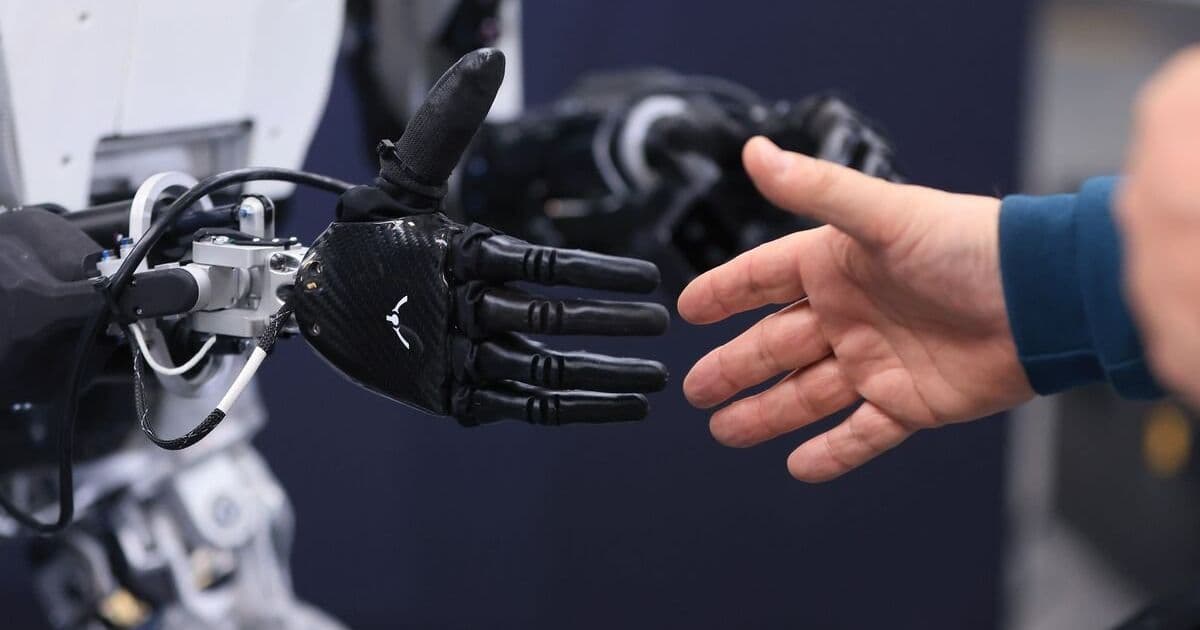
Stuttgart-based Sereact has secured $110 million in Series B funding to develop AI software that enables industrial robots to handle tasks beyond their explicit training, addressing a key limitation in traditional industrial automation.
The industrial robotics sector has long been constrained by the inflexibility of traditional automation systems. Most factory robots are meticulously programmed for specific, repetitive tasks and struggle significantly when encountering novel situations or objects. Stuttgart-based Sereact aims to address this fundamental limitation with its AI-powered software platform, which has now attracted $110 million in Series B funding led by Headventure.
What Sereact Claims
Sereact's technology promises to transform industrial robots from rigid, single-purpose machines into adaptable systems capable of handling tasks they weren't explicitly trained for. This represents a significant departure from conventional robotics programming, which typically requires precise specifications for every possible scenario the robot might encounter.
The company's approach appears to leverage advanced AI models to enable robots to generalize from limited training data and apply learned skills to new situations. This could dramatically reduce the programming time and costs associated with deploying industrial robots while expanding their utility in complex, unstructured environments.
What's Actually New
While the concept of "learning robots" isn't entirely new, Sereact's implementation appears to focus on practical industrial applications rather than research-oriented demonstrations. The key innovation appears to be in developing AI models that can reliably operate in the constrained but unpredictable environments of real factories.
Traditional industrial robots operate in highly controlled environments with predictable variables. Sereact's technology seems designed to bridge the gap between these controlled settings and the messy reality of real-world manufacturing, where objects may vary slightly in position, orientation, or appearance.
The technical approach likely combines several advanced techniques:
- Simulation-to-real transfer: Training AI models in virtual environments before deploying them to physical robots
- Few-shot learning: Enabling robots to learn new tasks with minimal demonstrations
- Robust perception systems: Computer vision models that can reliably identify and grasp objects despite variations
- Reinforcement learning: Allowing robots to improve their performance through interaction with the environment
These techniques, while individually established in research, appear to be combined in a practical, industrial-ready solution by Sereact. The company's approach reportedly uses a combination of deep learning architectures optimized for robotic manipulation, though specific model names and architectures have not been publicly disclosed.
Potential Applications
The technology could have significant implications across multiple industries:
- Manufacturing: Assembly lines where products have variations or require adjustments
- Logistics: Warehouses where robots need to handle diverse, unpredictably arranged items
- Agriculture: Harvesting crops that grow in irregular patterns
- Construction: Tasks requiring adaptability to changing environments
- Quality control: Inspection processes that need to accommodate product variations
In these scenarios, traditional programming approaches would become prohibitively complex or expensive, limiting the economic viability of automation.
Technical Limitations and Challenges
Despite the promising concept, several technical and practical challenges remain:
Safety and reliability: In industrial settings, robot failures can cause significant damage. Ensuring that AI systems make safe decisions in all scenarios is critical but difficult.
Data requirements: While the technology aims to reduce training needs, effective AI models still require substantial high-quality data collection, which can be expensive and time-consuming.
Computational demands: Advanced AI models typically require significant computational resources, potentially limiting deployment on existing factory hardware.
Integration with existing systems: Many factories have established automation infrastructure. Retrofitting new AI capabilities can be technically challenging.
Explainability: Industrial operators need to understand why a robot makes certain decisions, particularly for troubleshooting and maintenance purposes.
The Competitive Landscape
Sereact isn't alone in pursuing more capable industrial robotics. Other companies working on similar challenges include:
- Avidbots: Focuses on autonomous floor-cleaning robots
- Formant: Provides robot management and data platforms
- Covariant: Develops AI for robotics manipulation using deep learning
- Plus One Robotics: Combines AI with traditional industrial robotics
What sets Sereact apart appears to be its focus specifically on enabling robots to handle entirely novel tasks rather than simply optimizing existing ones.
Funding Implications
The $110 million Series B funding, led by Headline, indicates strong investor confidence in Sereact's technology and market potential. This level of investment suggests that the company is pursuing a substantial market opportunity and has made sufficient technical progress to justify significant financial backing.
For comparison, Series B rounds in the robotics sector typically range from $30-100 million, making Sereact's funding notably substantial. This suggests that either the company's technology represents a significant advancement or the market opportunity is particularly large.
Future Outlook
If Sereact's technology delivers on its promises, it could accelerate the adoption of industrial automation in sectors where the inflexibility of traditional robots has been a barrier. This could lead to increased productivity, reduced labor costs, and the ability to automate tasks previously considered too complex for robots.
However, the company will need to demonstrate not just technical capability but also reliability, safety, and economic viability in real-world deployments. The path from promising technology to widely adopted industrial solution is typically long and challenging.
The success of Sereact could also influence the broader robotics industry, potentially shifting focus toward more adaptable, AI-powered systems rather than increasingly optimized traditional approaches. As industrial manufacturers face increasing pressure to improve efficiency while accommodating product customization and shorter production runs, technologies that enable greater robotic flexibility may become essential competitive advantages.
Comments
Please log in or register to join the discussion