The legal tech ecosystem gains a powerful open-source tool with Legal Markdown JS—a full Node.js/TypeScript reimplementation of the Ruby-based document processor. Achieving 100% feature parity while adding AST-based processing, pipeline architecture, and interactive CLI tools, it brings legal document automation to the JavaScript ecosystem. Developers can now dynamically generate contracts with conditional clauses, cross-references, and mixins using familiar tools.
Legal Markdown JS: Node.js Revolution Hits Legal Document Automation
For years, legal professionals and technologists have wrestled with the tension between precise document requirements and flexible automation. Contracts demand conditional clauses, cross-references, and reusable templates—elements notoriously difficult to manage in traditional word processors. The original Ruby-based LegalMarkdown offered a text-based solution, but its new JavaScript successor transforms the landscape entirely. Legal Markdown JS arrives as a complete Node.js/TypeScript reimplementation with 100% feature parity plus modern enhancements that leverage the full JavaScript ecosystem.
Beyond Porting: A Strategic Evolution
This isn't merely a language translation. The team prioritized three core pillars:
- Faithful replication of the Ruby tool's behavior in
src/core/ - Node.js-specific extensions in
src/extensions/ - TypeScript's type safety throughout
The result bridges legacy compatibility and modern innovation. As one contributor notes:
"We preserved every ounce of legal document semantics from the original while unleashing Node.js capabilities like AST processing and pipeline architecture. It's a best-of-both-worlds approach."
The Developer Experience Revolution
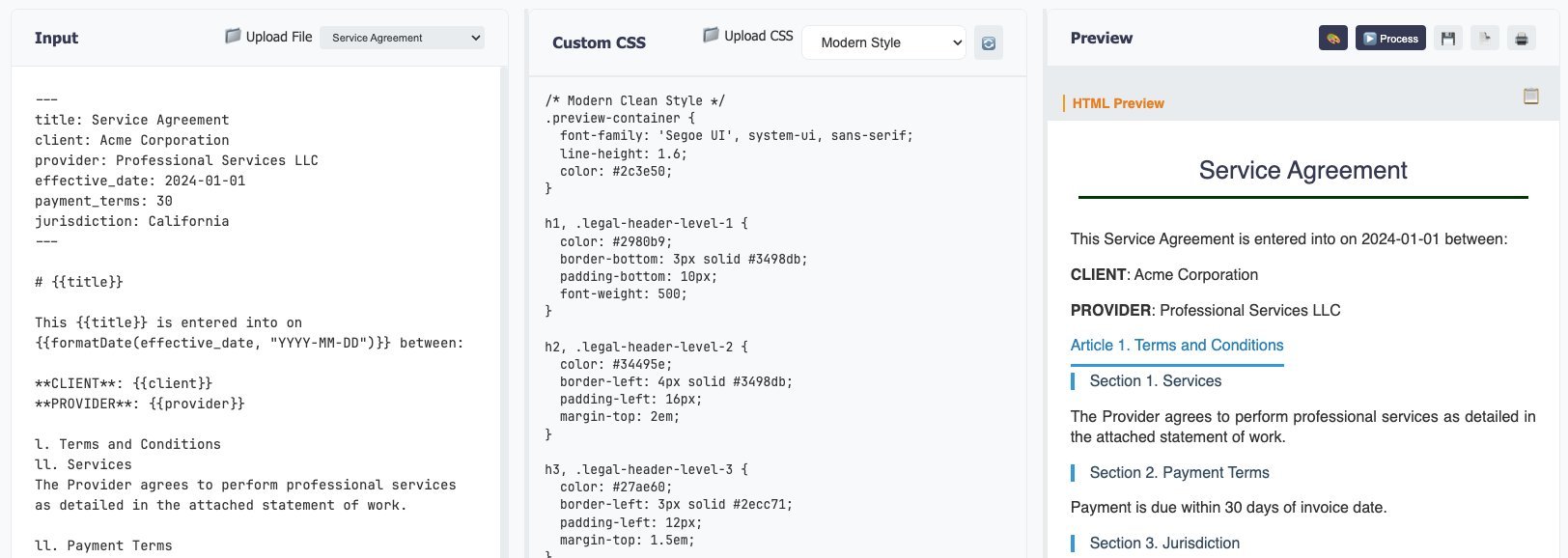
Example output showing conditional clauses and hierarchical numbering in Legal Markdown JS
Installation is standard npm fare (npm install legal-markdown-js), but the tooling suite surprises:
legal-md-ui # Interactive CLI with smart file discovery
legal-md-playground # Local or browser-based testing environment
legal-md-setup # Guided configuration wizard
The interactive CLI adapts options based on output formats—select PDF generation, and CSS styling choices automatically appear. For developers, the programmatic API offers sync and async processing:
const { content, metadata } = await processLegalMarkdownAsync(text, {
  exportFormat: 'json',
  enableFieldTracking: true,
  highlight: true // Visually flag conditional clauses in PDFs
});
Architectural Breakthroughs
Version 2.4.0 introduced a ground-up pipeline redesign:
- AST-Based Processing: Mixins (
{{variable}}) now parse via Abstract Syntax Trees, preventing text contamination - Dependency-Aware Steps: Ensures clauses, imports (
@import), and references (|section|) resolve in correct sequence - Performance Monitoring: Built-in profiling for each processing stage
- Graceful Degradation: Automatically falls back to legacy methods if pipeline errors occur
This architecture enables previously impossible features like template loops:
{{#parties}}
- {{name}} ({{address}})
{{/parties}}
Why This Matters for Legal Tech
Legal Markdown JS transforms contracts from static documents into dynamic artifacts:
- Version Control Integration: Treat legal templates like code with Git
- CI/CD Pipelines: Automate document generation in deployment workflows
- Cross-Platform Collaboration: JavaScript's ubiquity eases teamwork between legal and engineering
- Field Tracking: Audit trails show exactly which clauses activated under specific conditions
The MIT-licensed project actively seeks contributors, offering extensive documentation for both users and developers. With enterprises increasingly automating legal workflows, this Node.js shift makes sophisticated document engineering accessible to mainstream JavaScript developers—potentially accelerating innovation in compliance-heavy industries.
As legal tech converges with developer ecosystems, tools like Legal Markdown JS demonstrate how specialized domains can leverage general-purpose platforms without sacrificing domain-specific precision. The future of contract management might just compile with TypeScript.
Comments
Please log in or register to join the discussion