Lemonade 10.1 improves local LLM performance on AMD hardware with better CLI tools, Gemma 4 support, and image upscaling.
Lemonade 10.1 has arrived with significant improvements for running local large language models on AMD GPUs and NPUs, marking another milestone in making AI workloads more accessible on AMD hardware. The latest release, announced by Michael Larabel on April 7, 2026, builds upon the foundation laid by version 10.0, which finally enabled AMD Ryzen AI NPUs to run LLMs under Linux.
Enhanced Command Line Interface
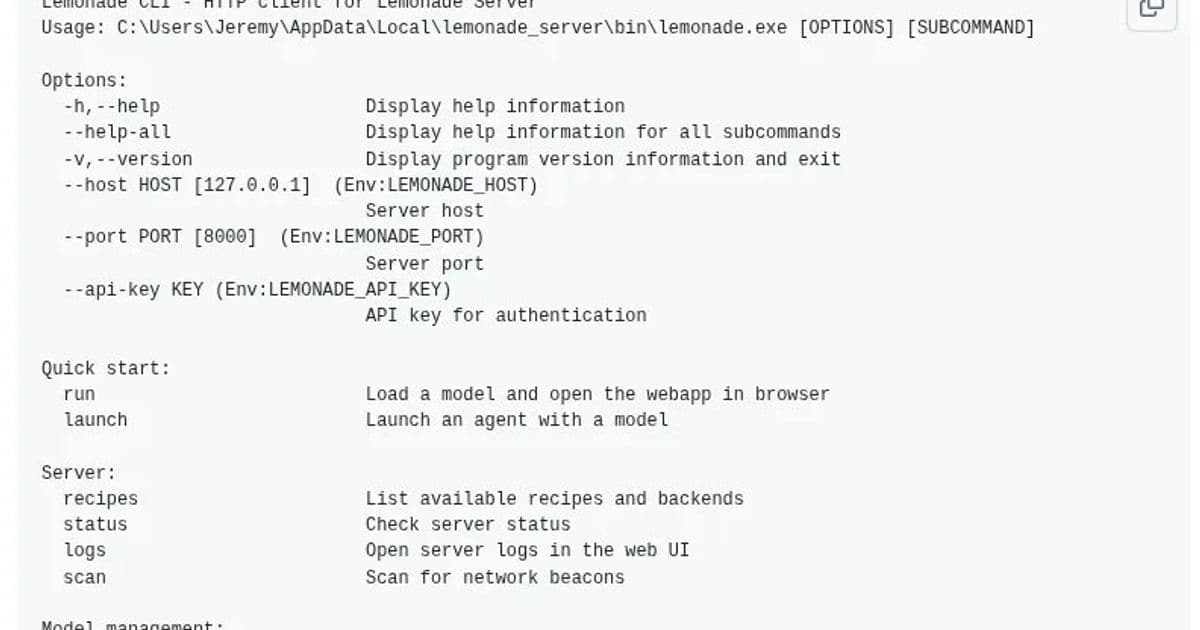
The most noticeable change in Lemonade 10.1 is the revamped command line interface. The developers describe the new CLI as a "much nicer way" of interacting with the service, with the lemonade-server CLI now simply called lemonade and "massively simplified." This streamlining makes the tool more approachable for users who want to run local AI applications without wrestling with complex command structures.
The lemonade launch sub-command has received particular attention. Users can now select models from a list rather than typing out full model names, which significantly reduces the friction of getting started. The team has also restored async model loading, added support for API keys with the "--api-key" flag, and introduced several other usability improvements that make the experience more polished.
AI-Powered Coding and Image Upscaling
For developers, Lemonade 10.1 introduces "supercharged" coding capabilities with improved lemonade launch codex|claude functionality. This enhancement likely refers to better integration with coding-focused models like Codex and Claude, making Lemonade more useful for programming tasks and code generation.
The release also brings super resolution upscaling to generated images, expanding Lemonade's capabilities beyond text generation. This feature allows users to enhance image quality directly through the Lemonade pipeline, which could be particularly useful for creative applications or when working with lower-resolution source material.
Expanded Model Support
Lemonade 10.1 now supports Gemma 4 models on GPUs, broadening the range of available models for users. Gemma, Google's family of open models, has been gaining traction in the AI community, and this addition gives AMD hardware users access to these capable models for local inference.
Installation Options
The project continues to offer multiple installation methods to accommodate different user preferences and system configurations. In addition to the open-source code available on GitHub, users can download a Linux AppImage build or use distribution-specific packages including an Ubuntu PPA and Fedora RPM. This flexibility ensures that Lemonade can be deployed across various Linux environments with minimal friction.
AMD Hardware Focus
Lemonade's development trajectory shows a clear focus on AMD hardware optimization. The transition from version 10.0 to 10.1 represents incremental but meaningful improvements in the local LLM ecosystem for AMD users. By providing a solution that can leverage both GPUs and NPUs while falling back to modern x86_64 CPUs, Lemonade offers a versatile platform for AI workloads that adapts to available hardware resources.
The continued development of Lemonade demonstrates the growing maturity of the local LLM ecosystem, particularly for AMD hardware users who have historically had fewer options compared to NVIDIA users. With each release, the barriers to running sophisticated AI models locally continue to decrease, enabling more users to explore AI capabilities without relying on cloud services.
For those interested in trying Lemonade 10.1, the project maintains active development on GitHub with installation instructions and documentation available for both Windows and Linux platforms.
Comments
Please log in or register to join the discussion