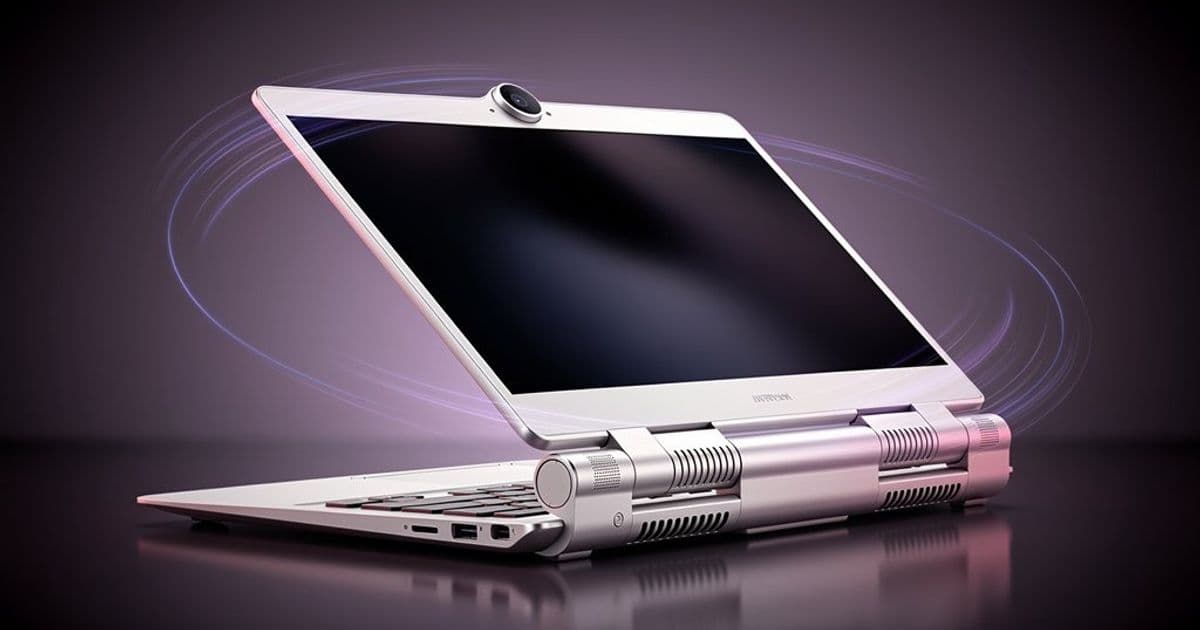
Lenovo is turning its experimental ThinkBook Plus line into a production model this June, shipping a laptop with a motorized hinge that automatically twists the screen 180 degrees and tracks users via webcam. The $1,650 ThinkBook Plus Gen 7 Auto Twist evolved from a 2024 concept, now featuring voice controls, improved motor durability, and a unique approach to convertible design that eliminates manual lid manipulation.
From Concept to Consumer: Lenovo's Automated Convertible Hits the Market
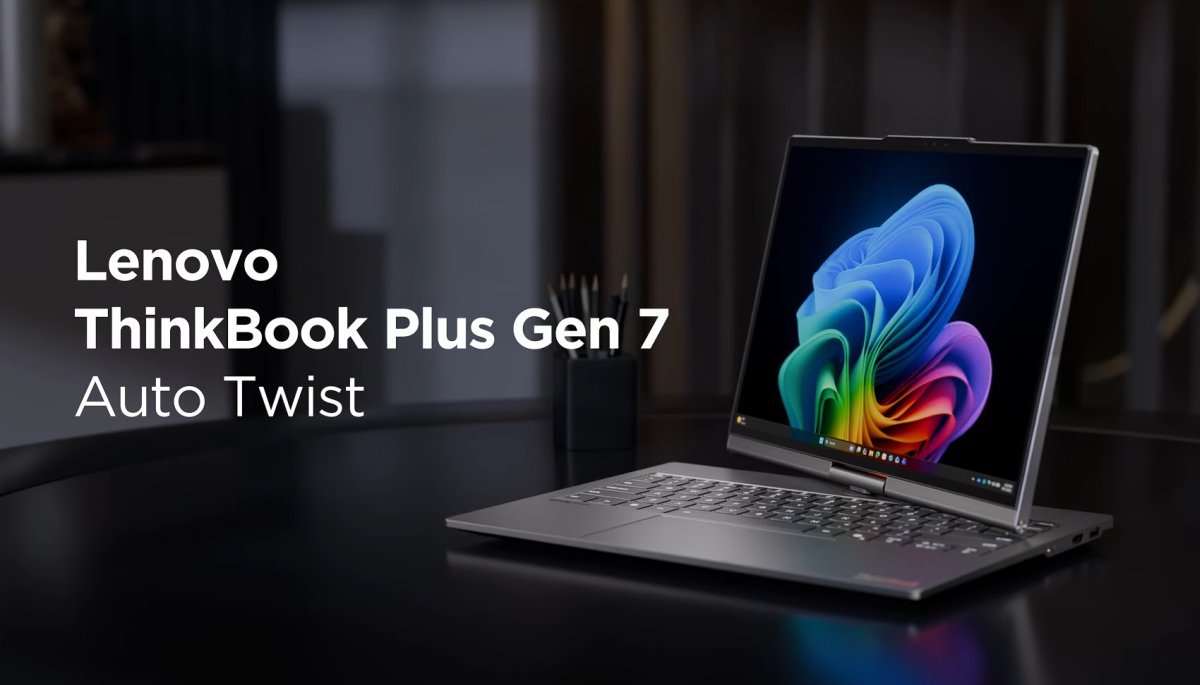
Lenovo's ThinkBook Plus line has always been the company's playground for experimental laptop features, but the upcoming Gen 7 Auto Twist represents something genuinely different. What started as a 2024 concept device is now a shipping product you'll be able to buy in June for $1,650, and it brings a motorized hinge system that fundamentally changes how you interact with a laptop's display.
The core concept is deceptively simple: a 14-inch 2.8K OLED display with a 120Hz refresh rate sits on a hinge that can rotate 180 degrees, allowing the laptop to transform into tablet, tent, or stand configurations. The twist—literally—is that this rotation happens automatically. The motorized hinge responds to voice commands and uses the built-in 10MP IR camera to track your position, adjusting the screen angle as you move around your workspace.
The Technology Behind the Auto-Twist
This isn't just a gimmick bolted onto standard laptop hardware. Lenovo engineered an entirely new mechanism that addresses the fundamental friction points of convertible laptops. Traditional 2-in-1s require you to physically grab the display and rotate it, which means you need to stabilize the base with one hand while manipulating the lid with the other. The Auto Twist eliminates this entirely.
The motor system has received significant refinement since the concept reveal. Lenovo claims the production version runs quieter while supporting faster rotation speeds. More importantly, they've improved durability—a critical concern for any moving part in a laptop. The company hasn't specified exact MTBF (mean time between failure) ratings, but given that this is launching as a consumer product rather than a concept, the mechanism must meet standard laptop reliability expectations.
The voice control system integrates with Windows 11's voice recognition capabilities, though Lenovo hasn't detailed whether this uses custom wake words or standard system commands. The camera-based tracking suggests computer vision processing happening locally, which would explain the need for an Intel Core Ultra Series 3 processor with its dedicated NPU (Neural Processing Unit).
Hardware Specifications and Practical Considerations
Beyond the rotating mechanism, the ThinkBook Plus Gen 7 Auto Twist packs competent hardware:
Processor: Intel Core Ultra Series 3 (exact model numbers TBD) Memory: Up to 32GB LPDDR5x-9600 Storage: M.2 2280 slot supporting up to 2TB PCIe NVMe Display: 14-inch 2.8K OLED, 120Hz refresh rate Camera: 10MP IR with Windows Hello face recognition Ports: 2x Thunderbolt 4, 2x USB 3.2 Gen 2 Type-A, HDMI 2.1, 3.5mm audio Audio: Stereo 2W speakers, 4-microphone array Dimensions: 313 x 233 x 24mm (12.3" x 9.2" x 0.9") Weight: 1.4kg (3.1 pounds)
The 10MP camera deserves special attention. Beyond face recognition for Windows Hello, it enables a unique video conferencing feature: as you move during a call, the screen physically rotates to keep you centered in the frame. This eliminates the need for digital cropping and zooming, maintaining full resolution and aspect ratio. For remote workers who spend hours in video meetings, this could be a genuine productivity improvement.
The port selection is modern and practical. Two Thunderbolt 4 ports provide high-speed connectivity and display output, while the two USB-A ports ensure compatibility with older peripherals. HDMI 2.1 supports high-resolution external displays, and the 3.5mm jack remains essential for many audio applications.
The ThinkBook Plus Legacy
The "Gen 7" designation places this device within Lenovo's established lineage of experimental laptops. Previous ThinkBook Plus models have included:
- ThinkBook Plus Gen 2: Featured a secondary E Ink display on the lid for notifications and quick reading
- ThinkBook Plus Gen 3: Ultra-wide 21:10 main display with a secondary 8-inch screen next to the keyboard
- ThinkBook Plus Twist: Dual-display convertible with both E Ink and OLED panels
What's notable about the Auto Twist is that it doesn't include a second screen or extendable display. Instead, Lenovo is doubling down on the convertible form factor itself, making the transformation process automated rather than adding more screen real estate.
This represents a philosophical shift in the ThinkBook Plus line. Rather than asking "what if we added another display?", Lenovo is asking "what if the laptop physically adapted to your workflow?"
Real-World Use Cases and Limitations
The Auto Twist's automation makes sense for several scenarios:
Presentations: Switch from laptop mode to tablet mode without fumbling with the hinge while standing in front of an audience.
Content consumption: Move from typing at a desk to reclining on a couch, with the screen automatically adjusting its angle.
Video calls: The tracking feature keeps you framed properly even if you shift in your chair or stand up to grab something.
Accessibility: Users with mobility limitations benefit from voice-controlled screen positioning.
However, there are practical questions that will only be answered through real-world testing:
Battery impact: Motors consume power. How much will the auto-rotation system reduce battery life during normal use?
Noise: Even if quieter than the concept, will the motor be noticeable in quiet environments like libraries or meetings?
Durability: Moving parts fail. The hinge mechanism is a known failure point on standard laptops; adding motors and gears introduces more potential issues.
Speed: "Faster rotation" is relative. If it takes 3-4 seconds to rotate, users might still prefer manual control for quick adjustments.
Privacy: The camera-based tracking requires the IR camera to be active and processing. Does this create new privacy concerns?
Pricing and Market Position
At $1,650 starting price, the ThinkBook Plus Gen 7 Auto Twist sits in the premium laptop category. This positions it above most consumer convertibles but below high-end workstations. The price reflects both the experimental nature of the hardware and the underlying specifications—32GB of LPDDR5x memory and 2TB NVMe storage can push the price significantly higher.
Target buyers appear to be:
- Early adopters who want the latest in laptop innovation
- Remote workers who spend extensive time in video calls
- Accessibility-focused users who benefit from automated controls
- ThinkBook Plus loyalists who've purchased previous experimental models
The broader market impact is more interesting. If the Auto Twist proves successful, it could influence mainstream convertible designs. Motorized hinges might become a standard feature in premium laptops, similar to how haptic touchpads evolved from premium to standard.
Cross-Platform Considerations
While the Auto Twist runs Windows, the concept of automated hardware adaptation has implications for cross-platform development. The voice control and camera tracking systems would need platform-specific implementations for macOS or Linux. The motorized mechanism itself is hardware-agnostic, but the software control layer would require OS-level integration.
For developers building cross-platform applications, the Auto Twist introduces new variables. Apps need to handle screen rotation events that happen automatically, potentially interrupting user input. Video conferencing software could leverage the tracking feature, but would need to coordinate with Lenovo's control system.
The Broader Trend
Lenovo's approach reflects a growing trend in hardware: using automation to reduce friction in user interactions. We've seen this with:
- Automatic brightness adjustment based on ambient light
- Adaptive refresh rates that sync with content
- AI-enhanced cameras that track and frame subjects
- Automatic keyboard backlighting based on hand proximity
The Auto Twist extends this philosophy to physical form factors. It's part of a larger movement toward "ambient computing," where devices anticipate and respond to user needs without explicit commands.
What This Means for Developers
For mobile and desktop developers, the Auto Twist signals that hardware is becoming more dynamic. Applications need to:
- Handle state changes gracefully: Screen rotation events may happen mid-task
- Adapt UI dynamically: Different orientations serve different purposes
- Leverage new sensors: Camera-based tracking provides novel input methods
- Consider power implications: Automated features consume battery
The device also highlights the importance of platform-specific optimization. While cross-platform frameworks like Flutter or React Native handle screen rotation, they may not account for automated rotation events or camera-based tracking.
Availability and Next Steps
The ThinkBook Plus Gen 7 Auto Twist is expected to go on sale in June 2024 through Lenovo's website and authorized retailers. Initial configurations will likely start with 16GB RAM and 512GB storage at the $1,650 price point, with higher-spec models reaching $2,000+.
For developers interested in optimizing for this hardware, Lenovo typically releases SDKs and APIs for their innovative features. The camera tracking system and motor controls would likely be exposed through Windows APIs, potentially allowing third-party applications to integrate with the rotation system.
The real test will be whether the automation provides meaningful value over traditional convertibles. If users find themselves saying "I didn't know I needed this" rather than "this is a neat party trick," the Auto Twist could mark the beginning of a new category of adaptive laptops.
For now, it stands as Lenovo's most ambitious ThinkBook Plus yet—a device that doesn't just add features, but fundamentally reimagines how a laptop's physical form should adapt to human behavior. The summer launch will reveal whether that reimagination translates to real-world utility.
Related Resources:
Comments
Please log in or register to join the discussion