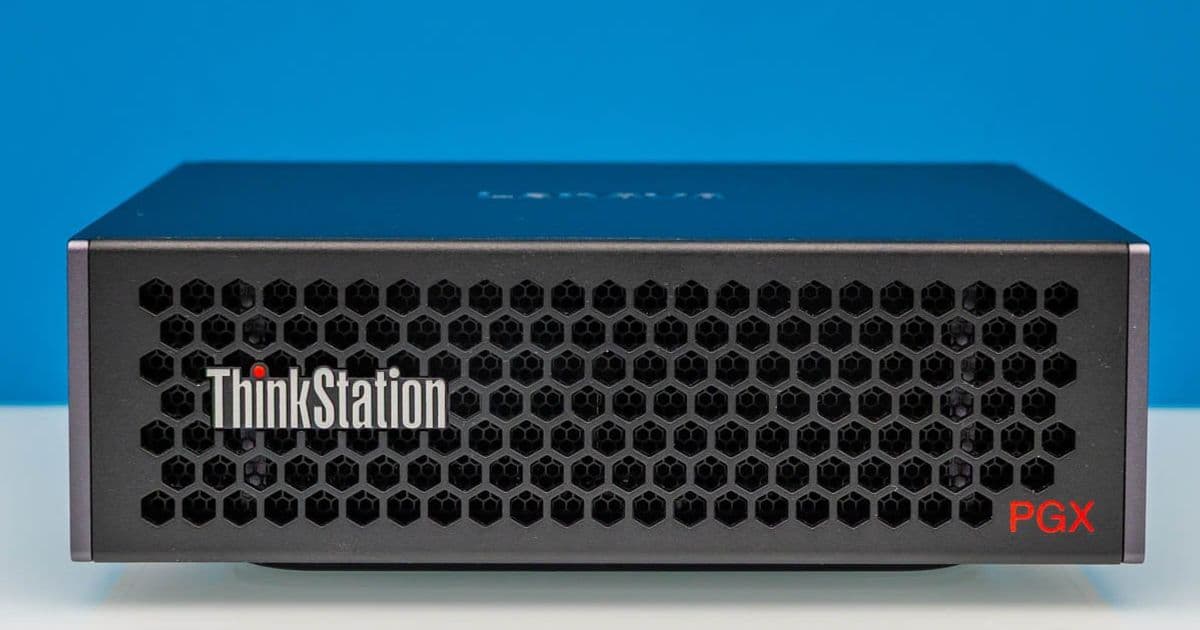
Lenovo's ThinkStation PGX brings the NVIDIA GB10 Superchip to the corporate desktop, combining enterprise-grade support with a compact 1L form factor designed for AI development workloads.
The Lenovo ThinkStation PGX represents a significant milestone in the evolution of AI workstations, marking NVIDIA's first foray into the corporate desktop market with its GB10 Superchip architecture. As one of the most established names in professional computing, Lenovo's decision to brand this compact AI powerhouse with its prestigious ThinkStation moniker signals a strong vote of confidence in NVIDIA's vision for accessible AI development hardware.
Corporate-First Design Philosophy
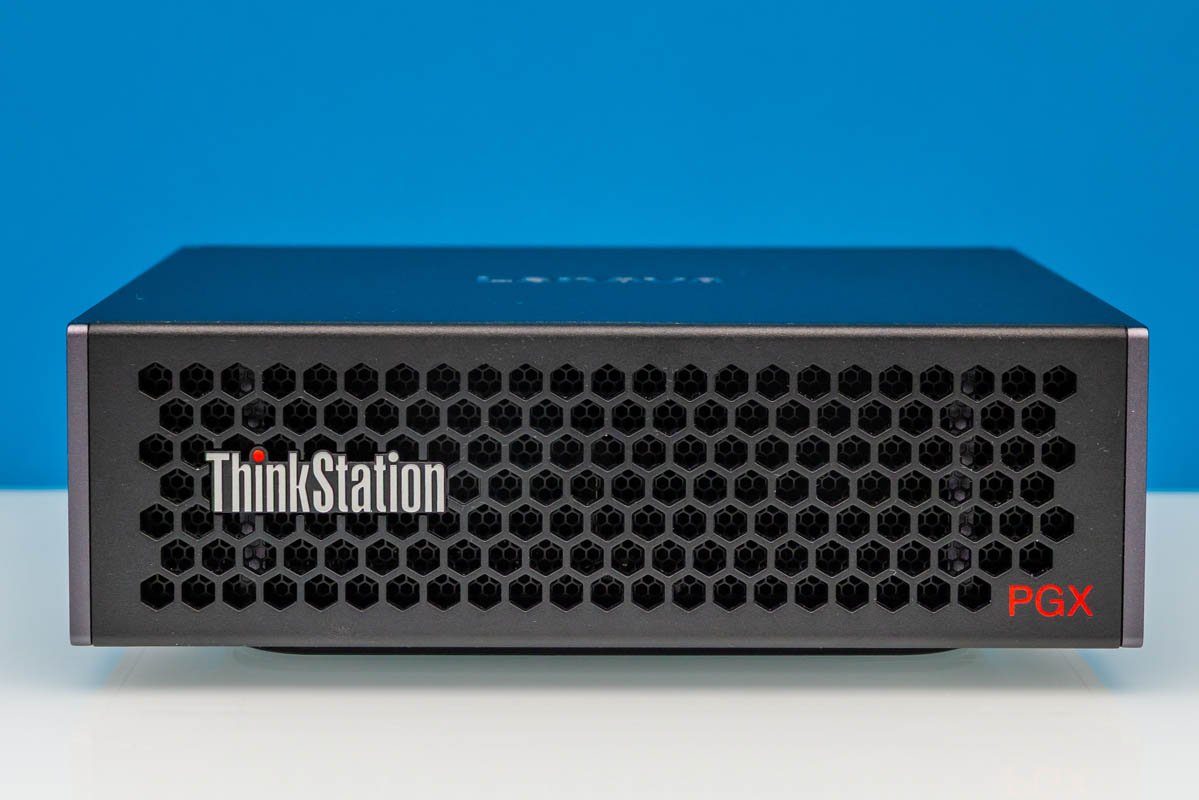
Unlike the flashy golden aesthetic of NVIDIA's own DGX Spark or the silver styling of ASUS's offerings, the ThinkStation PGX embraces a decidedly corporate aesthetic. The all-black chassis with hexagonal ventilation holes immediately communicates its enterprise pedigree, fitting seamlessly into any corporate environment where ThinkPads and ThinkCentres already dominate.
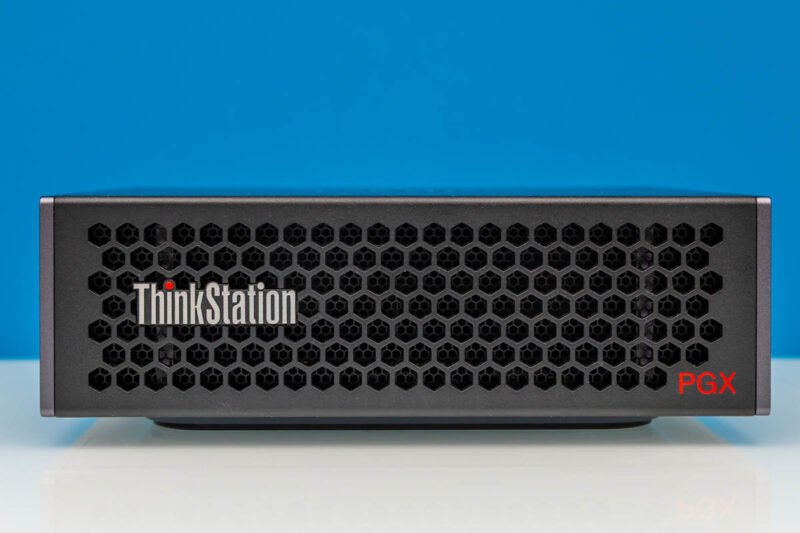
The front panel is intentionally minimalist - a blank slate devoted entirely to airflow with no ports or buttons to interrupt the clean lines. This design choice reinforces the PGX's positioning as a serious workstation rather than a consumer gadget. The power button's relocation to the rear further emphasizes this business-first approach, ensuring the front remains uncluttered and professional.
Compact Form Factor with Enterprise Features
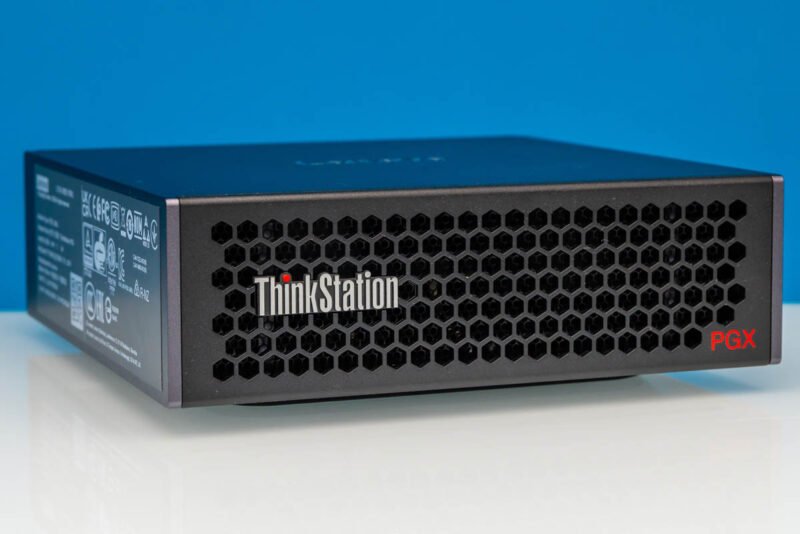
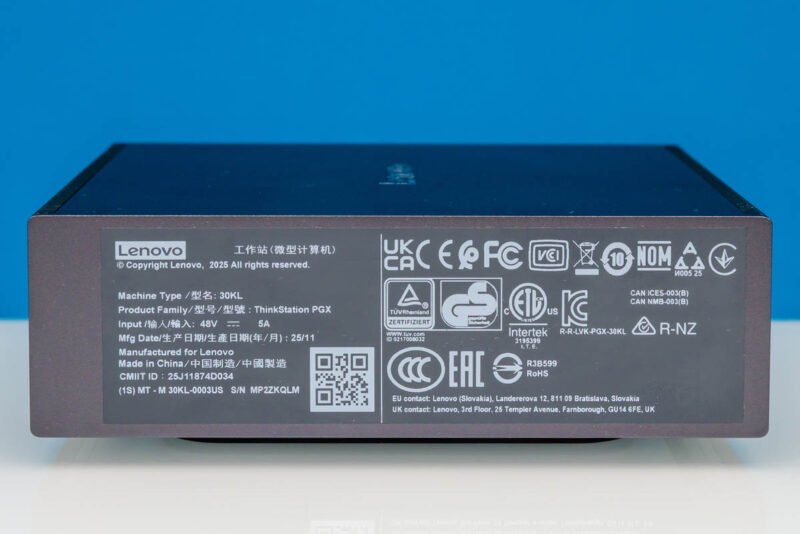
Measuring just 150mm x 150mm x 50.5mm (5.91 x 5.91 x 1.98 inches), the PGX maintains the ultra-compact 1-liter volume that has become standard for GB10 systems. However, Lenovo's attention to corporate usability details sets it apart. The product label placement on the left side rather than the bottom, while seemingly minor, demonstrates thoughtful consideration of how IT departments manage and identify hardware in rack environments or under-desk deployments.
The inclusion of USB Type-C to Type-A adapters in the box is a particularly welcome touch that many competitors overlook. This small gesture acknowledges that many corporate peripherals still use USB-A connectors, allowing users to connect their existing mouse and keyboard without additional adapters.

Comprehensive Connectivity Options
Lenovo has equipped the PGX with a robust port selection that caters to both AI development and general productivity needs:
- Four USB-C 20Gbps ports with DisplayPort 2.1 alt-mode support
- One HDMI 2.1a port for dedicated display output
- 10Gb Ethernet port for local networking
- Two 200Gbps QSFP112 ports for high-performance networking
- Wi-Fi 7 (2×2) + Bluetooth 5.4 for wireless connectivity
The 240W USB-C power adapter provides ample headroom for the GB10's power requirements while maintaining the convenience of a single-cable power solution.
Network Architecture and Scalability
The PGX's networking capabilities represent one of its most compelling features for AI development workloads. The integrated NVIDIA ConnectX-7 NIC with 200Gbps QSFP112 ports enables developers to create multi-node AI clusters with relative ease.
However, the GB10's internal architecture imposes some interesting constraints. While 200Gbps of networking bandwidth would typically require a PCIe 5.0 x8 connection, the GB10 can only provide x4 connections. NVIDIA's solution connects the NIC to a pair of x4 ports, achieving the same aggregate bandwidth but presenting the NIC as four separate network interfaces to the system.
This architecture mirrors what we've seen in high-end networking cards like the NVIDIA ConnectX-8 C8240, scaled down for the GB10 platform. For developers, this means the PGX can serve as an excellent testbed for understanding how their AI workloads will scale across multiple nodes in larger deployments.
The most common configuration we expect to see involves two PGX systems connected via a single 200Gbps cable, creating a compact yet powerful AI development cluster. With an appropriate network switch, this can scale to multiple machines, allowing organizations to start small and expand as their AI development needs grow.
Hardware Specifications and Performance
At its core, the ThinkStation PGX features the same GB10 Superchip configuration found across all current GB10 systems:
- 10x Arm Cortex-X925 cores for high-performance computing
- 10x Arm Cortex-A725 cores for efficiency
- Blackwell GB20B GPU with 48 SMs delivering 1 PFLOP FP4 AI performance
- 128GB LPDDR5X-8533 memory soldered to the board
- 4TB PCIe Gen4 x4 M.2-2242 SSD for storage
- NVIDIA DGX OS for optimized AI development
This consistent hardware foundation across all GB10 systems means that the primary differentiators between vendors come down to support, services, and ecosystem integration rather than raw performance specifications.
Corporate Support and Ecosystem Integration
Where the PGX truly shines is in its enterprise support capabilities. Lenovo's extensive corporate relationships mean that IT departments can procure PGX systems through the same channels they use for their existing ThinkStation deployments. This integration extends to support services, warranty coverage, and management tools that IT administrators already know and trust.
The ability to order AI development workstations alongside standard corporate hardware simplifies procurement processes and ensures consistent support levels across an organization's entire hardware fleet. For enterprises looking to dip their toes into AI development without creating separate support infrastructure, this integration is invaluable.
Market Positioning and Target Audience
The ThinkStation PGX is explicitly designed for organizations that need to bring AI development capabilities in-house but want to maintain their existing corporate IT infrastructure. This includes:
- Research institutions developing AI models that need to scale to larger GPU clusters
- Enterprise development teams prototyping AI applications before deployment to production GPU servers
- Financial institutions running AI workloads that benefit from the GB10's performance in a manageable form factor
- Healthcare organizations developing AI diagnostic tools that require significant computational resources
Competitive Landscape
In the current GB10 ecosystem, the PGX competes with systems from ASUS, Gigabyte, and NVIDIA's own DGX Spark. While the hardware specifications are nearly identical across all platforms, Lenovo's corporate focus and support infrastructure give it a distinct advantage in enterprise environments.
The PGX's closest competitor might actually be Gigabyte's AI TOP ATOM, which shares an identical chassis design. This similarity suggests that both companies are using the same ODM, though Lenovo's ThinkStation branding and corporate support differentiate it significantly in the market.
Value Proposition and ROI Considerations
For organizations considering AI development infrastructure, the PGX offers several compelling advantages:
- Lower entry cost compared to full-scale GPU servers while providing similar development capabilities
- Familiar support model through existing Lenovo relationships
- Scalable architecture that can grow from single-node development to multi-node clusters
- Energy efficiency with the 240W power envelope compared to multi-kilowatt GPU servers
- Compact footprint that fits easily into existing office environments
Conclusion
The Lenovo ThinkStation PGX successfully bridges the gap between cutting-edge AI development hardware and corporate IT requirements. By combining NVIDIA's powerful GB10 Superchip with Lenovo's enterprise support infrastructure, it offers organizations a practical path to in-house AI development without the complexity of managing specialized hardware support.
While the hardware specifications may not differ significantly from other GB10 systems, the PGX's corporate positioning, support integration, and thoughtful design details make it the natural choice for enterprise environments. For organizations already invested in the ThinkStation ecosystem, the PGX represents a logical and compelling addition to their hardware portfolio.
The PGX demonstrates that AI development hardware no longer needs to be confined to specialized data centers or research labs. With its compact form factor, comprehensive connectivity, and enterprise-grade support, Lenovo has created a system that brings AI development capabilities to the corporate desktop where they can be most effectively utilized by development teams.
For IT decision-makers evaluating AI development infrastructure, the ThinkStation PGX deserves serious consideration not just for its technical capabilities, but for how seamlessly it integrates into existing corporate IT operations. It's a system that proves AI development can be both powerful and practical in the enterprise environment.
Comments
Please log in or register to join the discussion