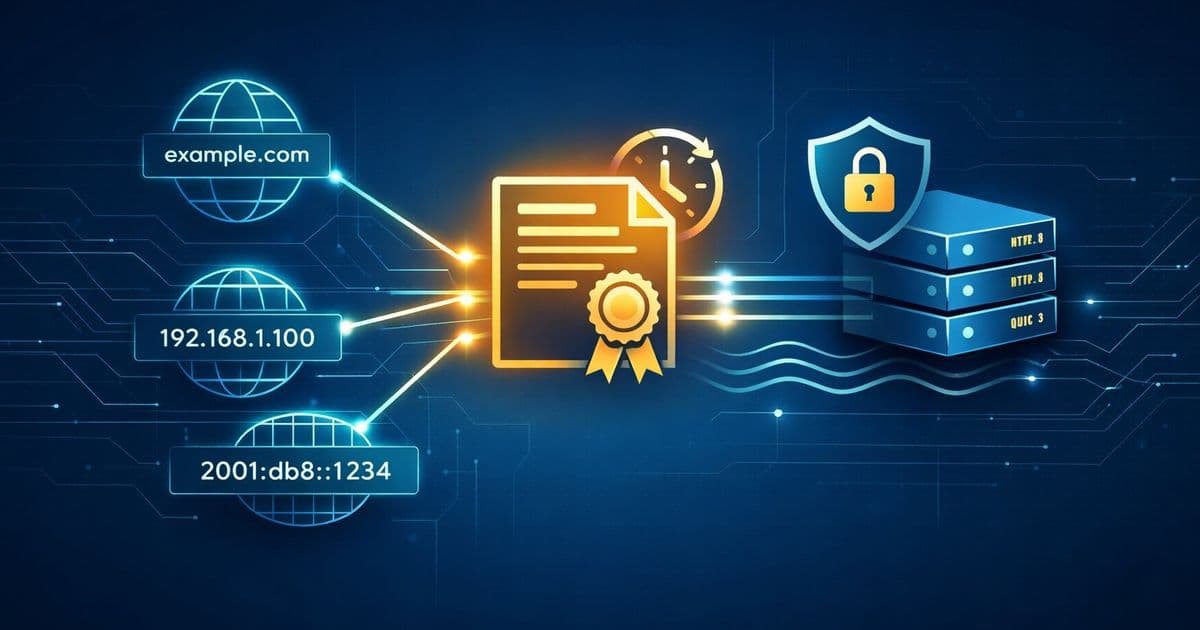
Let's Encrypt has eliminated a long-standing friction point in web security by enabling single certificates to validate both domain names and IP addresses. This advancement simplifies certificate management for developers and sysadmins while maintaining robust encryption standards. The update addresses critical use cases where services require dual identification methods.

For nearly a decade, system administrators and developers have navigated a frustrating limitation in web encryption: SSL/TLS certificates could secure domain names or IP addresses, but not both simultaneously in a single certificate. Let's Encrypt – the nonprofit certificate authority that revolutionized web security with free certificates – has now bridged this gap, fundamentally changing how we approach certificate management.
According to AI Moda's technical analysis, this advancement leverages extensions to the Subject Alternative Name (SAN) field within the X.509 certificate standard. Previously, Let's Encrypt certificates could include multiple domain names via SAN extensions, but IP addresses remained excluded due to validation complexities. The updated system now supports IP address validation through the same Automated Certificate Management Environment (ACME) protocol used for domains.
Why This Matters Beyond Convenience
- Operational Efficiency: Services requiring dual access methods (e.g., internal IP-based access and external DNS resolution) no longer need separate certificate lifecycles
- Reduced Attack Surface: Eliminating certificate sprawl decreases configuration errors and overlooked renewals
- IPv6 Adoption: Native support for IPv6 addresses future-proofs network configurations
- Cost Reduction: Organizations avoid purchasing commercial certificates solely for IP validation
Technical Implementation Insights
To validate IP address ownership, Let's Encrypt requires proof of control via:
- HTTP challenge responses served directly from the IP
- DNS TXT record verification for the reverse DNS zone
Crucially, wildcards remain unavailable for IP addresses, and private IPs (like 192.168.x.x) remain ineligible. Developers can implement this using Certbot with commands like:
certbot certonly --standalone -d example.com --subject-alternative-name 192.0.2.1
This evolution reflects Let's Encrypt's ongoing mission to reduce encryption barriers. As hybrid infrastructure becomes standard – spanning cloud instances, legacy systems, and IoT devices – unified certificate management transforms from convenience to necessity. The change arrives as zero-trust architectures increasingly demand encrypted communication channels regardless of access method.
While enterprise use cases benefit significantly, the update also simplifies development environments where temporary IP-based access remains common. As encryption becomes ubiquitous through initiatives like HTTPS Everywhere, such refinements ensure security doesn't compromise practicality.
Comments
Please log in or register to join the discussion