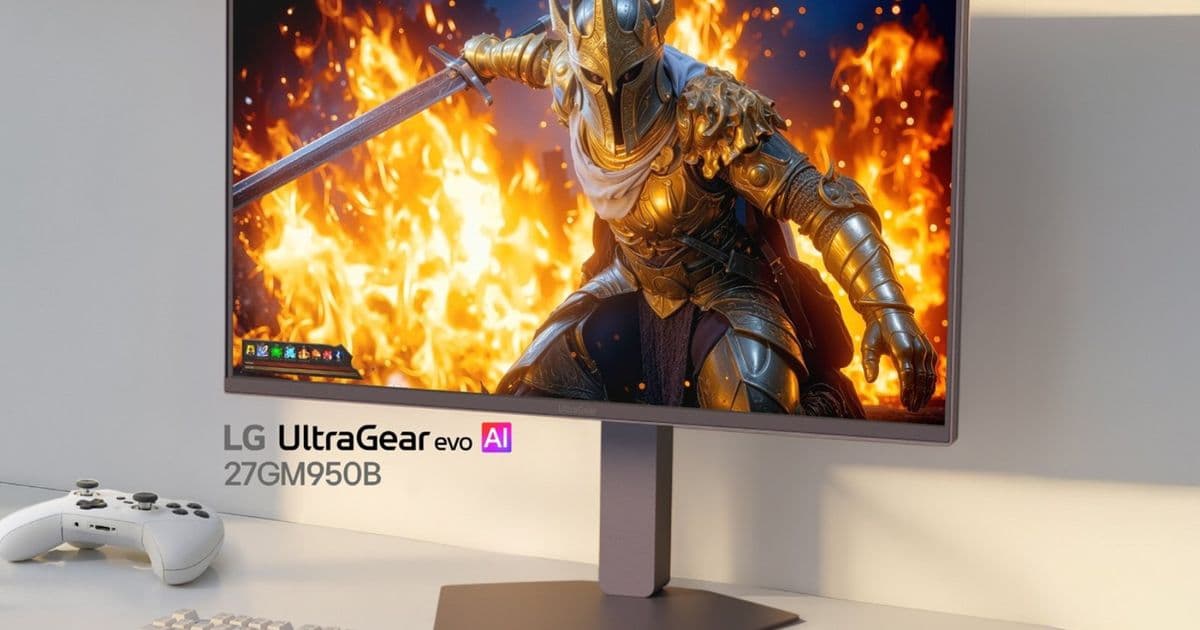
LG is preparing to launch a new 27-inch Mini LED gaming monitor that promises to bridge the gap between OLED's perfect blacks and the high brightness that only traditional backlighting can achieve. The UltraGear Evo 27GM950B features 2,304 local dimming zones and a peak brightness of 1,250 nits, positioning it as a direct competitor to both high-end OLED displays and existing Mini LED offerings from competitors like Samsung and Asus.
LG has provided the first concrete details about its upcoming UltraGear Evo 27GM950B gaming monitor, a 27-inch IPS display that relies on Mini LED backlighting technology to achieve brightness levels that OLED panels simply cannot match. The company originally teased the monitor in late December 2025 alongside the UltraGear Evo 52G930B and UltraGear OLED 39GX950B, but now we have specific specifications that reveal LG's strategy for competing in the premium gaming display market.

What Makes Mini LED Different
The UltraGear Evo 27GM950B's defining feature is its 2,304-zone Mini LED backlight system. Unlike traditional LED monitors that use a handful of dimming zones across the entire panel, Mini LED technology places thousands of tiny LEDs directly behind the IPS matrix. Each zone can independently dim or brighten, allowing the monitor to display bright highlights and dark shadows simultaneously without the blooming effect that plagues standard LED displays.
This architecture enables the 27GM950B to reach 1,250 nits of peak brightness in specific areas while maintaining 0.05 nit black levels. For context, most OLED monitors struggle to exceed 400-600 nits in HDR scenarios, and even the brightest gaming displays rarely surpass 1,000 nits sustained brightness. The trade-off is that Mini LED cannot achieve the per-pixel black levels of OLED—there will be some blooming around bright objects on dark backgrounds—but the brightness advantage is substantial.
The monitor has earned VESA DisplayHDR 1000 certification, which requires sustained 600 nit brightness and 1,250 nit peak brightness. LG claims 99% DCI-P3 color space coverage and DeltaE <2 factory calibration, meaning colors should be accurate enough for professional creative work, not just gaming.
Performance Specifications
Response times are competitive with OLED, though not quite as instantaneous. The 27GM950B promises 1 ms GtG (Gray-to-Gray) response times with Nvidia G-Sync support to eliminate screen tearing. This puts it in line with most high-refresh IPS gaming monitors, though the fastest OLED panels can achieve 0.03 ms or better.
The monitor's versatility shines in its input options and resolution flexibility:
- HDMI, DisplayPort 2.1, and USB Type-C connectivity
- 5K2K (5,210 x 2,880) at 165 Hz for high-resolution gaming and productivity
- WQHD (2,560 x 1,440) at 330 Hz for competitive gaming where speed matters more than pixels
- 90W USB-C power delivery for charging laptops or other devices
DisplayPort 2.1 support is particularly noteworthy. This standard supports significantly higher bandwidth than DP 1.4, enabling the 5K2K resolution at high refresh rates without compression. Many current monitors still use DP 1.4 and rely on Display Stream Compression (DSC), which is visually lossless but technically not "native" output.
Market Positioning
LG's timing is strategic. The 27GM950B sits between two extremes: ultra-fast OLED monitors like the UltraGear OLED 27GX790B ($999.99) and traditional high-refresh IPS displays. OLED offers superior response times and perfect blacks but struggles with brightness and can suffer from burn-in over time. Standard IPS monitors are bright and reliable but lack the contrast and HDR impact of OLED.
Mini LED attempts to split the difference. You get OLED-class HDR impact in bright scenes while maintaining the longevity and brightness advantages of traditional LCD technology. The 2,304 zones should provide much better local dimming than the 576-zone systems found in many current Mini LED monitors, though it still falls short of the 5,000+ zones in some 32-inch professional displays.
For gamers, the key question is whether the brightness advantage outweighs the response time deficit compared to OLED. In HDR games with lots of bright highlights—explosions, sun glare, neon lights—the 27GM950B should look significantly punchier. In fast-paced competitive games, the 1 ms response should be adequate, though professional esports players might still prefer OLED's near-instantaneous pixel transitions.

Availability and Pricing
LG has confirmed that pre-orders will begin soon in Japan, but pricing and availability for other markets remain unannounced. This suggests a staggered global rollout, which is common for premium displays where LG wants to gauge demand in its home market first.
Based on current market positioning, expect the 27GM950B to retail between $1,200 and $1,500. The 27-inch OLED model sells for $999, and Mini LED monitors typically command a premium over OLED due to manufacturing complexity. Samsung's 27-inch Mini LED gaming monitor (Odyssey Neo G7) launched at $1,299, which seems like a reasonable benchmark.
The Broader Monitor Landscape
This release highlights an industry-wide challenge: OLED dominates the high-end conversation, but brightness remains its Achilles heel. LG's own OLED TVs can reach higher brightness levels than their monitor counterparts thanks to larger heat sinks and more aggressive power budgets, but even those top out around 800-1,000 nits in specific scenarios.
Mini LED technology has matured significantly since its introduction. Early 2020 models used 144-288 zones and suffered from noticeable blooming. The jump to 2,304 zones represents a generational improvement, though it's still not true per-pixel control. For most users, the difference between 2,304 zones and OLED's 8+ million individually controlled pixels will be visible in dark scenes with bright objects, but the overall HDR impact should be comparable in typical content.
The 5K2K resolution at 165 Hz is also pushing display boundaries. That's 5,210 x 2,880 pixels—more than 4K but not quite 5K—running at a high refresh rate. This requires serious GPU horsepower. An RTX 4090 can handle it in many games, but you'll need to enable DLSS or reduce settings in demanding titles. The alternative WQHD at 330 Hz is more practical for competitive gaming where frame rates matter more than pixel count.
Who Should Buy This Monitor
HDR enthusiasts: If you play games with excellent HDR implementation and want the brightest possible highlights, the 27GM950B will likely outperform OLED. The 1,250 nit peak means specular highlights will truly pop.
Mixed-use professionals: The 99% DCI-P3 coverage and DeltaE <2 calibration make this suitable for color-critical work. The 90W USB-C power delivery means you can connect a laptop for a single-cable workstation setup.
Competitive gamers: While OLED has a response time advantage, 1 ms GtG is still excellent. The 330 Hz WQHD mode provides extreme speed for games like Counter-Strike 2 or Valorant.
OLED skeptics: If you're worried about burn-in or primarily use your monitor for productivity with static elements (taskbars, spreadsheets, code editors), Mini LED eliminates that risk while still providing excellent HDR performance.
Wait-and-see buyers: With pricing unconfirmed and only Japanese pre-orders announced, it's worth waiting for reviews that compare the 27GM950B directly against the OLED 27GX790B and competitors like the Samsung Odyssey Neo G7.
The UltraGear Evo 27GM950B represents LG's bet that brightness, not just contrast, will drive the next wave of premium gaming monitor upgrades. For users in bright rooms or those who value HDR impact above all else, it could be the ideal compromise between OLED's picture quality and LCD's reliability.
LG UltraGear official product page | VESA DisplayHDR certification details
Comments
Please log in or register to join the discussion