
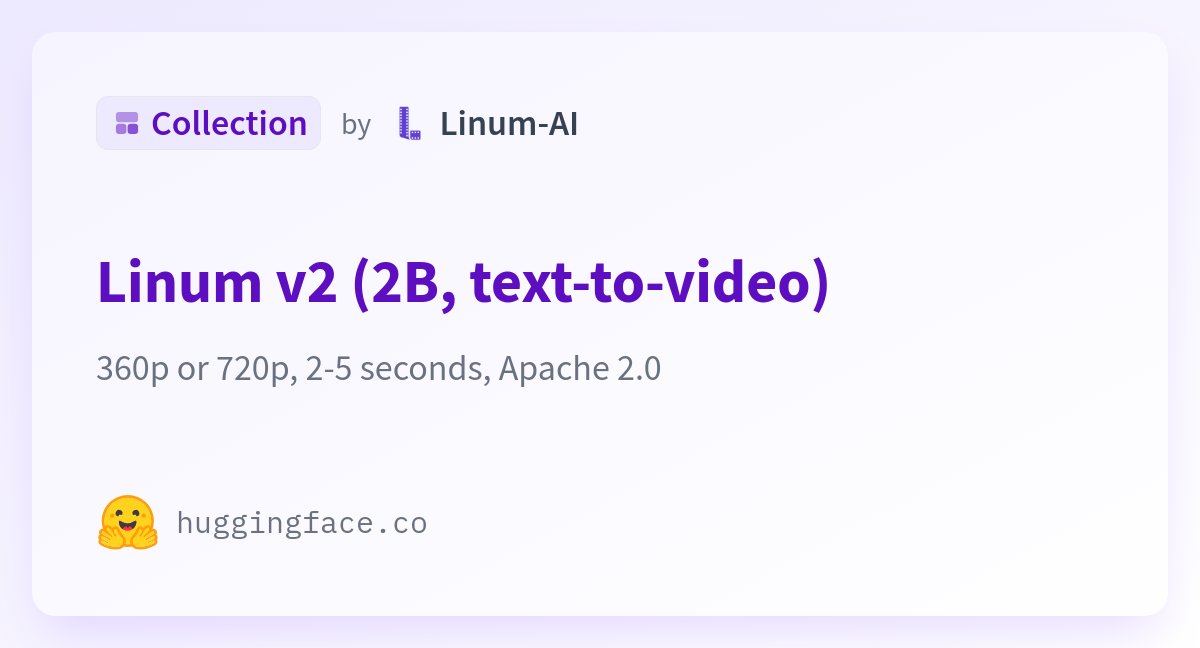
A new 2-billion parameter text-to-video model from Linum-AI has appeared on Hugging Face, offering Apache 2.0 licensed generation at 360p or 720p resolution for 2-5 second clips. The release signals continued momentum in open-source video generation, but questions remain about practical utility and resource requirements.
The open-source video generation landscape gained another contender this week with the release of Linum v2, a 2-billion parameter text-to-video model from Linum-AI. The model, available through a Hugging Face collection, generates 2-5 second clips at 360p or 720p resolution under the permissive Apache 2.0 license.
Technical Specifications and Licensing
Linum v2 represents a modest entry in the rapidly expanding field of video generation models. With 2 billion parameters, it sits well below the scale of commercial offerings like OpenAI's Sora or Runway's Gen-3, which likely contain hundreds of billions of parameters. The parameter count suggests Linum v2 prioritizes accessibility over cutting-edge quality, targeting users with consumer-grade hardware rather than requiring enterprise-level infrastructure.
The Apache 2.0 license is significant for commercial applications. Unlike more restrictive licenses, Apache 2.0 allows for modification, private use, and commercial distribution without requiring derivative works to be open-sourced. This makes Linum v2 immediately viable for startups and developers building commercial products around video generation, though the model's actual quality will determine its practical value.
The resolution options (360p and 720p) reflect current hardware realities. Generating higher-resolution video requires exponentially more computational resources and memory. By capping at 720p, Linum v2 remains feasible for users with mid-range GPUs, though the 2-5 second clip length limits its utility for narrative content or longer-form applications.
Community Adoption Signals
The model's presence on Hugging Face follows a pattern seen with other open-source AI releases: initial community interest, followed by practical testing. The collection shows 360p or 720p as output options, suggesting the model might offer different quality tiers. The "updated about 14 hours ago" timestamp indicates active development, though it's unclear whether this represents bug fixes, performance improvements, or new features.
The collection's structure reveals Linum-AI's approach to organizing their models. By grouping text-to-video models together, they're creating a discoverable portfolio that helps users compare different versions and capabilities. This organization mirrors how other AI labs present their work, making it easier for developers to find the right tool for their specific needs.
Technical Trade-offs and Limitations
The 2-5 second clip length represents a fundamental constraint in current video generation technology. Even with billions of parameters, maintaining temporal consistency beyond a few seconds remains challenging. The model must predict not just spatial relationships between pixels, but also how those pixels evolve over time. Each additional frame multiplies the complexity exponentially.
Resolution choices involve direct trade-offs. 360p (640x360) requires roughly 230,000 pixels per frame, while 720p (1280x720) requires about 922,000 pixels. For a 5-second clip at 30 frames per second, that's 6.9 million pixels for 360p versus 27.7 million pixels for 720p. The memory and compute requirements scale accordingly, making 720p generation significantly more demanding.
The Apache 2.0 license, while permissive, doesn't guarantee quality or reliability. Unlike proprietary models with dedicated support teams, open-source models depend on community maintenance. Users must evaluate whether the model meets their quality thresholds and be prepared to troubleshoot issues independently.
Counter-Perspectives and Practical Reality
Despite the excitement around open-source video generation, practical adoption faces significant hurdles. Training video models requires massive datasets of high-quality video content, often with associated text descriptions. The computational cost of training such models limits who can develop them, typically to well-funded organizations or research institutions.
For end users, the utility of 2-5 second clips is limited. While useful for social media content, product demonstrations, or creative experimentation, longer-form applications require stitching multiple clips together—a process that introduces its own challenges with temporal consistency and narrative coherence.
The 2-billion parameter size, while accessible, may not capture the nuance and detail of larger models. Text-to-video generation requires understanding complex prompts, maintaining object permanence, generating realistic physics, and producing coherent motion. Smaller models often struggle with these aspects, producing videos that may have visual artifacts, inconsistent lighting, or illogical movement patterns.
Broader Context in Video Generation
Linum v2 enters a crowded field. Open-source alternatives include models like Stable Video Diffusion from Stability AI, which offers similar capabilities with different technical approaches. Each model represents different architectural choices, training methodologies, and quality trade-offs.
The trend toward smaller, more accessible models reflects a broader shift in the AI community. While large language models and image generators continue to grow in size, there's increasing interest in efficient models that can run on consumer hardware. This democratization allows more developers to experiment and build applications without requiring cloud infrastructure or expensive GPUs.
However, the gap between open-source and commercial video generation remains substantial. Current open-source models produce shorter clips at lower resolutions with less temporal coherence than their commercial counterparts. This gap may narrow as research progresses, but for now, Linum v2 represents a stepping stone rather than a replacement for commercial offerings.
Looking Ahead
The release of Linum v2 suggests continued investment in open-source video generation. As the model matures, we may see improvements in clip length, resolution, and quality. Community contributions could enhance its capabilities, though the model's architecture and training data will ultimately determine its ceiling.
For developers considering Linum v2, the practical approach involves testing the model against specific use cases. The Apache 2.0 license removes legal barriers, but technical limitations may still restrict applications. The model's value will emerge through real-world testing and community feedback, not just its theoretical specifications.
The text-to-video field continues to evolve rapidly, with each new model adding to our understanding of what's possible with current technology. Linum v2 contributes another data point in this ongoing experiment, offering a permissively licensed option for those willing to work within its constraints.
Comments
Please log in or register to join the discussion