
The Linux kernel is finally removing support for Intel 486 processors, marking the end of an era for one of computing's most influential architectures.
The Linux kernel is preparing to drop support for Intel 486 processors with the upcoming Linux 7.1 release, ending compatibility with hardware that dates back to the late 1980s. This change, queued in the development branches ahead of the Linux 7.1 merge window, represents a significant milestone in the kernel's evolution and reflects the reality that maintaining support for such ancient hardware has become increasingly burdensome for developers.
The End of an Era
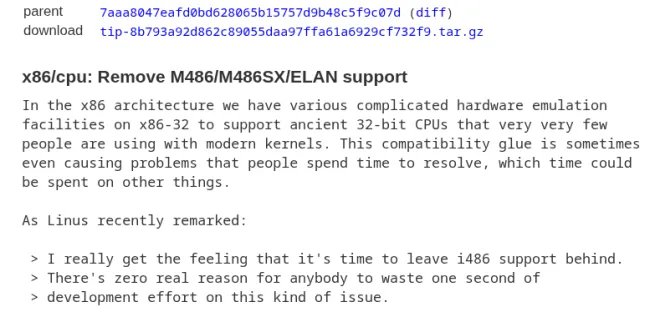
The i486, introduced by Intel in 1989, was a groundbreaking processor that brought 32-bit computing to the mainstream and introduced features like an on-chip floating-point unit and cache memory. For decades, Linux maintained compatibility with these processors, but as Ingo Molnar's patch notes, this support has become increasingly difficult to maintain.
Linus Torvalds himself has expressed that there's "zero real reason" to keep i486 support around, noting that it wastes upstream Linux kernel development efforts. The maintenance burden stems from the need for "various complicated hardware emulation facilities on x86-32" that are required to support these ancient 32-bit CPUs.
What's Being Removed
The initial patch being prepared for Linux 7.1 removes three Kconfig build options:
- CONFIG_M486SX: For 486-class CPUs without an FPU, including AMD/Cyrix/IBM/Intel SL/SLC/SLC2/SLC3/SX/SX2 and UMC U5S variants
- CONFIG_M486: For 486-class CPUs with FPU, including AMD/Cyrix/IBM/Intel 486DX/DX2/DX4 and UMC U5D
- CONFIG_MELAN: For the AMD Elan processor
This means users will no longer be able to build an i486 kernel image starting with Linux 7.1. The actual i486 CPU support code will be removed in a subsequent kernel series, further reducing the maintenance burden on kernel developers.
Who's Affected?
Realistically, very few users will be impacted by this change. No known Linux distribution vendors are still shipping with i486 CPU support, and anyone still using an i486 CPU with an upstream Linux kernel would be incredibly rare. Users who absolutely need to run Linux on these vintage systems can continue using existing Linux LTS kernel versions that still include the necessary support.
Historical Context
The i486 processor represents a significant chapter in computing history. It was the first tightly pipelined x86 design and introduced several innovations that became standard in later processors. The fact that Linux supported these processors for over 30 years is a testament to the kernel's commitment to backward compatibility and its roots in the hobbyist and enthusiast communities.
However, as computing has advanced dramatically since the i486 era, the practical value of maintaining support for such limited hardware has diminished. Modern kernel development focuses on supporting current and emerging hardware while maintaining compatibility with reasonably recent systems.
Technical Implications
The removal of i486 support has several technical implications:
- Simplified codebase: Removing the compatibility code reduces complexity in the x86-32 architecture support
- Reduced maintenance: Kernel developers no longer need to test and maintain compatibility with these ancient processors
- Cleaner Kconfig options: The build system becomes simpler without these rarely-used configuration options
- Performance improvements: While minimal, removing legacy code can slightly improve kernel performance and reduce binary size
Looking Forward
This change is part of a broader trend in the Linux kernel to focus development efforts on modern hardware while maintaining support for reasonably recent systems. As hardware continues to evolve rapidly, kernel developers must make difficult decisions about where to allocate their limited resources.
The i486 was a revolutionary processor in its time, but after more than three decades, it's time to let it go. Linux 7.1 will mark the beginning of the end for i486 support, with the final removal of the actual CPU support code coming in a later kernel release.
For most users, this change will go completely unnoticed. For those few who still maintain vintage hardware, it's a reminder that even the most enduring technologies eventually reach their end of life. The Linux kernel's decision to finally drop i486 support is a pragmatic acknowledgment that it's time to move forward and focus on the future of computing.
Comments
Please log in or register to join the discussion